

Iran Pushes Back Against Gulf and Western Moves to Reduce Its Strategic Influence
Over the Strait of Hormuz

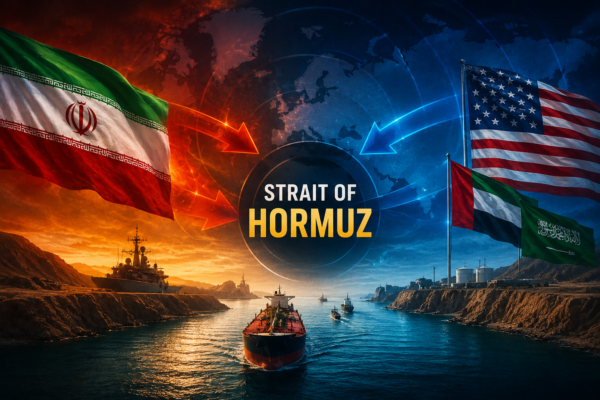
War-Report : Iran has intensified its opposition to what it describes as coordinated Western and Gulf initiatives aimed at diminishing Tehran’s strategic influence over the Strait of Hormuz, one of the world’s most vital maritime trade corridors. Iranian officials and state-affiliated media argue that recent regional proposals seek to weaken Iran’s longstanding role in overseeing navigation through the narrow waterway, which has frequently served as a key element of the country’s geopolitical leverage.
The latest dispute emerged after several Iranian media outlets reported on July 7 that the United Arab Emirates (UAE) had submitted a proposal to the International Maritime Organization (IMO) calling for a new framework to manage navigation in the Strait of Hormuz. According to the reports, Iran immediately rejected the proposal, describing it as lacking any legal foundation and exceeding the technical authority of the IMO Council. Iranian sources further claimed that the proposal received support from eight additional countries allied with the UAE, although the identities of those nations were not disclosed.
At the time of publication, neither the IMO nor independent regional or Western media outlets had confirmed the existence or contents of the reported Emirati proposal. Nevertheless, Iranian officials used the reports to reiterate that the Islamic Republic remains fully capable of ensuring the safe movement of commercial vessels through the strategically important passage.
Iranian state-affiliated media quoted an unnamed “informed source” asserting that all maritime transit through the Strait of Hormuz must continue under arrangements coordinated with Iran. The statement reflected Tehran’s broader position that any international effort to alter the governance or operational management of the waterway without Iranian participation would be unacceptable.
The renewed rhetoric comes amid increasing efforts by Gulf Arab states and the United States to reduce their dependence on routes that could be influenced by Iran during periods of regional tension. Security analysts have noted that several countries are exploring alternative shipping mechanisms and maritime transit procedures that would allow commercial vessels to enter and exit the Strait of Hormuz while remaining closer to Oman’s territorial waters, thereby reducing exposure to potential Iranian interference.

Such alternatives are viewed by Tehran as direct attempts to weaken one of its most significant strategic advantages. The Strait of Hormuz handles a substantial portion of the world’s seaborne oil exports, making any disruption to navigation capable of affecting global energy markets. For decades, Iran has relied on its geographic position along the strait as an important source of political and military leverage during disputes with regional rivals and Western governments.
Iran has also recently opposed a separate proposal reportedly advanced by Oman that would have allowed shipping companies to voluntarily pay navigation-related fees for using the Strait of Hormuz. Although the proposal was presented as a commercial initiative, Iranian authorities reportedly viewed it as another attempt to establish maritime arrangements outside Tehran’s direct influence.
Iranian lawmakers have echoed the government’s concerns. Alaeddin Boroujerdi, a member of the Iranian Parliament’s National Security and Foreign Policy Committee, warned that any foreign activities in the Strait of Hormuz conducted without prior coordination with Iran could increase regional tensions. He specifically referred to reported French plans to remove naval mines from the area, arguing that such operations should not proceed without Iranian consultation.

Boroujerdi emphasized that security and maritime operations within the Strait of Hormuz involve sensitive regional considerations and should respect the interests of neighboring coastal states. His remarks reflected Tehran’s longstanding position that external military involvement in the Persian Gulf often contributes to instability rather than enhancing maritime security.
The latest developments highlight the continuing geopolitical competition surrounding one of the world’s most strategically important waterways. The Strait of Hormuz remains the primary maritime gateway connecting the Persian Gulf with international markets through the Gulf of Oman and the Arabian Sea. Every day, millions of barrels of crude oil and liquefied natural gas pass through the narrow passage, making uninterrupted navigation essential for global energy supplies.
Western governments have consistently sought to safeguard freedom of navigation in the region through multinational naval patrols and maritime security initiatives. Gulf Arab states have similarly invested in infrastructure projects, pipeline networks, and alternative export routes designed to reduce reliance on the Strait of Hormuz during periods of heightened regional tensions.
Iran, however, continues to argue that its geographic location gives it both legitimate security responsibilities and strategic interests within the waterway. Iranian officials maintain that any international initiatives affecting navigation or maritime governance must include Tehran and respect existing legal frameworks.
The dispute also underscores broader regional rivalries between Iran and several Gulf Cooperation Council (GCC) states, particularly the UAE and Saudi Arabia. While diplomatic relations between Iran and some Gulf nations have improved in recent years, disagreements over maritime security, regional military presence, and freedom of navigation continue to generate friction.
With no independent confirmation of the reported IMO proposal, questions remain regarding the exact nature of the alleged Emirati initiative. Nevertheless, Iran’s swift rejection demonstrates its determination to preserve its influence over the Strait of Hormuz and resist any measures perceived as limiting its strategic role in one of the world’s most critical maritime chokepoints.
As regional powers continue exploring new shipping arrangements and international maritime cooperation, the Strait of Hormuz is expected to remain at the center of geopolitical competition, balancing global commercial interests with the complex security concerns of the Middle East.