

Pakistan–Afghanistan Border Tensions Deepen as Drone Strikes
Trigger Fresh Security Crisis
 Samir Singh 'Bharat'-Editor-in-Chief
Send an email
7 July 2026
Samir Singh 'Bharat'-Editor-in-Chief
Send an email
7 July 2026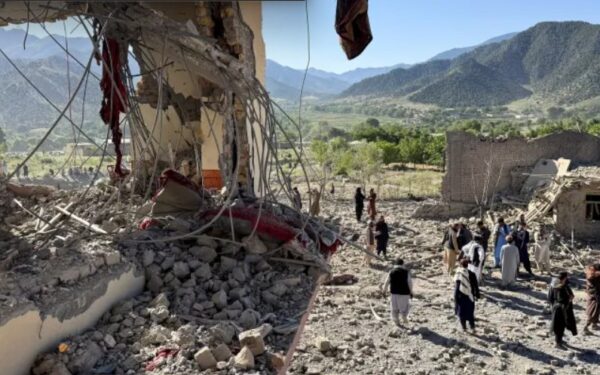
War-Report : Tensions between Pakistan and Afghanistan have entered another dangerous phase after Pakistan’s military announced that it intercepted and destroyed four drones allegedly launched from Afghan territory into Balochistan. The incident occurred only hours after Afghanistan’s Ministry of Defence claimed responsibility for air strikes targeting what it described as Islamic State (ISIL/ISIS) facilities inside Pakistan’s Balochistan province and parts of Khyber Pakhtunkhwa.
The latest exchange represents yet another escalation in the increasingly volatile relationship between the neighboring countries, where military operations, drone attacks, cross-border accusations, and retaliatory strikes have become a recurring feature of regional security. Although neither country’s claims have been independently verified, the developments highlight the fragile security environment along one of South Asia’s most sensitive frontiers.
Pakistan Claims Successful Interception of Four Drones
According to Pakistan’s military media wing, the Inter-Services Public Relations (ISPR), security forces detected four unmanned aerial vehicles immediately after they crossed the Pakistan-Afghanistan border.
The military stated that all four drones were neutralized using advanced electronic warfare systems and sophisticated counter-drone technology before they could reach their intended targets inside Balochistan.
In its official statement, the ISPR accused the Afghan Taliban administration of supporting terrorist organizations operating against Pakistan.

The military described the drone launches as evidence of what it called the Afghan Taliban’s continued “patronisation and support of terrorist outfits” targeting Pakistan’s internal security.
Officials emphasized that Pakistan’s border surveillance capabilities remain highly effective and warned that any future violations of its airspace would receive a decisive response.
Kabul Claims Air Strikes on ISIL Positions
Meanwhile, Afghanistan’s Ministry of Defence issued its own statement, asserting that Afghan Air Force aircraft had carried out precision strikes against locations in Pakistan’s Pishin district of Balochistan and parts of Khyber Pakhtunkhwa.

According to Kabul, the targeted facilities were allegedly being used by ISIL fighters to coordinate attacks and destabilize Afghanistan.
The Afghan government maintained that the operation specifically targeted militant infrastructure and insisted that no civilians were harmed during the strikes.
Afghan officials argued that the action was necessary to protect Afghan national security and to eliminate cross-border threats posed by extremist organizations.
However, Pakistan has not acknowledged the existence of ISIL facilities inside the targeted regions, creating yet another point of dispute between the two governments.
Independent Verification Remains Difficult
As with many previous incidents involving the Pakistan-Afghanistan border, independent verification has proven extremely difficult.
The mountainous terrain, limited media access, and heavy military presence prevent journalists and international observers from confirming battlefield claims made by either side.
International monitoring organizations have not yet issued independent assessments regarding the reported drone interceptions or the Afghan air strikes.
Consequently, much of the available information continues to rely on official statements released by Islamabad and Kabul.
Background: Rising Violence Along the Border
The latest confrontation follows weeks of mounting violence.
On June 27, heavily armed militants attacked a Pakistani paramilitary compound in Karachi, resulting in the deaths of three security personnel.
The attack was later claimed by Jamaat-ul-Ahrar, a splinter faction associated with the Tehreek-e-Taliban Pakistan (TTP).
Pakistani authorities stated that one of the suspects captured alive during the operation was an Afghan national, reinforcing Islamabad’s long-standing allegation that militant groups continue to operate from Afghan territory.
In response, Pakistan conducted air strikes on June 29 targeting areas in Afghanistan’s Paktia, Paktika, and Kunar provinces.
Pakistani officials claimed that approximately 25 militants were killed during those operations.
The Afghan Taliban government, however, disputed those claims and alleged that 36 civilians lost their lives in the Pakistani strikes.
The conflicting casualty figures once again illustrated the deep mistrust between the neighboring governments.
Cycle of Retaliation Intensifies
The recent drone incident is viewed by many regional observers as another step in an ongoing cycle of retaliation that has steadily intensified since late 2025.
Military analysts note that nearly every cross-border militant attack has been followed by retaliatory air strikes, artillery shelling, or drone operations.
Instead of reducing violence, these military responses have frequently triggered additional countermeasures, creating a continuous escalation cycle.
The increasing reliance on drones also marks a significant evolution in the conflict, allowing both sides to project force without committing large numbers of ground troops.
Pakistan Faces Rising Terror Threat
Pakistan continues to face a significant internal security challenge.
According to figures released by the Pakistan Institute for Peace Studies (PIPS), the country recorded approximately 699 terrorist attacks during 2025.
The report indicated that militant violence increased by nearly 34 percent compared to the previous year.
More than 1,000 people reportedly lost their lives in attacks carried out by various militant organizations.
Security experts say that Balochistan and Khyber Pakhtunkhwa remain among the worst affected regions, where multiple armed groups continue to operate.
These include separatist organizations, the Tehreek-e-Taliban Pakistan (TTP), and factions linked to ISIL.
Drone Warfare Becoming Increasingly Common
Security researchers have also observed a growing use of drone technology by militant organizations.
Data compiled by international conflict monitoring organizations indicate that numerous drone incursions have been reported along the Pakistan-Afghanistan border during recent months.
Experts believe drones provide militant groups with relatively inexpensive tools capable of surveillance, psychological warfare, and targeted attacks.
The expanding availability of commercial drone technology has further complicated border security operations.
Pakistan has responded by investing heavily in electronic warfare systems, radar networks, and anti-drone capabilities designed to detect and neutralize aerial threats before they penetrate deeper into its territory.
Pakistan’s Strategy of Controlled Escalation
According to security officials familiar with Pakistan’s policy, Islamabad currently appears to be pursuing what some analysts describe as a strategy of “controlled escalation.”
Under this approach, Pakistan seeks to respond forcefully against militant organizations while carefully managing direct confrontation with the Afghan Taliban government.
Officials believe such a strategy allows Pakistan to maintain military pressure without triggering a full-scale interstate conflict.
However, maintaining this delicate balance has become increasingly difficult as attacks continue on both sides of the border.
Operation “Ghazab-lil-Haq”
Earlier this year, Pakistan announced the launch of Operation “Ghazab-lil-Haq,” translated as “Wrath for Justice.”
The operation followed attacks on Pakistani border posts allegedly carried out by Taliban fighters after earlier Pakistani strikes on militant camps inside Afghanistan.
Since then, Pakistan has intensified aerial operations against suspected militant infrastructure while increasing troop deployments along key border sectors.
Military commanders argue that stronger action is necessary to prevent cross-border terrorism.
Humanitarian Concerns Continue
Human rights organizations have repeatedly expressed concern over civilian casualties resulting from cross-border military operations.
Following Pakistani strikes near Kabul earlier this year, independent estimates suggested that more than one hundred people may have been killed.
Taliban authorities condemned those operations, describing them as violations of international law.
Pakistan rejected those allegations, insisting that its military targets only terrorist infrastructure.
The absence of independent investigations has made it difficult to establish the true humanitarian impact of these operations.
Diplomatic Efforts Have Produced Limited Results
Several international mediation efforts have attempted to reduce tensions between Pakistan and Afghanistan.
Qatar and Turkey previously facilitated negotiations that resulted in a temporary ceasefire.
Although violence briefly declined, subsequent talks reportedly collapsed without producing a lasting political settlement.
Later, China hosted discussions in Urumqi aimed at rebuilding confidence between the two governments.
Those negotiations reportedly produced temporary reductions in Pakistani air strikes after Taliban representatives offered assurances regarding militant groups operating from Afghan territory.
However, the relative calm lasted only a few months before fresh violence resumed.
Experts See a Dangerous Pattern
Regional security specialists argue that the current situation reflects a broader structural problem rather than isolated incidents.
Many analysts believe that military retaliation alone has failed to reduce militant violence.
Instead, repeated strikes have often strengthened hostility while encouraging further reprisals.
Some observers argue that the border conflict has gradually evolved into a normalized pattern of military exchanges, making each new confrontation increasingly predictable.
Others warn that the continued use of drones introduces additional risks because aerial incidents can rapidly escalate before diplomatic channels have an opportunity to intervene.
Differing Views on Responsibility
Security analysts remain divided over who bears primary responsibility for the deteriorating situation.
Some experts argue that Pakistan’s domestic security weaknesses have allowed militant networks to expand despite extensive counterterrorism operations.
Others maintain that the Afghan Taliban has failed to prevent militant organizations from using Afghan territory as a base for attacks inside Pakistan.
Afghan officials, meanwhile, accuse Pakistan of providing sanctuary to individuals opposed to Taliban rule.
These competing narratives have complicated diplomatic engagement and deepened mutual distrust.
Need for Long-Term Solutions
Many regional experts emphasize that lasting peace will require more than military operations.
Analysts argue that Pakistan must complement security measures with broader political, economic, and governance reforms in regions affected by long-running insurgencies.
Similarly, Afghanistan faces increasing international pressure to prevent armed groups from using its territory for cross-border operations.
Improved intelligence cooperation, border management, and sustained diplomatic dialogue are widely viewed as essential components of any durable solution.
Regional Stability at Stake
The deteriorating relationship between Pakistan and Afghanistan has implications extending beyond their shared border.
Instability threatens regional trade routes, investment, humanitarian assistance, and broader efforts to combat extremist organizations across South and Central Asia.
Neighboring countries continue to monitor developments closely, concerned that continued escalation could undermine wider regional security initiatives.
International observers have repeatedly encouraged both governments to prioritize dialogue over military confrontation while strengthening mechanisms for border coordination and intelligence sharing.
Outlook
The interception of four drones and Afghanistan’s reported air strikes demonstrate how rapidly security conditions along the Pakistan-Afghanistan border continue to evolve. With militant attacks persisting, mutual accusations intensifying, and diplomatic efforts producing only temporary relief, both countries face mounting pressure to prevent the conflict from escalating further.
While military responses may provide short-term tactical advantages, security experts increasingly argue that sustainable peace will depend upon rebuilding trust, addressing the underlying causes of militancy, improving cross-border cooperation, and reviving meaningful diplomatic engagement.
Until such measures are successfully implemented, the Pakistan-Afghanistan frontier is likely to remain one of the region’s most volatile flashpoints, with each new incident carrying the potential to trigger another round of retaliation and further destabilize an already fragile security landscape.
SOURCE : [Stringer/Reuters]