

North Korea Doubles Down on Nuclear Expansion as Kim Jong…
Kim Unveils New Military Vision Amid Rising Tensions With the US and South Korea
 Samir Singh 'Bharat'-Editor-in-Chief
Send an email
2 July 2026
Samir Singh 'Bharat'-Editor-in-Chief
Send an email
2 July 2026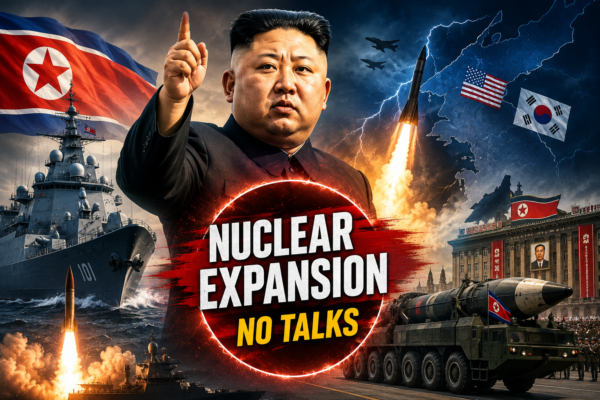
WAR-REPORT : North Korean leader Kim Jong Un has once again reaffirmed his country’s commitment to expanding its nuclear weapons program, signaling that Pyongyang has no intention of returning to denuclearization negotiations with the United States or South Korea. During the Second Enlarged Plenary Meeting of the Ninth Central Committee of the Workers’ Party of Korea (WPK), Kim declared that strengthening North Korea’s nuclear arsenal remains the country’s “only correct path” in response to what he described as increasing military provocations from Washington and Seoul.
The latest announcements reflect a significant shift in North Korea’s long-term defense strategy. Rather than focusing solely on land-based nuclear deterrence, Pyongyang is now investing heavily in advanced naval capabilities, strategic missile cruisers, military infrastructure, and border fortifications. Analysts believe these developments represent one of the most ambitious military modernization programs undertaken by North Korea in decades.
Nuclear Weapons Remain the Core of North Korea’s Security Strategy
Kim Jong Un used the high-level party meeting to justify further expansion of North Korea’s nuclear capabilities by accusing both the United States and South Korea of destabilizing the Korean Peninsula.
According to North Korean state media, Kim criticized:
- The growing military cooperation between Washington and Seoul.
- The US-South Korea Nuclear Consultative Group (NCG).
- South Korea’s plans to develop a nuclear-powered attack submarine (SSN).
- Joint military exercises conducted by allied forces.
Kim argued that these initiatives leave North Korea with no alternative but to accelerate the modernization of its own nuclear deterrent.

He stated that nuclear force expansion is not simply a military objective but a necessity for national survival.
Massive Expansion of Strategic Naval Power
One of the biggest announcements during the meeting was North Korea’s intention to construct a 10,000-ton strategic guided missile cruiser, representing an entirely new class of warship.
Military experts believe this vessel could eventually carry:

- Long-range cruise missiles
- Ballistic missiles
- Advanced air-defense systems
- Nuclear-capable weapon systems
Such a platform would dramatically increase North Korea’s ability to project military power beyond its coastline.
If successfully completed, it would become the largest and most sophisticated warship ever built by North Korea.
North Korea Wants an Ocean-Going Navy
For decades, North Korea’s navy has primarily focused on coastal defense.
Kim Jong Un now appears determined to transform it into a regional naval force capable of operating hundreds or even thousands of kilometers from North Korean waters.
During the commissioning ceremony of the country’s first Choe Hyon-class guided missile destroyer, Kim declared that the Korean People’s Army Navy should no longer remain confined to defending coastal waters.
Instead, he envisioned a fleet capable of demonstrating North Korea’s military strength across the open ocean.
Defense analysts describe this strategy as the transition toward a green-water navy—a naval force capable of sustained operations beyond coastal regions while remaining short of a full blue-water navy.
Choe Hyon-Class Destroyer Marks Historic Milestone
The commissioning of the Choe Hyon-class guided missile destroyer is regarded as one of North Korea’s most significant naval achievements.
The destroyer reportedly features:
- Modern missile-launch systems
- Improved radar capabilities
- Enhanced anti-ship weapons
- Long-range operational capability
Although many details remain classified, analysts believe the ship provides North Korea with a foundation for future naval expansion.
Its commissioning demonstrates that Pyongyang is gradually moving away from reliance on small patrol boats and submarines alone.
Expansion of Naval Bases Underway
Kim also ordered the rapid modernization of naval infrastructure.
Plans reportedly include:
- Expansion of naval shipyards
- New docking facilities
- Improved maintenance centers
- Larger ammunition depots
- Expanded logistics hubs
These upgrades would be essential if North Korea intends to maintain larger warships capable of extended deployments.
Modernization of Weapons Factories
Beyond naval expansion, Kim instructed officials to accelerate upgrades at military-industrial facilities.
The objectives include:
- Faster missile production
- Increased ammunition manufacturing
- Improved quality control
- Higher production capacity
- Development of next-generation weapon systems
Military production remains central to North Korea’s long-term strategic planning.
Southern Border Fortifications Continue
Kim also emphasized completing new defensive fortifications along North Korea’s southern border.
These projects reportedly involve:
- Reinforced defensive positions
- Underground military facilities
- Improved surveillance infrastructure
- Expanded artillery positions
- Enhanced troop deployment capabilities
North Korea argues these measures are defensive, while South Korea views them as preparations for possible military escalation.
Denuclearization Talks Appear Increasingly Unlikely
Perhaps the most significant political message from Kim’s speech was his continued rejection of denuclearization negotiations.
North Korea insists that:
- Nuclear weapons are non-negotiable.
- US military pressure justifies further expansion.
- South Korea must abandon military cooperation with Washington.
- Dialogue cannot proceed unless the United States changes its policy.
These positions make meaningful diplomatic negotiations increasingly difficult.
Russia’s Support Strengthens Kim’s Position
Observers believe recent political developments involving Russia have emboldened Pyongyang.
Russian President Vladimir Putin has openly strengthened strategic ties with North Korea through:
- Military cooperation
- Political support
- Economic engagement
- Diplomatic coordination
This growing partnership reduces North Korea’s international isolation and gives Kim greater confidence to reject Western pressure.
China’s Position Becomes More Nuanced
China continues to support regional stability but has recently adopted a more balanced approach toward North Korea.
Rather than aggressively pressuring Pyongyang over nuclear weapons, Beijing appears increasingly focused on preventing instability near its borders.
Analysts suggest China is carefully balancing:
- Relations with North Korea
- Strategic competition with the United States
- Regional security interests
- Its partnership with Russia
This evolving position gives North Korea additional diplomatic space.
South Korea Balances Deterrence and Dialogue
South Korean President Lee Jae Myung’s administration appears to be pursuing a dual-track strategy.
The government seeks to:
- Maintain strong military deterrence.
- Continue cooperation with the United States.
- Keep diplomatic channels open.
- Avoid unnecessary escalation.
However, North Korea’s latest statements indicate little willingness to engage.
Nuclear Consultative Group Faces Growing Criticism
Kim specifically targeted the US-South Korea Nuclear Consultative Group (NCG).
The NCG was established to improve coordination regarding nuclear deterrence and crisis management.
North Korea claims the initiative increases regional tensions rather than reducing them.
South Korea, however, views the mechanism as essential for strengthening deterrence against North Korean threats.
Submarine Development Becomes Flashpoint
Kim also criticized South Korea’s effort to develop a nuclear-powered attack submarine.
Such submarines would offer:
- Longer underwater endurance
- Greater operational range
- Improved stealth
- Enhanced missile deployment capability
North Korea portrays the project as evidence of South Korea’s military ambitions.
Challenges Facing North Korea’s Naval Ambitions
Despite ambitious announcements, military experts caution that North Korea faces major obstacles.
These include:
- Limited industrial capacity.
- Economic sanctions.
- Restricted access to advanced technologies.
- Financial constraints.
- Difficulty producing sophisticated naval engines and electronics.
Without outside assistance, constructing and maintaining advanced warships may prove extremely challenging.
Dependence on Foreign Assistance
Analysts believe North Korea may require continued support from either Russia or China in areas such as:
- Shipbuilding technology
- Advanced propulsion systems
- Radar equipment
- Missile guidance technology
- Logistics support
External cooperation could significantly accelerate Pyongyang’s modernization efforts.
Regional Security Concerns Intensify
North Korea’s expanding military capabilities are likely to increase security concerns across East Asia.
Countries closely monitoring developments include:
- South Korea
- Japan
- United States
- China
- Russia
Any further missile testing or naval deployments could heighten military tensions in the region.
Implications for Future Diplomacy
Kim Jong Un’s latest statements suggest North Korea now views its nuclear arsenal as permanent rather than temporary leverage for negotiations.
Unless there is a significant change in policy from one or more parties, prospects for renewed denuclearization talks remain extremely limited.
Diplomatic engagement may instead focus on crisis management, confidence-building measures, and preventing unintended military escalation rather than achieving complete denuclearization.
Strategic Outlook
North Korea’s current trajectory indicates a long-term commitment to military modernization centered on nuclear deterrence and expanded naval capabilities. By combining missile development, naval expansion, industrial modernization, and strengthened border defenses, Kim Jong Un aims to transform North Korea into a more formidable military power capable of projecting influence beyond the Korean Peninsula.
While these ambitions face substantial economic and technological hurdles, continued support from strategic partners and persistent regional tensions could enable Pyongyang to gradually realize many of its objectives. For the United States, South Korea, and their allies, this evolving security environment will require a careful balance between deterrence, diplomacy, and regional stability as the Korean Peninsula enters another period of heightened geopolitical uncertainty.