


Delhi Police Busts ‘Digital Arrest’ Cyber Fraud Network,
Editorial
 war-times.com
Send an email
3 July 2026
war-times.com
Send an email
3 July 2026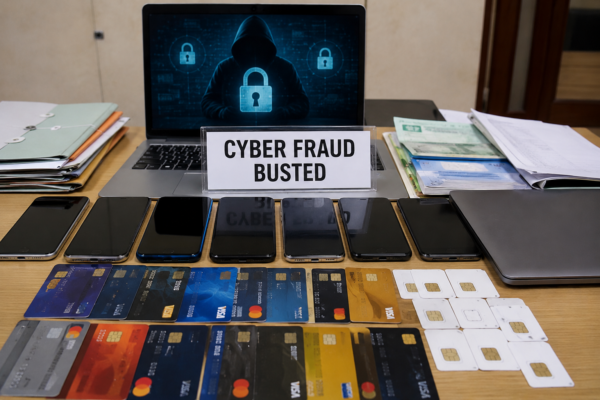
New Delhi: In a major breakthrough against the rapidly growing menace of cybercrime, the South Cyber Police Unit of the Delhi Police has dismantled an organized cyber fraud syndicate allegedly involved in executing sophisticated “digital arrest” scams. The operation led to the arrest of three suspects from West Bengal and uncovered a network that allegedly supplied fake bank accounts, SIM cards, and financial credentials to cybercriminals operating across India and possibly beyond.
The investigation began after a woman reported losing Rs 7.22 lakh to fraudsters who allegedly posed as senior law enforcement officials. Police believe the case is part of a larger cybercrime ecosystem that exploits fear, technology, and fake identities to deceive victims into transferring substantial sums of money.
Woman Allegedly Trapped Through Fake ‘Digital Arrest’
According to investigators, the victim received calls from individuals who falsely claimed to represent prestigious law enforcement agencies, including the Mumbai Anti-Terrorism Squad (ATS), senior IPS officers, and the Central Bureau of Investigation (CBI).
The fraudsters allegedly convinced the woman that she was under investigation in a serious criminal case. To make their claims appear legitimate, they reportedly kept her connected on an extended WhatsApp video call, creating the illusion of an official interrogation.
During the call, the victim was allegedly threatened with arrest, legal proceedings, and severe criminal consequences unless she cooperated immediately.

Police said the scammers used intimidation, psychological pressure, and fabricated legal procedures to isolate the victim and prevent her from seeking help from family members or local authorities.
Eventually, under immense pressure, she transferred Rs 7.22 lakh through Real-Time Gross Settlement (RTGS) transactions, believing she was complying with official instructions.
What Is a ‘Digital Arrest’ Scam?
The so-called “digital arrest” scam has emerged as one of India’s fastest-growing cyber fraud techniques.

Unlike a genuine legal investigation, cybercriminals falsely claim that the victim has been linked to crimes such as money laundering, narcotics trafficking, identity theft, or financial fraud.
Victims are often told that confidential investigations prevent them from contacting anyone else. Fraudsters may display fake identity cards, forged government documents, or manipulated video backgrounds resembling police stations or government offices.
Many victims are instructed to remain continuously connected through video calls for several hours while being psychologically manipulated into believing they are under constant official surveillance.
Cybersecurity experts emphasize that no legitimate Indian law enforcement agency conducts arrests, investigations, or financial settlements through WhatsApp or video conferencing platforms.
Delhi Police Launches Detailed Financial Investigation
Following the victim’s complaint, the South Cyber Police Station registered a formal case and initiated an extensive investigation.
Cyber investigators began tracing:
- Banking transactions
- Digital payment trails
- Mobile communication records
- SIM card registrations
- Internet Protocol (IP) addresses
- Beneficiary accounts
Financial analysis revealed that the victim’s money had first been transferred into a bank account located in West Bengal before being dispersed through multiple intermediary accounts.
Police believe this layering technique was intentionally designed to complicate financial tracing and delay recovery efforts.
Investigation Exposes Mule Banking Network
As investigators dug deeper, they reportedly uncovered a sophisticated network allegedly supplying “mule” bank accounts.
A mule account refers to a legitimate bank account that is knowingly or unknowingly used by criminals to receive, transfer, or launder illicit funds.
According to police, the arrested individuals allegedly played a critical logistical role by providing:
- Bank accounts
- ATM cards
- Debit cards
- Credit cards
- SIM cards
- Banking credentials
These resources allegedly enabled cybercriminals to rapidly move stolen money through multiple financial channels before victims or banks could freeze the transactions.
Investigators believe such networks form the backbone of organized cyber fraud operations.
Multi-State Raids Lead to Three Arrests
Using technical surveillance, banking intelligence, and digital forensic evidence, Delhi Police teams conducted coordinated raids in South 24 Parganas and Howrah districts of West Bengal.
The operation resulted in the arrest of three accused:
- Samiran Roy
- Prince Shaw
- Samar Chatterjee
Police are questioning the suspects regarding their alleged roles within the larger cyber fraud syndicate.
Authorities are also examining whether additional accomplices assisted in opening fraudulent bank accounts or facilitating illegal financial transfers.
Electronic Devices and Financial Documents Seized
During the raids, investigators reportedly recovered a significant quantity of electronic devices and financial materials believed to be connected to cyber fraud operations.
Items seized include:
- Six mobile phones
- One laptop
- Eighteen debit and credit cards
- Fifteen SIM cards
- Multiple banking documents
- Financial records under examination
Digital forensic experts are now analyzing the seized devices to identify additional victims, communication channels, cryptocurrency activity, and possible overseas links.
International Connections Under Investigation
One of the most significant aspects of the investigation is the possibility that the network may have international connections.
According to Delhi Police, preliminary findings suggest the arrested suspects may have been associated with cybercriminal groups operating across borders.
Investigators are examining whether the financial infrastructure supplied by the accused was used in scams targeting victims both within India and internationally.
If confirmed, the case could involve transnational cybercrime networks that use Indian bank accounts as temporary channels for laundering fraudulent proceeds.
Rise of Psychological Cybercrime
Cyber experts note that modern online fraud increasingly relies on psychological manipulation rather than technical hacking.
Instead of breaking into computer systems, criminals exploit fear, urgency, and authority.
Victims are often convinced they are:
- Under investigation.
- Linked to criminal organizations.
- Facing arrest warrants.
- Involved in financial crimes.
- Required to maintain secrecy.
This emotional pressure frequently causes otherwise cautious individuals to ignore warning signs.
Authorities have repeatedly stressed that genuine police officers, intelligence agencies, or investigative bodies never demand money to avoid arrest.
Why Cybercriminals Prefer Mule Accounts
Financial investigators explain that mule accounts serve several criminal purposes.
They help criminals:
- Hide the true destination of stolen money.
- Delay detection by banks.
- Break transaction trails.
- Withdraw cash rapidly.
- Transfer funds across multiple states.
Many mule accounts are opened using forged documents or by recruiting financially vulnerable individuals in exchange for commissions.
Police continue to warn citizens never to allow others to use their personal bank accounts for financial transactions.
Public Advisory Issued by Delhi Police
Following the arrests, Delhi Police urged citizens to remain vigilant against digital arrest scams.
Authorities advised people to remember the following precautions:
- No police agency conducts arrests through WhatsApp or video calls.
- Never transfer money based on threats received over phone or messaging apps.
- Verify the identity of anyone claiming to represent government agencies.
- Disconnect suspicious calls immediately.
- Contact local police if threatened.
- Report cyber fraud without delay through the national cybercrime helpline 1930 or the official cybercrime reporting portal.
Prompt reporting significantly improves the chances of freezing fraudulent transactions before funds disappear through multiple banking channels.
Investigation Continues
Police officials stated that the investigation remains active, with efforts underway to identify additional members of the syndicate, trace the remaining financial trail, recover stolen funds, and determine the full extent of the group’s operations.
Authorities are also coordinating with banks, cyber forensic laboratories, and other law enforcement agencies to uncover possible interstate and international connections.
The case highlights the rapidly evolving nature of cybercrime in India, where organized fraud networks increasingly rely on fake identities, digital communication platforms, and sophisticated financial laundering techniques. Law enforcement agencies continue to strengthen technological capabilities to counter these threats, but officials emphasize that public awareness remains one of the strongest defenses against cyber fraud.

war-times.com
Send an email
3 July 2026