

Syria’s Foreign Fighter Dilemma 2026
Thousands of Armed Militants Remain After Assad’s Fall
 Samir Singh 'Bharat'-Editor-in-Chief
Send an email
13 May 2026
Samir Singh 'Bharat'-Editor-in-Chief
Send an email
13 May 2026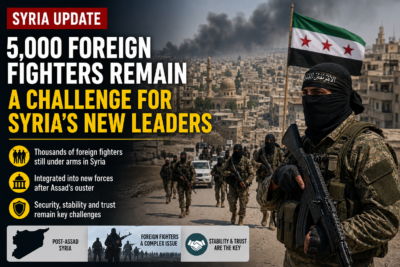
WAR-REPORT : The dramatic collapse of former Syrian President Bashar al-Assad in late 2024 marked one of the most significant turning points in the modern history of the Middle East. After more than a decade of devastating civil war, shifting alliances, foreign intervention, and humanitarian catastrophe, the Assad government finally lost control of Damascus as opposition forces swept into the capital.
At the center of the military campaign that toppled Assad was Hay’at Tahrir al-Sham, commonly known as HTS, the powerful Islamist-led rebel coalition that emerged as the dominant force in northwestern Syria during the latter years of the conflict. Following its rapid advance into Damascus, HTS leader Ahmad al-Sharaa assumed leadership of the country’s interim administration, promising stability, reconstruction, and a new political order after years of war.
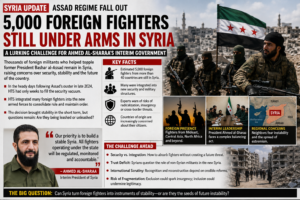
But nearly two years after Assad’s ouster, Syria remains far from secure. One of the most difficult and potentially dangerous challenges facing the interim government is the continued presence of approximately 5,000 foreign fighters who participated in the rebellion and remain armed inside the country.
These fighters, many of whom arrived in Syria over the course of the civil war from countries across the Middle East, Central Asia, North Africa, Europe, and the Caucasus region, played a significant role in anti-Assad operations. Some joined extremist factions early in the war, while others later aligned themselves with HTS as the conflict evolved.
Now, their future has become one of the most sensitive issues confronting Syria’s fragile post-war transition.

A Security Vacuum After Assad’s Collapse
When Assad’s government collapsed in late 2024, Syria descended into a brief but dangerous period of uncertainty. Government ministries stopped functioning, security agencies disappeared from large areas, military command structures fractured, and local institutions struggled to maintain order.
For HTS, which had transformed itself from an insurgent organization into Syria’s de facto ruling force almost overnight, the immediate challenge was not only political legitimacy but basic security control.
The group had only a matter of weeks to prevent total chaos from spreading across major cities and former regime territories. Prisons needed guarding, military depots required protection, infrastructure had to be secured, and rival militias had to be prevented from seizing territory.

In that environment, HTS leadership made a controversial but pragmatic decision: instead of disarming foreign militants immediately, it chose to integrate many of them into newly formed armed and security institutions under the interim government.
The strategy was intended to stabilize the country quickly while rewarding fighters who had contributed to Assad’s downfall. Some foreign militants were assigned military roles, others were incorporated into border security units, while several commanders reportedly received respected positions within the evolving defense structure.
At the time, many HTS officials argued there was little alternative.
Syria’s domestic institutions had collapsed, large numbers of Syrian fighters were exhausted after years of war, and the interim government lacked enough trained personnel to impose nationwide control. Foreign fighters, despite their controversial backgrounds, were experienced, heavily armed, and loyal to HTS leadership.
For the new rulers in Damascus, keeping them inside the system appeared safer than pushing them outside it.
Between Integration and Threat
Yet from the very beginning, the decision triggered deep anxiety among Syrians, regional governments, and international observers.
Critics questioned whether HTS was genuinely trying to absorb and regulate the foreign fighters — or whether it was effectively legitimizing thousands of radical militants by giving them official status within the post-Assad state.
For many Syrians, especially minorities and civilians traumatized by years of extremist violence during the civil war, the continued presence of foreign Islamist fighters created fears that the country could simply exchange one authoritarian system for another militarized order dominated by armed factions.
Communities in parts of Damascus, Aleppo, Homs, and coastal Syria expressed concern about accountability, law enforcement, and the ideological influence of non-Syrian militants who had little connection to Syria’s social fabric.
Human rights organizations also warned that integrating foreign fighters without proper vetting mechanisms could undermine long-term stability and transitional justice efforts.
Some of these militants had reportedly been linked in the past to extremist organizations, battlefield abuses, or hardline ideological movements during the war years. Although HTS itself spent years attempting to distance itself from global jihadist networks and present a more nationalist image, doubts persisted internationally regarding the backgrounds and loyalties of many fighters operating under its umbrella.
The uncertainty created a central question that continues to shape Syria’s political future: Were these fighters being controlled and neutralized through integration — or empowered and normalized through state recognition?
Who Are the Foreign Fighters?
The estimated 5,000 foreign fighters still present in Syria are not a unified group.
They come from different countries, speak different languages, and possess varying ideological motivations. Some entered Syria years ago motivated by religious ideology. Others arrived as mercenaries, anti-Assad volunteers, or members of transnational militant networks.
Over the course of the civil war, many foreign fighters became deeply embedded within Syria’s military landscape. They married locally, established economic connections, and built long-term relationships with Syrian armed groups.
Several factions composed largely of Central Asian, Chechen, Uyghur, Arab, and North African fighters gained reputations as highly disciplined and effective combat units during the war against Assad’s forces.
HTS leadership relied heavily on some of these groups during crucial offensives in northwestern Syria and later during the campaign that ultimately captured Damascus.
As a result, removing them from Syria’s power structure is now politically and militarily complicated.
Some commanders reportedly believe the foreign fighters deserve protection and recognition because of their sacrifices during the conflict. Others fear that forcing them out too aggressively could provoke internal rebellion, fragmentation, or the emergence of independent extremist cells.
International Pressure Mounts
The presence of armed foreign militants has also complicated Syria’s attempts to rebuild diplomatic relationships with regional and international powers.
Several neighboring countries remain deeply concerned that Syria could once again become a safe haven for transnational militant movements.
Western governments, while cautiously engaging with Syria’s interim administration in limited humanitarian and security discussions, continue to monitor HTS and associated groups closely. Intelligence agencies fear that poorly managed foreign fighter networks could eventually fuel instability beyond Syria’s borders.
Regional governments are especially worried about battle-hardened militants potentially moving across borders if Syria’s security situation deteriorates again.
Countries in Central Asia and the Caucasus are also concerned about citizens who joined the Syrian war years ago and may eventually attempt to return home with extremist experience and international militant connections.
This has placed additional pressure on Ahmad al-Sharaa’s administration to demonstrate that the foreign fighters are under effective state control.
Diplomatic observers note that Syria’s ability to gain broader international recognition, attract reconstruction funding, and normalize relations with foreign governments may depend partly on how it handles the foreign fighter issue.
HTS’s Transformation Under Scrutiny
For years, HTS has attempted to reposition itself politically.
Originally linked to jihadist movements during the early stages of the Syrian conflict, the group later distanced itself from international extremist organizations and attempted to portray itself as a Syrian nationalist force focused primarily on governance and stability.
The fall of Assad provided HTS with an opportunity to further that transformation by becoming the country’s dominant political authority.
However, the continued integration of foreign militants into security structures risks undermining that effort.
Critics argue that genuine state-building requires professional national institutions rather than networks of ideologically motivated armed groups.
Some analysts believe HTS leadership faces an internal balancing act. On one side, it must reassure foreign fighters and maintain cohesion within the armed movement that brought it to power. On the other, it must convince Syrians and the international community that the new Syria will not remain governed through militant structures.
This balancing act has become increasingly difficult as Syria enters the complex phase of reconstruction and political transition.
Public Concerns Inside Syria
Among ordinary Syrians, reactions remain mixed.
Some citizens credit HTS and its allied fighters with ending Assad’s rule after years of destruction and repression. In parts of northern Syria where HTS established administrative systems before the fall of Damascus, some residents view the group as more organized than rival militias that operated elsewhere during the war.
Others, however, fear the militarization of public life and the long-term role of non-Syrian armed actors inside the country.
Minority communities in particular remain cautious. Christians, Alawites, Druze, and secular Syrians worry about ideological extremism and whether Syria’s future political system will protect diversity and civil rights.
There are also economic concerns.
With Syria’s infrastructure devastated, millions displaced, and unemployment widespread, many Syrians believe national reconstruction should prioritize civilian governance, investment, and institution-building rather than sustaining large armed formations.
The presence of thousands of foreign fighters complicates those ambitions.
Risks of Fragmentation
Security experts warn that mishandling the issue could create several dangerous scenarios.
If foreign fighters are abruptly marginalized, disarmed, or expelled without negotiated arrangements, some could splinter into underground extremist groups capable of launching insurgent attacks.
Others may join criminal networks or align themselves with rival regional actors seeking influence inside Syria.
At the same time, allowing them to remain permanently integrated into state institutions could undermine Syria’s legitimacy internationally and weaken the development of a professional national military.
Some analysts compare Syria’s current situation to post-conflict environments in other war-torn countries where governments struggled to transition armed factions into stable state institutions.
The challenge is not simply military — it is political, ideological, and social.
The Future of Syria’s Transition
For interim President Ahmad al-Sharaa, the foreign fighter question may ultimately become one of the defining tests of his leadership.
His government must simultaneously maintain security, avoid internal fragmentation, reassure civilians, and gain international legitimacy — all while managing armed groups that helped bring it to power.
So far, the administration has attempted a gradual approach rather than immediate confrontation.
Officials insist that foreign fighters operating under state authority are being monitored, regulated, and incorporated into centralized command structures. They argue that controlled integration is safer than uncontrolled exclusion.
Yet skepticism remains widespread.
Many Syrians and foreign governments are still unsure whether the interim government truly controls these fighters — or whether it remains dependent on them.
That uncertainty continues to cast a shadow over Syria’s fragile post-Assad future.
After more than a decade of war, Syrians hoped the fall of Bashar al-Assad would mark the beginning of stability and reconstruction. Instead, the country now faces another difficult chapter: determining whether armed foreign militants can be transformed into instruments of order — or whether they may become the seeds of future instability.
The answer could shape not only Syria’s recovery, but the broader security landscape of the Middle East for years to come.