

Thalapathy Vijay Takes Bold Action, Shuts 717 TASMAC Shops in Tamil Nadu
By Doruvu Paul Jagan Babu: Assistant Chief Editor

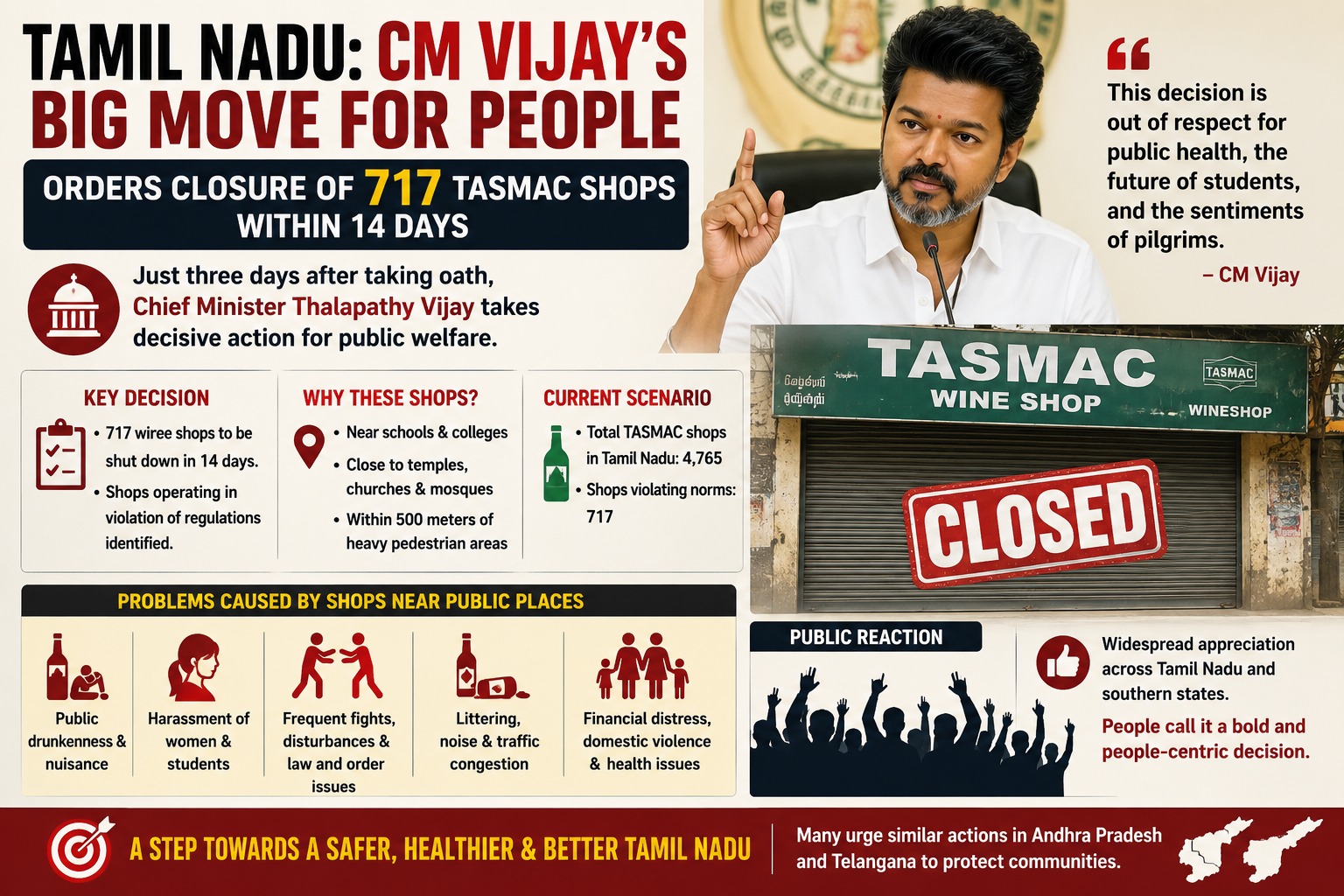
Tamil Nadu: In a major administrative decision just three days after assuming office as Chief Minister of Tamil Nadu, actor-turned-politician Thalapathy Vijay has reportedly ordered the closure of 717 TASMAC wine shops operating in violation of regulations across the state. The move, announced on Tuesday, has generated widespread discussion and appreciation on social media, with many hailing Vijay as a “People’s Chief Minister” for prioritizing public health, student welfare, and public sentiment.
The state government has directed officials to shut down all identified shops within two weeks, particularly those located near educational institutions, places of worship, and densely populated public areas.
717 wine shops identified for closure
According to official sources, Tamil Nadu currently has 4,765 liquor outlets functioning under the Tamil Nadu State Marketing Corporation (TASMAC). After scrutiny, authorities reportedly identified 717 shops operating in violation of norms and public convenience guidelines.
Chief Minister Vijay instructed officials to ensure that all such outlets are completely closed within 14 days.
The crackdown primarily targets liquor shops near schools and colleges, outlets close to temples, churches, and mosques, and shops operating within a 500-meter radius of crowded pedestrian zones and public gathering areas.

Officials stated that the decision was taken keeping in mind public health concerns, safety of students and women, sentiments of pilgrims and worshippers, and overall public welfare.
Public reaction: “A decision for the common people”
The move quickly gained traction on social media platforms across southern India. Many users praised the Chief Minister for taking decisive action so early in his tenure, calling the move courageous and people-centric.

Several social media users described Vijay as a “People’s CM,” while others urged governments in Andhra Pradesh and Telangana to adopt similar measures to reduce the impact of liquor outlets in residential and sensitive public areas.
Public discussions online highlighted growing frustration among families and local communities living near wine shops.
Problems faced by residents near wine shops
Residents in many urban and semi-urban areas have long complained about the problems caused by liquor outlets situated close to homes, schools, and public spaces.
Common complaints often include public drunkenness, harassment of women and students, noise pollution, roadside altercations, littering of liquor bottles, traffic congestion, and increased feelings of insecurity in neighborhoods.
Parents frequently express concern over liquor shops operating near schools and colleges, arguing that such environments negatively influence students and create unsafe surroundings for children and young women.
Similarly, devotees and religious groups have repeatedly objected to liquor outlets functioning near temples, churches, and mosques, stating that they disturb the sanctity and peace of worship areas.
Public health and social concerns
Health experts have consistently warned about the broader social and economic consequences associated with alcohol addiction.
These include domestic violence, financial distress in families, health complications, road accidents, and loss of productivity.
Social activists argue that easy accessibility to liquor in residential and educational zones often worsens these problems.
Many observers believe that stricter regulation of liquor outlets can contribute toward creating safer and healthier public environments.
Governance through symbolic and administrative action
Political analysts note that the decision carries both administrative and symbolic significance.
Coming within days of assuming office, the move is being interpreted as an attempt by the new Chief Minister to project an image of responsive governance focused on public concerns.
Observers say such actions often resonate strongly with ordinary citizens because they directly affect daily life and neighborhood environments.
However, experts also point out that long-term impact will depend on strict implementation, prevention of illegal liquor operations, rehabilitation measures, and broader public awareness initiatives.
Debate on balancing revenue and public welfare
The issue of liquor regulation has always remained politically and economically sensitive because TASMAC contributes significant revenue to the Tamil Nadu government.
At the same time, increasing public pressure for tighter regulation reflects growing concern over alcohol-related social problems.
The latest decision has once again revived a broader national debate:
Should governments prioritize revenue generation from liquor sales, or focus more aggressively on long-term social welfare and public health?
For now, Vijay’s move has sparked strong public conversation—not only in Tamil Nadu, but also across neighboring southern states where similar concerns over liquor shop locations continue to persist.