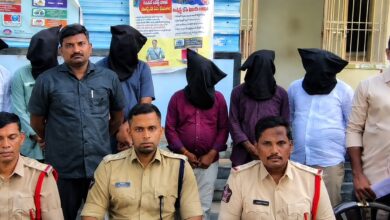


Anantapur ACB Trap: Municipal Health Officer, Clerk Caught Accepting ₹25,000 Bribe for Exhibition Approval
By Doruvu Paul Jagan Babu: Assistant Chief Editor

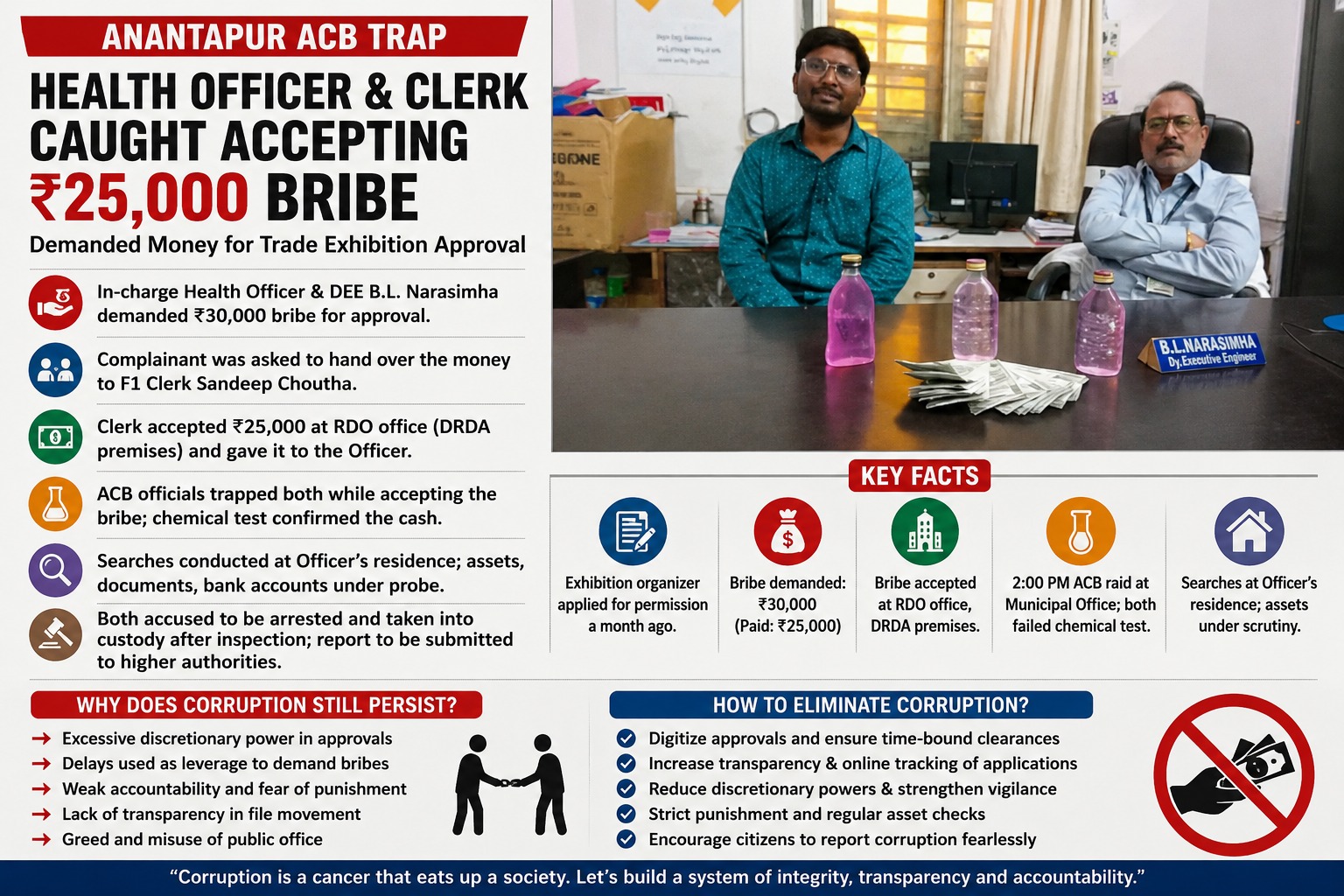
Anantapur – Andhra Pradesh: In a significant anti-corruption operation in Anantapur, officials of the Anti-Corruption Bureau (ACB) on Monday caught a senior Municipal Corporation official and a clerk allegedly accepting a bribe of ₹25,000 from an exhibition organizer in exchange for issuing an approval letter. The accused include In-charge Health Officer and Deputy Executive Engineer (DEE) BL Narasimha and F1 Clerk Sandeep Choutha of the Public Health Department.
The case has once again drawn attention to the persistence of bribery in government offices, despite repeated anti-corruption campaigns and increasing public scrutiny. The incident has sparked fresh debate on why corruption continues to thrive even among officials occupying responsible and higher-ranking positions.
ACB conducts surprise raid at Municipal Corporation office
According to ACB DSP Prasad Reddy, the complainant, Raghu Prasada Rao—organizer of the Bala Bharathi Trade Exhibition—had applied nearly a month ago for permission to conduct the exhibition in Anantapur.
Despite repeated visits to the Municipal Corporation office, the approval letter was allegedly withheld. The complainant stated that In-charge Health Officer BL Narasimha demanded ₹30,000 as a bribe to clear the file.
Unable to secure permission despite multiple attempts, Rao approached the Anti-Corruption Bureau and lodged a complaint. Acting on the complaint, ACB officials laid a trap on Monday.

Bribe allegedly routed through clerk
Officials said that when the exhibition organizer approached Narasimha to hand over the money, the Health Officer allegedly instructed him to give the amount to F1 Clerk Sandeep Choutha.
The clerk reportedly accepted ₹25,000 from the complainant at the RDO office situated within the DRDA premises.

Investigators stated that after receiving the cash, Sandeep Choutha proceeded directly to the office of In-charge Health Officer BL Narasimha and allegedly handed over the bribe amount.
At around 2:00 PM, ACB officials entered the office and conducted chemical tests on both individuals.
According to officials, the tests confirmed contact with the tainted currency as their hands reportedly changed colour during examination.
Both officials were subsequently taken into custody for further investigation.
Searches conducted at officer’s residence
Simultaneously, under the supervision of ACB CI Jayamma, searches were carried out at the apartment residence of BL Narasimha.
Officials stated that scrutiny of documents, bank transactions, movable and immovable assets, and income sources is underway.
Investigators are also examining whether the accused possessed assets disproportionate to known sources of income.
The ACB indicated that a detailed report will be submitted to higher authorities after completion of the investigation and searches.
Corruption persists despite awareness and enforcement
The incident has once again highlighted the continuing challenge of corruption within public offices, particularly in departments dealing directly with public permissions, licenses, and approvals.
Observers note that even officials occupying senior administrative positions continue to face allegations of bribery due to:
discretionary powers in file clearances,
delays in administrative approvals,
weak accountability mechanisms,
and a perception among some officials that bribe-taking has become normalized.
Citizens frequently complain that ordinary approvals are delayed intentionally to pressure applicants into making illegal payments.
Anti-corruption activists argue that such practices not only burden citizens financially but also erode public trust in governance and democratic institutions.
Need for structural reforms and transparency
Experts believe that merely arresting officials after complaints may not be enough to eliminate corruption permanently.
Several governance reforms are often suggested to curb bribery, including:
complete digitization of approval systems,
fixed timelines for file clearances,
online tracking of applications,
reduction of discretionary authority,
mandatory transparency in approval processes,
and stronger internal vigilance mechanisms.
Analysts also stress the importance of protecting whistleblowers and encouraging citizens to report corrupt practices without fear.
Regular departmental audits, lifestyle scrutiny of officials, and stricter punishments in proven corruption cases are seen as critical deterrents.
Public confidence depends on accountability
The ACB operation in Anantapur has been welcomed by many residents who believe such actions send a strong message against misuse of public office.
However, public observers note that long-term improvement will depend not only on raids and arrests, but also on building a governance culture rooted in accountability, integrity, and citizen service.
For many citizens, the incident serves as another reminder that corruption remains one of the biggest obstacles to transparent administration and efficient public service delivery in India.