


Sir David Attenborough at 100: The Fearless Broadcaster
Editorial
 war-times.com
Send an email
9 May 2026
war-times.com
Send an email
9 May 2026
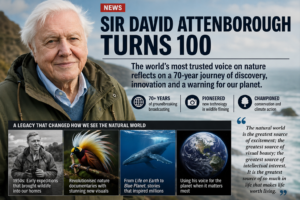
Special Report : For generations across the globe, the unmistakable voice of Sir David Attenborough has become synonymous with the wonders of the natural world. Calm, measured, and deeply compassionate, he has guided audiences through dense rainforests, icy polar landscapes, endless oceans, and remote deserts with an unmatched ability to transform science into storytelling. Now, as he reaches the remarkable age of 100, the legendary broadcaster stands not only as a beloved television icon but also as one of the most influential environmental communicators in modern history.
Yet behind the gentle narration and grandfatherly presence lies a far more adventurous and daring figure than many viewers realize. Over a career spanning more than seven decades, Attenborough repeatedly pushed the boundaries of broadcasting. He embraced emerging technology long before others recognized its potential, ventured into isolated and often dangerous territories, and helped revolutionize the way television documentaries were made. His journey reflects not merely the evolution of nature programming but the transformation of television itself.
Born in 1926 in London, Attenborough grew up with an early fascination for fossils, animals, and geology. As a child, he collected stones, insects, and natural specimens, displaying a curiosity that would later define his life’s work. After studying natural sciences at Cambridge University, he initially worked in publishing and later joined the British Broadcasting Corporation, better known as the BBC, in the early 1950s.
At that time, television was still a developing medium. Programs were mostly studio-based, technical equipment was bulky, and international filming was extremely limited. Nature broadcasting was almost nonexistent. But Attenborough quickly recognized television’s potential to bring distant worlds directly into people’s homes. Rather than relying solely on studio presentations, he believed audiences should witness real animals in their natural habitats.
His breakthrough came with the groundbreaking series “Zoo Quest,” which began in 1954. The program followed Attenborough and a small team as they traveled across the globe searching for rare animal species for zoos and scientific institutions. While modern viewers may see such expeditions differently today, the series was revolutionary for its era. It introduced millions of people to wildlife they had never seen before.

More importantly, “Zoo Quest” revealed Attenborough’s willingness to take enormous risks. The production crews worked in difficult conditions with limited medical support, unreliable transport, and primitive communication systems. They filmed in tropical forests, swamps, mountains, and isolated regions where roads barely existed. Equipment failures were common, dangerous animals were ever-present, and illness posed constant threats.
In one expedition, Attenborough narrowly escaped serious injury while filming aggressive wildlife. On another journey, his crew battled extreme weather and tropical disease. Yet these hardships only strengthened his determination to continue exploring. Unlike many presenters of the time, he insisted on being directly involved in the fieldwork rather than narrating from a comfortable studio.
Throughout the 1960s and 1970s, Attenborough rose within the BBC’s leadership structure and eventually became controller of BBC Two. It was during this period that he demonstrated another side of his bold personality: his willingness to embrace technological innovation.

Television broadcasting was rapidly changing, and many executives remained cautious about expensive new technologies. Attenborough, however, understood that innovation could transform storytelling. He became a strong advocate for color television at a time when black-and-white broadcasting still dominated many households. His support helped BBC Two become Europe’s first regular color television service.
This decision fundamentally altered nature documentaries. Suddenly, viewers could experience the vivid colors of tropical birds, coral reefs, flowering jungles, and African sunsets with unprecedented realism. Attenborough recognized that color would deepen emotional connections between audiences and wildlife. His gamble paid off enormously, helping nature programming evolve into one of television’s most visually captivating genres.
But Attenborough did not stop there. Over subsequent decades, he continued supporting advances in filming technology, including lightweight portable cameras, underwater cinematography, aerial photography, satellite imaging, and later, ultra-high-definition digital recording. These innovations allowed filmmakers to capture extraordinary animal behavior previously impossible to document.
Under Attenborough’s guidance, documentaries increasingly focused not only on scientific information but also on emotional storytelling. Viewers could observe wolves hunting in snowy forests, whales communicating beneath Arctic ice, or birds performing elaborate mating rituals in stunning detail. The emotional impact of these images helped create a stronger global awareness of biodiversity and conservation.
One of the defining achievements of his career came in 1979 with the release of “Life on Earth,” a monumental documentary series that traced the evolution of life across the planet. The production took years to complete and involved filming in dozens of countries. It became one of the most ambitious natural history projects ever attempted.
The series demonstrated Attenborough’s extraordinary talent for making complex science accessible to ordinary viewers. Rather than overwhelming audiences with technical language, he combined scientific accuracy with curiosity, humor, and wonder. Millions of viewers who had never studied biology suddenly became fascinated by evolution, ecosystems, and animal behavior.
“Life on Earth” was followed by a succession of landmark series including “The Living Planet,” “The Trials of Life,” “Planet Earth,” “Blue Planet,” and many others. Each production pushed technical and creative boundaries further.
The acclaimed “Planet Earth” series, produced by the BBC Natural History Unit, showcased filmmaking techniques that redefined wildlife television. High-speed cameras captured snow leopards leaping across cliffs, while aerial shots revealed massive migrations spanning entire continents. The series reached audiences in hundreds of countries and became a global phenomenon.
Attenborough’s narration remained central to its success. His voice conveyed excitement without exaggeration, seriousness without alarmism, and emotion without sentimentality. In an era increasingly dominated by sensational media, his calm and trustworthy delivery earned extraordinary public respect.
However, the most significant transformation in Attenborough’s later career may have been his growing focus on environmental conservation and climate change. During his early broadcasting years, nature documentaries often emphasized discovery and exploration. But over time, Attenborough witnessed dramatic environmental decline firsthand.
He observed shrinking rainforests, melting polar ice, collapsing coral reefs, and disappearing species. Places once rich with biodiversity became damaged by deforestation, pollution, overfishing, and industrial expansion. Rather than remaining silent, Attenborough increasingly used his global platform to warn humanity about the consequences of environmental destruction.
His documentaries evolved from celebrations of nature into urgent calls for action. Productions such as “Climate Change: The Facts,” “A Life on Our Planet,” and later installments of “Blue Planet” highlighted the devastating effects of plastic pollution, rising global temperatures, and habitat destruction.
Importantly, Attenborough’s environmental advocacy resonated because it emerged from decades of firsthand observation. He was not speaking as a politician or activist alone but as a witness who had spent much of his life documenting Earth’s ecosystems.
His warnings carried emotional weight precisely because audiences trusted him. Across political and cultural divides, viewers saw Attenborough as a credible and sincere figure rather than a partisan voice. Scientists praised his ability to communicate environmental issues clearly without oversimplifying them.
Even in his later years, Attenborough continued undertaking physically demanding projects. Though advancing age naturally reduced some of his travel, he remained deeply involved in documentary production, recording narration, and environmental campaigns. His enduring work ethic astonished colleagues decades younger than him.
Many younger filmmakers and broadcasters consider Attenborough a mentor figure whose influence extends far beyond nature television. His storytelling style shaped modern documentary filmmaking, inspiring countless presenters, cinematographers, and environmental journalists.
Beyond broadcasting, Attenborough’s impact can also be measured in public awareness. Entire generations developed an appreciation for wildlife because of his documentaries. Children inspired by his programs pursued careers in biology, conservation, ecology, and environmental science. Others simply learned to value the natural world more deeply.
His influence reached governments and international institutions as well. Environmental campaigns connected to his documentaries helped increase public discussion about marine conservation, endangered species, renewable energy, and sustainable living. In some cases, policy discussions intensified following the release of major Attenborough productions.
Despite global fame, Attenborough maintained a relatively modest and thoughtful public persona. Unlike many celebrities, he rarely sought controversy or personal attention. Instead, he consistently redirected focus toward science, conservation, and the importance of protecting ecosystems.
Colleagues frequently describe him as meticulous, curious, and endlessly enthusiastic about learning. Even after decades in broadcasting, he reportedly continued asking scientists detailed questions during productions, eager to understand the latest discoveries.
His remarkable longevity in television is also partly due to his adaptability. Many broadcasters struggle to remain relevant across changing generations and technologies. Attenborough, however, continually evolved alongside the media landscape.
From black-and-white television to streaming platforms and digital media, he embraced change rather than resisting it. His documentaries found new audiences online, where younger viewers shared clips highlighting rare animal encounters and environmental messages.
Streaming services and international broadcasters further expanded his global reach. Viewers from Asia, Africa, Europe, and the Americas all connected with the same voice narrating the planet’s extraordinary diversity. Few broadcasters in history achieved such universal recognition.
Attenborough’s work also demonstrated the power of patience in storytelling. Unlike fast-paced entertainment designed for short attention spans, his documentaries encouraged audiences to slow down and observe the rhythms of nature. Scenes of animals hunting, migrating, nesting, or raising young unfolded gradually, allowing viewers to appreciate the complexity of ecosystems.
At the same time, he never romanticized nature entirely. His programs showed the harsh realities of survival, competition, and extinction. Yet even these difficult moments were presented with respect and scientific honesty.
As he turns 100, tributes continue pouring in from scientists, world leaders, conservationists, filmmakers, and ordinary viewers. Many describe him as one of the most trusted public figures of the modern era. Others credit him with fundamentally changing humanity’s relationship with the natural world.
In a media environment often marked by division, sensationalism, and misinformation, Attenborough’s voice became a symbol of credibility and thoughtful reflection. His documentaries reminded audiences that Earth’s ecosystems are interconnected and fragile, deserving not exploitation but stewardship.
Perhaps his greatest achievement lies not simply in documenting wildlife but in helping people feel emotionally connected to it. Through his storytelling, distant forests, oceans, and polar landscapes became part of viewers’ emotional imagination. Animals once perceived as strange or remote became recognizable and valued.
Attenborough himself has often emphasized hope alongside warning. While acknowledging the seriousness of climate change and biodiversity loss, he repeatedly argued that humanity still possesses the ability to protect and restore nature if decisive action is taken.
This balance between realism and optimism helped his message resonate globally. Rather than encouraging despair, he urged responsibility and collective effort.
Looking back across his extraordinary 70-year career, it becomes clear that Sir David Attenborough was never merely a narrator standing behind a microphone. He was an explorer, innovator, risk-taker, educator, and environmental witness.
He ventured into dangerous places when few broadcasters dared to travel there. He championed new technologies before they became mainstream. He transformed nature documentaries into cinematic experiences capable of inspiring millions. And he used his influence to advocate for the protection of the planet itself.
At 100 years old, Sir David Attenborough remains more than a broadcaster. He stands as a living bridge between generations — a man who spent his life showing humanity both the beauty of Earth and the urgent responsibility to preserve it for the future.
war-times.com
Send an email
9 May 2026