


Leaked Intelligence Report Suggests Heightened Security Concerns for Vladimir Putin 2026
Special Investigation Report

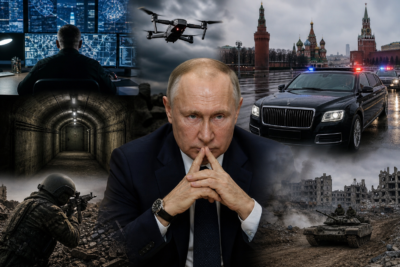
Special-Report: A leaked European intelligence report has raised serious questions about the personal security concerns of Vladimir Putin and the broader stability of Russia’s leadership structure. According to the report, Russian authorities have significantly intensified security arrangements amid fears of potential assassination attempts, including threats posed by advanced drone strikes.
Western and Russian opposition sources cited the intelligence findings on May 4, stating that Russian security agencies have adopted stricter protective measures for top officials. These steps reportedly include increased surveillance, movement restrictions, and the deployment of enhanced anti-drone systems across sensitive locations.
One of the most notable claims in the report is that Putin has drastically changed his daily routine and living arrangements. It suggests that he now spends most of his time in underground bunkers located in Krasnodar Krai. The report further claims that he has stopped visiting his well-known residences in Moscow Oblast and Valdai, which were previously used frequently for official and personal purposes.
The intelligence document also connects recent internet disruptions in Moscow to heightened security protocols. Sources familiar with the situation indicate that these shutdowns were partly implemented to strengthen anti-drone defenses and prevent unauthorized surveillance or coordination of potential attacks.
In response to these perceived threats, Putin reportedly amended regulations governing the Federal Protective Service (FSO). These changes extend security coverage to at least ten high-ranking generals, reflecting increased concern about the safety of senior military leadership.

Putin Security Fears Rise Amid Leaked Intelligence Report
The report links these developments to a high-level security meeting held in December 2025. During this meeting, officials reportedly debated responsibility for the assassination of Fanil Sarvarov, who was killed in Moscow on December 22, 2025. The incident appears to have intensified internal tensions and prompted a reassessment of existing security systems.
However, not all aspects of the leaked report have been independently verified. The Institute for the Study of War (ISW) stated that it has not found evidence supporting claims that Putin fears an internal coup attempt. The report also mentions Sergei Shoigu as being associated with potential coup risks, but provides no solid proof. CNN, which accessed the document, also acknowledged the absence of concrete evidence for these specific claims.
Alongside internal security concerns, Russia’s military operations in Ukraine continue to face challenges. Russian forces reportedly began infiltrating the outskirts of Kostyantynivka in late October 2025. Despite several months of engagement, progress in the Kostyantynivka–Druzhkivka area has been minimal.

Recent estimates indicate that Russian forces have gained control of only about 10.14 percent of Kostyantynivka, with just 0.7 percent advancement in its eastern outskirts. These figures suggest a slow pace of operations, especially when compared to earlier official statements that claimed significant progress.
Russian military commentators and bloggers have increasingly criticized what they describe as exaggerated claims by senior officials. This internal criticism highlights a growing gap between official narratives and the reality on the battlefield.
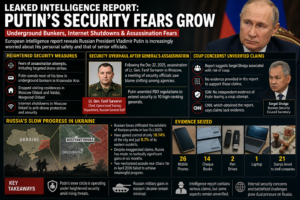
Further evidence of operational difficulty came in April 2026, when Russian forces launched two mechanized assaults near Chasiv Yar. These attacks failed to achieve meaningful tactical gains, reinforcing the perception that Russian forces are struggling to advance in key areas.
The combination of heightened leadership security concerns and limited military progress presents a complex and challenging situation for Russia. On one hand, the leadership appears increasingly focused on personal safety and internal stability. On the other, the ongoing military campaign continues to face logistical and strategic obstacles.
Experts suggest that the growing emphasis on anti-drone measures reflects the evolving nature of modern warfare, where unmanned systems pose significant threats even to high-level targets. This has forced governments to rethink traditional security strategies and invest in new defense technologies.
At the same time, the reported reliance on underground bunkers and restricted movement indicates the seriousness of the perceived threat environment. Whether these actions are based on specific intelligence warnings or broader precautionary measures remains unclear, but they signal a shift in leadership behavior.
The lack of independent confirmation for some of the report’s more dramatic claims highlights the difficulty of evaluating leaked intelligence. Such reports often include a mix of verified facts and unconfirmed assessments, making it challenging to draw definitive conclusions.
Nevertheless, the broader trends outlined—tightened security, leadership caution, and slow battlefield progress—are consistent with other observations about Russia’s current situation.
As the conflict in Ukraine continues and geopolitical tensions remain high, both internal security dynamics and military developments will be closely monitored by the international community. The coming months are likely to reveal whether these challenges are temporary or indicative of deeper structural issues.
Our Investigation Expert Opinion, the leaked intelligence report provides insight into a period of increased caution and uncertainty within Russia’s leadership. While some claims remain unverified, the overall picture suggests a government balancing significant internal concerns with ongoing external military commitments in an increasingly complex global environment.