

Tensions between Afghanistan and Pakistan have erupted into a dangerous new phase 2026
By Samir Singh 'Bharat': Editor In Chief
 war-times.com
Send an email
21 March 2026
war-times.com
Send an email
21 March 2026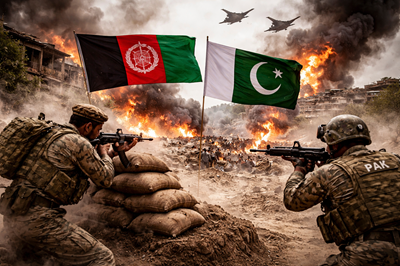
WAR-REPORT : The long-simmering tensions between Afghanistan and Pakistan have erupted into a dangerous new phase, raising serious concerns about regional stability in South Asia. Overshadowed in global headlines by conflicts in the Middle East, the escalating hostilities along the Afghanistan–Pakistan frontier are now threatening to spiral into a broader and more destructive confrontation.
The latest flashpoint came on March 16, when authorities in Afghanistan, led by the Taliban, accused Pakistan of conducting a devastating airstrike near the capital, Kabul. According to Afghan officials, the strike targeted a drug rehabilitation center, resulting in what they described as a catastrophic loss of civilian life.
Allegations of a Deadly Airstrike
Afghan authorities labeled the alleged bombing as a “crime against humanity,” claiming that more than 400 civilians were killed and at least 265 others injured. If verified, the incident would represent the deadliest single episode in the growing conflict between the two neighboring countries.
The reported target—a rehabilitation facility—has intensified outrage within Afghanistan and drawn international attention. Officials in Kabul insist that the site had no military value and was purely humanitarian in nature, housing individuals recovering from drug addiction in a country grappling with one of the world’s highest rates of opioid dependency.
Pakistan, however, has not fully confirmed the details of the strike and has historically denied targeting civilian infrastructure in its cross-border operations. Islamabad has repeatedly stated that its actions are aimed at militant groups that it accuses of using Afghan territory as a safe haven.

A Conflict Years in the Making
The roots of the Afghanistan–Pakistan conflict run deep, shaped by decades of mistrust, geopolitical maneuvering, and unresolved border disputes. The two countries share a porous and contested frontier known as the Durand Line, which has long been a source of tension.
Since the Taliban’s return to power in Afghanistan in 2021, relations between Kabul and Islamabad have become increasingly strained. Pakistan had initially hoped that a Taliban-led government would help curb cross-border militancy. Instead, Islamabad claims that attacks by groups such as the Tehrik-i-Taliban Pakistan (TTP) have increased, with militants allegedly operating from Afghan soil.
Afghanistan, on the other hand, has accused Pakistan of violating its sovereignty through repeated cross-border strikes and military incursions.

Escalation Along the Border
In recent months, the situation along the Afghanistan–Pakistan border has deteriorated significantly. Skirmishes, artillery exchanges, and air operations have become more frequent, leading to civilian casualties and displacement in border regions.
Villages on both sides of the frontier have reported damage to homes, infrastructure, and livelihoods. The humanitarian impact of these clashes is growing, with thousands of families forced to flee their homes amid fears of further violence.
The March 16 incident marks a sharp escalation, signaling a shift from localized skirmishes to more high-impact operations that risk drawing the region into a larger conflict.
Strategic Calculations and Miscalculations
For Pakistan, the primary concern remains internal security. The country has faced a resurgence of militant attacks in recent years, many of which it attributes to groups based in Afghanistan. Islamabad views cross-border strikes as a necessary measure to neutralize these threats.
However, such actions carry significant risks. Airstrikes that result in civilian casualties can inflame anti-Pakistan sentiment within Afghanistan and undermine any prospects for cooperation between the two governments.
For Afghanistan, the situation is equally complex. The Taliban leadership must balance its desire to assert sovereignty with the need to avoid a full-scale conflict with a militarily stronger neighbor.
At the same time, the Taliban faces internal and external pressure to prevent Afghan territory from being used by militant groups targeting other countries—a challenge that has proven difficult to manage.
Regional and Global Implications
The escalating conflict between Afghanistan and Pakistan has significant implications for regional stability. Both countries occupy a strategic position in South Asia, bordering key players such as India, China, and Iran.
A prolonged or intensified conflict could disrupt trade routes, destabilize border regions, and create opportunities for extremist groups to expand their influence.
Moreover, the situation poses a challenge for international diplomacy. With global attention largely focused on other crises, there is a risk that the Afghanistan–Pakistan conflict could escalate without sufficient international intervention.
Humanitarian Concerns
The reported airstrike near Kabul has highlighted the severe humanitarian consequences of the conflict. Civilian casualties, displacement, and damage to essential infrastructure are becoming increasingly common.
Afghanistan’s already fragile healthcare system is struggling to cope with the influx of injured individuals. Aid organizations warn that continued violence could exacerbate the country’s humanitarian crisis, which is already one of the worst in the world.
In Pakistan, border communities are also facing the impact of the conflict, with residents living in constant fear of retaliatory attacks.
Calls for Restraint and Dialogue
In the wake of the latest escalation, there have been growing calls from regional and international actors for both sides to exercise restraint.
Diplomats and analysts emphasize that continued hostilities will serve neither Pakistan’s nor Afghanistan’s long-term interests. Instead, they argue that dialogue and confidence-building measures are essential to de-escalate tensions.
Friendly countries and regional organizations could play a crucial role in mediating between the two sides, helping to address underlying issues such as border management, counterterrorism cooperation, and economic engagement.
The Risk of a Wider Conflict
One of the most pressing concerns is the potential for the conflict to widen. Miscalculations, miscommunication, or further high-casualty incidents could trigger a cycle of retaliation that becomes increasingly difficult to contain.
Both Afghanistan and Pakistan have significant military capabilities, and while neither side appears to be seeking full-scale war, the current trajectory raises the risk of unintended escalation.
A Path Forward
De-escalating the conflict will require political will and diplomatic engagement from both sides. Key steps could include:
-
Establishing communication channels to prevent misunderstandings
-
Agreeing on mechanisms to address cross-border militancy
-
Engaging in confidence-building measures to rebuild trust
-
Seeking mediation from neutral parties
Ultimately, the resolution of the conflict will depend on the ability of both countries to prioritize long-term stability over short-term tactical gains.
Our Media Opinion
The recent exchange of fire between Afghanistan and Pakistan marks a dangerous turning point in their already fraught relationship. The alleged airstrike near Kabul has underscored the human cost of the conflict and the urgent need for de-escalation.
As tensions continue to rise, the stakes for regional stability have never been higher. Without immediate efforts to reduce hostilities and engage in meaningful dialogue, the conflict risks spiraling into a broader crisis with far-reaching consequences.
In a region already burdened by instability, the path forward must be guided by restraint, diplomacy, and a shared commitment to peace.
war-times.com
Send an email
21 March 2026