


War Escalation: 5 Critical Reasons US–Israel Target Iran’s Ballistic Missiles
By Samir Singh 'Bharat': Editor In Chief

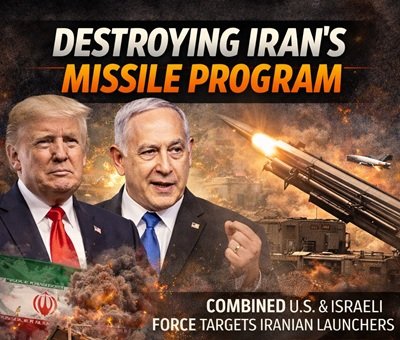
WAR-REPORT : The United States and Israel have shaped their joint military campaign around a central strategic objective: destroy Iran’s ballistic missile capabilities before interceptor stockpiles are exhausted. In the escalating conflict that began on February 28, both Washington and Jerusalem have concluded that the most effective way to preserve defensive capacity is to eliminate the source of missile launches altogether.
Former US President Donald Trump and Israeli Prime Minister Benjamin Netanyahu have repeatedly emphasized that degrading Iran’s ballistic missile program is a primary war aim. While long-term strategic considerations include preventing Iran from rebuilding or expanding its missile arsenal, there is also an urgent operational calculation: the destruction of missile launchers reduces the number of incoming projectiles that require interception. In short, if fewer missiles are launched, fewer interceptors must be fired.
A Campaign Built Around Interceptor Sustainability
Modern missile defense systems rely on high-cost interceptor munitions that cannot be replenished overnight. Both the United States and Israel maintain sophisticated air and missile defense networks, but those systems are designed to withstand limited barrages—not indefinite, large-scale saturation attacks.
Iran’s ballistic missile arsenal, by contrast, is structured around mass launch capability. Tehran has long invested in mobile launchers, hardened silos, and concealed storage depots capable of sustaining repeated waves of missile fire. If such barrages continue unchecked, defensive systems can become strained—not necessarily because they fail technically, but because interceptor inventories dwindle.
This strategic reality has driven the combined force to prioritize missile launcher destruction. Military planners have targeted transporter-erector-launchers (TELs), underground facilities, storage bunkers, and command nodes associated with missile brigades. By disrupting launch capacity, the coalition aims to ensure that interceptor stockpiles remain viable for extended operations.

Defense analysts note that destroying launchers has a cascading effect. It not only prevents immediate launches but also complicates Iran’s ability to coordinate synchronized strikes. Ballistic missile warfare depends on timing and volume; eliminating launch platforms reduces both.

Strategic Convergence Between Washington and Jerusalem
Both Trump and Netanyahu have publicly framed the missile campaign as a matter of national survival and regional stability. For Israel, Iranian missile capabilities represent a direct existential concern. For the United States, the stakes include protecting forward-deployed forces and maintaining stability across Gulf partner nations.

Though their rhetoric has sometimes differed in tone, the strategic alignment is clear: degrading Iran’s missile infrastructure is essential to safeguarding allied personnel and preventing escalation into a wider regional war.
Netanyahu has argued that Iran’s missile arsenal serves as a delivery mechanism for strategic coercion. Even absent nuclear payloads, medium- and long-range ballistic missiles can threaten population centers and critical infrastructure. Trump, meanwhile, has highlighted the need to ensure that American troops and diplomatic facilities are not left vulnerable to sustained bombardment.
Iran Expands Drone and Missile Campaign
Despite the coalition’s focused targeting efforts, Iran has continued to launch both drones and ballistic missiles against US forces and facilities in Gulf countries. These attacks have expanded the geographic scope of the conflict, underscoring Tehran’s capacity for retaliation.
On March 3, at least one Iranian drone struck the US Consulate in Dubai, located in the Dubai, within the United Arab Emirates. The strike ignited a fire that was subsequently extinguished by Emirati emergency services. While no casualties were reported, the incident marked a significant escalation: an Iranian drone had directly impacted a US diplomatic facility on Emirati soil.
The Dubai strike followed two Iranian drone attacks on the US Embassy in Riyadh, the capital of Saudi Arabia, on March 2. According to multiple reports, one drone reportedly struck a section of the embassy compound believed to house intelligence operations. While officials declined to publicly confirm sensitive details, the symbolic significance of targeting embassy grounds was unmistakable.
In response to the Riyadh incidents, the US State Department ordered the temporary closure of the embassy on March 3. Diplomatic personnel were relocated, and security postures were heightened across the region.
Embassy Closures Spread to Kuwait
The regional fallout did not end in Saudi Arabia. Separate US officials told major American outlets that an Iranian drone struck the US Embassy in Kuwait City on March 2. While the embassy did not officially confirm a direct hit, it announced closure “until further notice,” citing regional tensions.
Diplomatic sources speaking to international media indicated that several Iranian drone strikes caused structural damage to the embassy compound. One Kuwait-based diplomat reported that at least one drone directly impacted the building.
Earlier, on March 1, Iran struck Camp Arifjan in Kuwait, killing six US servicemembers. Camp Arifjan serves as a major logistical hub for American operations in the Gulf. The attack marked one of the deadliest single incidents involving US personnel since the conflict began.
Since February 28, Iran has repeatedly targeted American military installations and diplomatic sites across Gulf states. These strikes suggest a deliberate strategy: pressure the United States by threatening its regional footprint while avoiding full-scale confrontation with Israel directly.
The Logic of Preemptive Suppression
Coalition officials argue that Iran’s ongoing drone and missile attacks validate the decision to prioritize launcher destruction. Each successful Iranian strike reinforces the urgency of suppressing launch capabilities before further damage occurs.
Ballistic missiles and drones differ in scale and sophistication, but both can tax defensive systems. Interceptors are generally optimized for higher-velocity ballistic threats, while drones require layered air defense solutions, including radar detection and short-range countermeasures. Sustained mixed attacks can strain both.
By targeting launchers and storage sites, the combined force aims to reduce the number of inbound threats at their origin point. This strategy mirrors past military doctrines emphasizing “left-of-launch” operations—neutralizing threats before they are airborne.
Defense experts note that eliminating launchers is operationally challenging. Many are mobile, capable of rapid relocation after firing. Others are concealed within mountainous terrain or underground facilities. Nevertheless, advances in satellite surveillance, signals intelligence, and persistent aerial reconnaissance have improved detection rates.
Interceptor Economics and Strategic Patience
One underappreciated aspect of the conflict is cost asymmetry. Interceptors are often significantly more expensive than the missiles or drones they destroy. A prolonged exchange risks imposing financial strain even on technologically advanced militaries.
By shifting the campaign toward infrastructure destruction, Washington and Jerusalem aim to reverse that asymmetry. Destroying a launcher once can prevent dozens of future launches. In economic terms, the upfront cost of a precision strike may be offset by the long-term savings in interceptor expenditure.
Military planners must also consider production timelines. Interceptor systems cannot be replenished instantly. Supply chains, manufacturing capacity, and deployment logistics impose constraints. Preserving stockpiles is therefore both a tactical and strategic imperative.
Diplomatic Fallout Across the Gulf
The closure of US diplomatic facilities in Riyadh and Kuwait City underscores the broader regional consequences of Iran’s retaliatory campaign. Host governments in Saudi Arabia, the United Arab Emirates, and Kuwait face the delicate task of balancing domestic security with alliance commitments.
Publicly, Gulf officials have condemned attacks on diplomatic compounds while calling for restraint from all sides. Privately, regional leaders are reportedly concerned about becoming battlegrounds in a widening confrontation.
The drone strike on the US Consulate in Dubai was particularly sensitive. The United Arab Emirates has cultivated a reputation as a stable commercial hub insulated from regional conflict. A direct strike on American diplomatic property threatens that perception.
Escalation Risks and Strategic Calculations
The ongoing cycle of strikes and counterstrikes carries inherent escalation risks. Iran’s willingness to target embassies and military bases signals resolve, but also raises the prospect of broader retaliation.
For Washington, the deaths of US servicemembers at Camp Arifjan represent a significant threshold. Historically, American administrations have treated lethal attacks on troops as triggers for forceful response. Whether the current leadership chooses proportional retaliation or broader escalation will shape the next phase of the conflict.
Israel, meanwhile, continues to frame the missile suppression campaign as essential to preventing existential threats. Netanyahu has maintained that Iran’s missile program cannot be allowed to regenerate after hostilities subside.
The Road Ahead
The conflict’s trajectory will hinge on several factors: the success rate of launcher destruction, Iran’s remaining missile inventory, and the sustainability of interceptor stockpiles. If coalition forces can meaningfully curtail Iran’s launch capacity, the tempo of incoming attacks may decline.
Conversely, if Iran retains sufficient mobile launchers and underground reserves, sporadic strikes may persist. Even limited drone attacks on diplomatic compounds can generate outsized political impact.
Ultimately, the combined force’s strategy reflects a calculus of endurance. By prioritizing missile launcher elimination, Washington and Jerusalem aim to outlast Iranian retaliatory capacity without exhausting their own defenses.
Whether this approach succeeds will depend on intelligence accuracy, operational tempo, and regional diplomacy. For now, the skies above the Gulf remain contested—not only by aircraft and missiles, but by competing strategies of attrition and deterrence.
As embassies shutter their gates and air defense batteries remain on high alert, the message from coalition commanders is clear: neutralize the launchers, preserve the shield, and deny Iran the ability to dictate the pace of conflict.