


Global leaders call for urgent regulation of Artificial Intelligence
By Doruvu Paul Jagan Babu: Assistant Chief Editor

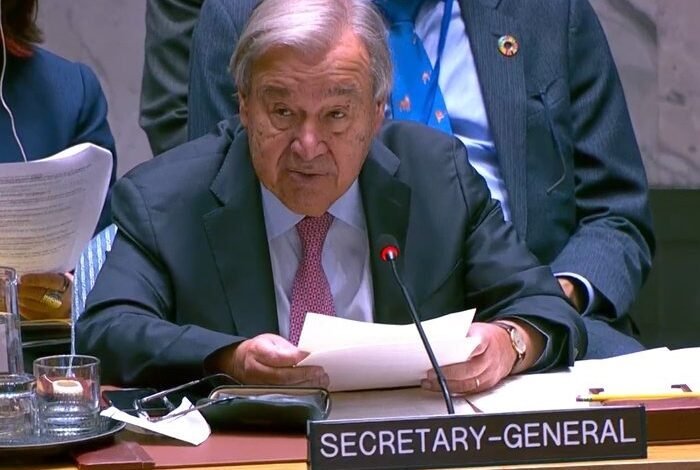
United Nations: Artificial intelligence (AI) offers extraordinary opportunities for global progress but poses grave risks if misused, especially in the military domain, speakers cautioned at the UN Security Council. Leaders, experts, and officials urged urgent global regulation to ensure AI serves peace, not destruction.
Guterres calls for guardrails and human oversight

Secretary-General António Guterres stressed that AI is “no longer a distant horizon” but a force already transforming economies and societies. While it can help tackle crises like food insecurity and demining, he warned of AI-enabled cyberattacks and disinformation campaigns. “Innovation must serve humanity — not undermine it,” emphasizing it he urged a global ban on lethal autonomous weapons without human control and called for binding agreements by 2026. Citing AI-enabled cyberattacks that can disrupt critical infrastructure in minutes and threats to information integrity, he emphasized:
Experts warn of existential threats
Yoshua Bengio, AI pioneer from Université de Montréal, said that scientists still lack the ability to guarantee AI safety. He cautioned against risks ranging from bioweapons and cyberattacks to the concentration of political and economic power. He urged greater investment in trustworthy AI research and stronger government oversight.

Equitable access and avoiding concentration of power
Yejin Choi of Stanford University argued that AI development is dominated by a few global companies, narrowing scientific progress and inclusivity. She called for smaller, adaptive AI models and equitable access, stressing that today’s systems underperform in non-English languages and often exclude diverse cultural perspectives.
Military risks and ethical challenges

Several leaders highlighted the dangers of AI in warfare. Pakistan’s Defence Minister cited its use in South Asian conflicts, while Slovenia’s President warned that robots and algorithms lack conscience. Greece’s Prime Minister compared the challenge to nuclear arms regulation, urging urgent global governance.
Africa warns against digital colonialism
African leaders voiced concerns over being left behind or exploited. Somalia’s President warned of “digital colonialism”, while Algeria noted Africa’s limited data capacity despite its large population. Sierra Leone’s foreign minister likened AI risks to past exploitations of slavery and colonial warfare.
Diverging global views on regulation
While France, Portugal, and the Netherlands called for international frameworks, the United States rejected centralized global control, warning that overregulation could stifle innovation. China, meanwhile, urged consensus-based governance, while Panama called for urgent transparency and accountability mechanisms.
Council urged to lead on AI governance
Poland, the Netherlands, and Yemen stressed that the Security Council must set rules for AI use in armed conflict. Poland reported over 100,000 cyber incidents in 2024, mostly linked to Russia, underscoring the urgency of collective defense. Portugal’s President insisted that human judgment and accountability must remain central in decisions on force.