


Amitabh Bachchan Opens Up About Knee Injury During Kaun Banega Crorepati 18 Shoot
At 83, the legendary actor reveals he slipped and injured his knee on set, prompting doctors to explain when a fall-related knee injury needs medical attention

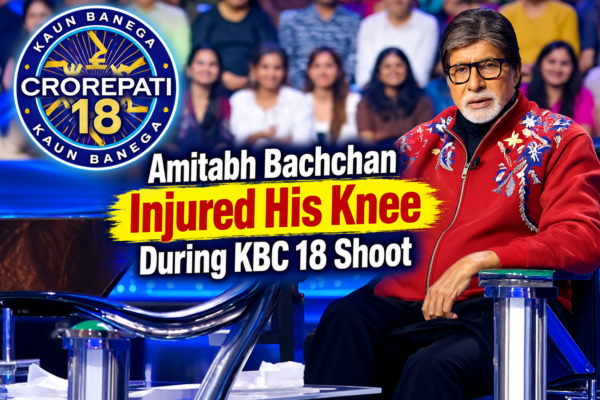
Opinion I Mumbai: Bollywood veteran Amitabh Bachchan, 83, recently gave viewers of Kaun Banega Crorepati 18 an unexpected glimpse into his personal health after revealing that he had suffered a knee injury during the shooting of the popular quiz show. Known for beginning the programme’s opening monologue while standing at the centre of the stage, Bachchan appeared seated at the start of a recent episode, explaining that a fall during the previous day’s shoot had left him struggling to stand comfortably.
The actor’s candid disclosure immediately drew attention not only because of his age and demanding professional schedule, but also because knee injuries after slips and falls can range from relatively minor soft-tissue problems to injuries involving ligaments, the meniscus or bones.
Bachchan explained to viewers that he normally does not sit while delivering his opening monologue. Instead, he usually stands at the centre of the stage before welcoming contestants and beginning the episode. On this occasion, however, he made an exception because of his injured knee.
He reportedly told the audience that he had slipped and fallen during the previous day’s shooting, producing a loud impact and injuring his knee. He described the injury as a tear and said that he was having difficulty standing. He therefore decided to deliver the beginning of the episode while seated and planned to stand later while playing the game.
His reassuring message to viewers indicated that he did not want them to become unnecessarily worried about him. Nevertheless, his experience highlights an important health issue, particularly for older adults: what should a person do after suffering a knee injury in a fall, and when does difficulty standing indicate that medical evaluation is necessary?

According to orthopaedic specialist Dr Ashish Phadnis, Director of Orthopaedics at Jupiter Hospital, Thane, the consequences of a fall depend considerably on how the knee is struck, the direction of the force and the way the person lands.
A fall does not always result in the same type of injury. In some cases, the person may experience nothing more than a bruise, temporary swelling or a soft-tissue injury. In other cases, the impact can damage more important structures inside or around the knee.
These can include the ligaments, meniscus and bones.

From a Bruise to a More Serious Injury
The knee is a complex joint that provides stability while allowing the leg to bend and straighten. It contains several structures that work together to support body weight and facilitate movement.
When a person slips or falls, the knee can be subjected to sudden twisting, bending or direct impact. The resulting injury depends on the force involved and the position of the knee at the time of the accident.
Dr Phadnis explained that a fall may result in a relatively simple injury such as bruising or swelling. However, it can also cause ligament or meniscus injuries, and in more severe situations, a fracture.
For older adults, additional factors can become important. Bone strength can decrease with age, and some people may already have conditions such as osteoarthritis. Consequently, an accident that appears relatively minor may sometimes result in a more significant injury.
One injury mentioned by Dr Phadnis is an avulsion injury. This can occur when a ligament pulls away a small fragment of bone while the ligament itself remains intact. Such injuries demonstrate why the apparent severity of a fall should not always be judged solely by whether a person can stand or walk afterwards.
The circumstances surrounding the fall and the symptoms that follow generally provide the initial clues about what may have happened.
Is Difficulty Standing After a Fall a Warning Sign?
Bachchan’s statement that he had difficulty standing after his knee injury raises a common question: Does difficulty getting up after a fall necessarily mean that the injury is serious?
Dr Phadnis said that difficulty standing can occur for several reasons. Pain, swelling, stiffness and temporary restriction of knee movement can all make it difficult for a person to stand or walk normally.
Therefore, difficulty standing by itself does not automatically indicate a major injury.
However, certain symptoms should not be ignored.
Severe pain, particularly pain that appears disproportionate to the nature of the fall, can warrant medical assessment. Significant swelling, difficulty bearing weight on the affected leg, a feeling that the knee is unstable, or a sensation that the knee is giving way or locking can also be warning signs.
In such circumstances, professional medical evaluation becomes important because an apparently straightforward fall may have caused an injury that cannot be diagnosed simply by observing the person’s ability to walk.
What Should Be Done Immediately After a Knee Injury?
One of the most important steps following a knee injury is to avoid repeatedly testing the joint.
People sometimes try to stand repeatedly, walk around or bend the knee to determine whether it is “really injured”. According to Dr Phadnis, unnecessary strain should be avoided during the initial period.
Resting the affected leg can help prevent further irritation.
An ice pack wrapped in a cloth may be applied for approximately 15 to 20 minutes at a time during the initial period. Direct application of ice to the skin should be avoided.
If swelling develops, elevating the leg can also provide some relief.
However, first-aid measures should not be treated as a substitute for medical assessment when symptoms are significant.
If pain or swelling continues, becomes worse, or interferes with normal movement and weight-bearing, consulting a doctor is advisable. Returning immediately to normal physical activity despite persistent symptoms could potentially aggravate an underlying injury.
The principle is simple: after a fall, the injured knee should be allowed time to settle rather than being repeatedly subjected to stress.
Can an X-Ray Detect Every Knee Injury?
Another important misconception concerns X-rays.
An X-ray is extremely useful for identifying fractures and assessing the condition of bones. However, it does not show every type of knee injury.
Structures such as ligaments and the meniscus are soft tissues and cannot always be adequately assessed through a conventional X-ray.
This means that a person can sometimes have a normal initial X-ray while still experiencing a soft-tissue injury.
Dr Phadnis noted that some patients may initially feel better and begin walking normally even though an underlying problem remains. If symptoms persist, an orthopaedic specialist may recommend follow-up evaluation.
Depending on the examination and the symptoms, a doctor may advise the patient to return after several days, sometimes around a week or 10 days, to reassess the knee. If a soft-tissue injury is suspected, an MRI scan may be recommended.
This approach underlines the importance of monitoring symptoms rather than assuming that a normal initial X-ray means that every possible injury has been ruled out.
Why Age Matters in Knee Injuries
A fall can affect people of every age, but the approach to injury can be different in older adults.
With advancing age, some people experience reduced bone strength, changes in muscle strength, reduced balance or pre-existing joint conditions. Osteoarthritis is particularly common and can already cause pain, stiffness and restricted movement.
An older person with an arthritic knee may therefore experience a substantial increase in pain following what appears to be a relatively minor fall.
There is another concern: instability.
A ligament injury can affect the stability of the knee. If the joint becomes unstable, the individual may have a greater tendency to lose balance or experience another fall.
This can create a cycle in which an initial injury leads to instability, instability contributes to another fall, and another fall produces additional injury.
For this reason, older adults should not necessarily dismiss a fall simply because they can eventually stand up and walk.
The Role of Physiotherapy and Strengthening
Recovery from a knee injury does not always end when the initial pain disappears.
Depending on the nature of the injury, rehabilitation may be necessary to restore movement, strength and stability.
Physiotherapy and appropriate strengthening exercises can play an important role in helping a person regain confidence and stability after an injury.
However, exercises should be appropriate for the individual’s condition. A person with a significant ligament injury, fracture or other structural problem may require a different treatment plan from someone with a simple soft-tissue injury.
In selected cases involving significant ligament damage, surgical treatment may also be considered by specialists.
Therefore, rehabilitation should ideally be guided by the nature of the injury and the individual’s overall health and mobility.
Amitabh Bachchan’s Experience Highlights a Wider Health Message
Bachchan’s decision to begin Kaun Banega Crorepati 18 while seated was a visible reminder that even highly active professionals can experience unexpected injuries.
At 83, continuing to work on a demanding television production requires regular movement, long shooting schedules and physical engagement with the programme. A sudden slip on set demonstrates how quickly an ordinary movement can result in pain or restricted mobility.
His decision to explain the situation directly to viewers also offered an opportunity to highlight a broader message: a fall should not automatically be dismissed, particularly when it is followed by persistent pain, swelling, instability or difficulty bearing weight.
At the same time, not every fall represents a major medical emergency. Pain and temporary stiffness can make standing difficult even in the absence of a serious structural injury.
The key is to pay attention to symptoms and seek professional assessment when necessary.
When Should Medical Help Be Sought?
Following a knee injury caused by a fall, medical attention becomes particularly important when symptoms are severe, persistent or worsening.
Some signs that warrant evaluation include:
- Severe or increasing knee pain
- Significant swelling
- Difficulty putting weight on the affected leg
- A sensation that the knee is unstable or giving way
- Locking of the knee
- Persistent difficulty walking
- Symptoms that do not improve with rest
- Continuing pain despite an apparently normal initial X-ray
Older adults should be particularly cautious because underlying arthritis, reduced bone strength or previous joint problems can influence how the knee responds to a fall.
A Reminder About Safe Recovery
The incident involving Bachchan is also a reminder that recovery should not be rushed.
For someone who has sustained a knee injury, returning immediately to strenuous activity simply because the pain has temporarily decreased may not always be appropriate. Rest, observation and appropriate medical advice can help determine when normal activity should resume.
At the same time, prolonged inactivity without professional guidance can also affect muscle strength and mobility. Once an injury has been assessed, a doctor or physiotherapist can advise on appropriate movement and strengthening.
For older adults in particular, maintaining muscle strength, joint mobility and balance can contribute to stability and help reduce the risk associated with future falls.
A Fall Deserves Attention, Even When Walking Is Possible
Amitabh Bachchan’s recent appearance on Kaun Banega Crorepati 18 may have begun differently from his usual routine, but his experience illustrates an issue that extends well beyond the television studio.
A knee injury following a slip can range from a minor bruise to damage involving ligaments, the meniscus or bone. Difficulty standing can result from pain and swelling and does not necessarily indicate a serious injury, but warning signs such as severe pain, substantial swelling, inability to bear weight, instability or locking should receive medical attention.
An X-ray can identify many bone-related problems, but it cannot rule out every soft-tissue injury. When symptoms persist, further clinical assessment and, where appropriate, imaging such as an MRI may be required.
For older adults, the importance of careful evaluation becomes even greater because age-related changes and pre-existing joint conditions can influence both the severity of an injury and the recovery process.
Bachchan’s decision to sit during the opening of the programme demonstrated a practical response to his immediate difficulty. His experience also serves as a broader reminder that after a fall, the body should be given time to recover, unnecessary strain should be avoided, and persistent or concerning symptoms should not be ignored.