

At Ujjain’s Historic Shahi Masjid, a Long Night as Residents Gather Ahead of Demolition, Court Hearing
Police deployed as community members oppose the proposed removal of part of the mosque for road widening ahead of Simhastha 2028; matter to be heard by the Madhya Pradesh High Court.

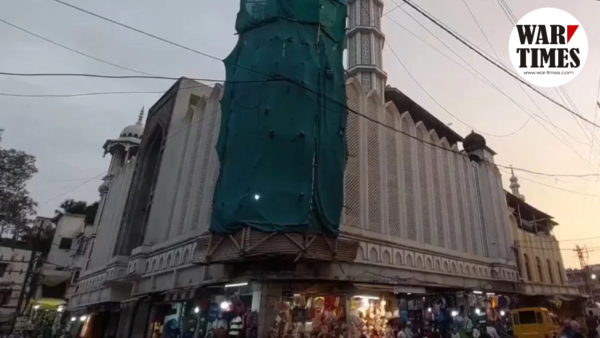
Ujjain Madhya Pradesh: Tensions have emerged in Ujjain as members of the Muslim community gathered in large numbers at the Shahi Masjid on Sunday to oppose the proposed removal of a portion of the mosque as part of a road-widening project ahead of Simhastha 2028.
Some community members said they planned to remain inside the mosque overnight and would not vacate the premises. Police personnel have been deployed in the area as the administration attempts to resolve the matter through discussions with mosque committee members.
For the time being, authorities have decided not to proceed with demolition. Ujjain Superintendent of Police Pradeep Sharma said that adequate police personnel had been deployed to maintain peace and that officials were attempting to settle the issue through dialogue.
According to the police, discussions have been held with members of the mosque committee regarding the proposed action and the legal aspects of the matter. Authorities have also urged the committee to consider removing the affected structures voluntarily.
The dispute concerns the portion of the Shahi Masjid that falls within the proposed alignment of a road that the Ujjain Municipal Corporation plans to widen to approximately 15 metres.

Members of the Muslim community have questioned the proposed alignment and argued that the road could instead be widened by removing structures located opposite the mosque.
Mosque Committee Opposes Removal
Imam Mohammad Ibrahim has urged the administration to exclude the mosque from the road-widening plan, saying religious sites should be protected.
He said the mosque is believed by the community to be around 636 years old and dates back to 1390. According to him, previous road-widening projects had been carried out without removing religious structures.

The mosque authorities have approached the Madhya Pradesh High Court, with their petition scheduled for hearing before a larger bench on Monday, September 28.
Ibrahim said the community had already surrendered portions of property, including several shops, during earlier development-related actions but maintained that the mosque itself could not be given up.
Community Members Remain at Mosque
Mohammad Zakir, a member of the Muslim Representative Committee, said a large number of people had gathered at the mosque to oppose its proposed demolition.
He said community members wanted the authorities to reconsider the decision and preserve the religious structure.
The gathering has remained peaceful so far, while police and administrative officials continue efforts to prevent the situation from escalating.
Owaisi Raises Waqf Concerns
AIMIM president Asaduddin Owaisi has also commented on the controversy, describing the community’s protest as a peaceful, Gandhian form of resistance.
Owaisi linked the Ujjain development to concerns he had previously raised regarding the Waqf Amendment law. He alleged that the amended framework could increase the role of government officials in matters concerning Waqf properties.
He argued that the developments in Ujjain reinforced concerns he had previously expressed regarding the protection and management of Muslim religious properties.
What the High Court Had Earlier Observed
The present dispute follows an order passed by the Madhya Pradesh High Court on September 9, when two petitions challenging the Ujjain Municipal Corporation’s proposed action concerning the portion of the Shahi Masjid falling within the road alignment were dismissed.
The mosque is registered as a Waqf property.
The petitioners had argued that the proposed action would affect part of the prayer hall, a 120-foot minaret and the Mazhar Chowk Shahi. They had also raised constitutional and property-rights issues, including references to Articles 14, 25, 26 and 300A of the Constitution.
Justice Sandeep N. Bhatt held that the municipal corporation had followed the prescribed statutory procedure and had provided affected parties an opportunity to submit objections.
The court also rejected the argument that the mosque was being specifically targeted because it was a religious structure. The judgment noted that other religious structures had also been affected during the road-widening process.
According to the court’s observations, portions of 10 temples and one mosque had already been removed along the same road, while action had been taken in relation to around 80 religious structures across Ujjain.
The court therefore did not accept the allegation that the mosque was being treated differently solely because it was a religious property.
Simhastha 2028 and Road-Widening Plans
The Ujjain Municipal Corporation has maintained that the road-widening project forms part of the Ujjain Development Plan 2035 and is intended to improve traffic movement and public infrastructure.
The project is particularly significant ahead of Simhastha 2028, when Ujjain is expected to receive a very large number of pilgrims and visitors.
Authorities have cited traffic management, public safety and the movement of devotees during major religious processions, including the Shahi Sawari and Peshwai, as reasons for improving road capacity.
The High Court also took into account the location of the mosque, which is situated near the Mahakaleshwar Temple and the Kshipra river, areas expected to experience substantial crowds during Simhastha.
The court concluded in its September 9 order that the municipal corporation’s action had been undertaken in accordance with the applicable legal procedure and did not warrant interference under Article 226.
Larger Bench to Hear Matter
Despite the earlier court order, the dispute remains unresolved on the ground. The mosque committee has approached a larger bench, with the matter scheduled to come up for hearing on Monday.
Community representatives have indicated that they may consider approaching the Supreme Court if they do not receive relief.
The controversy comes at a sensitive stage of Ujjain’s preparations for Simhastha 2028, with authorities seeking to expand road infrastructure and improve traffic management while local residents and religious representatives continue to oppose the removal of structures they consider historically and religiously significant.
War Times will continue to follow the developments in the case and provide updates as the legal proceedings and administrative action progress.