

Iran Escalates Strait Showdown
IRGC missile attack on U.S. warships and planned maritime restrictions signal a broader effort to challenge the blockade and pressure Washington

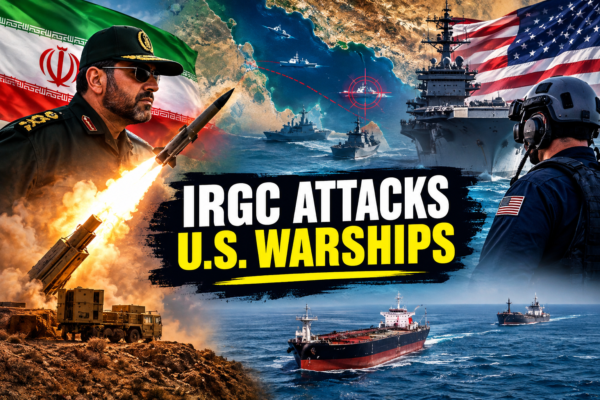
War-Report : The confrontation between Iran and the United States over maritime access in and around the Strait of Hormuz has entered a more dangerous phase, with the Islamic Revolutionary Guards Corps (IRGC) reportedly launching ballistic missiles toward U.S. Navy warships and Tehran announcing plans for a new restricted maritime zone.
The developments point to a wider Iranian strategy aimed not only at confronting U.S. naval forces but also at increasing the military, economic and political costs of Washington’s blockade of Iranian ports. At the heart of the confrontation is the Strait of Hormuz, one of the world’s most strategically important maritime corridors and a critical route for commercial shipping.
According to the assessment provided by the Institute for the Study of War and Critical Threats Project (ISW-CTP), the IRGC Aerospace Force announced on September 5 that it had targeted a U.S. aircraft carrier and a destroyer because the vessels were enforcing the American naval blockade. U.S. Central Command (CENTCOM), however, confirmed that Iran launched ballistic missiles toward two U.S. Navy warships but stated that the missiles did not strike the vessels and caused no casualties.
The incident nevertheless represents a significant escalation. Even without a successful hit, the launch demonstrates Tehran’s willingness to directly threaten U.S. military assets operating in a strategically sensitive maritime environment.
A Direct Challenge to the U.S. Navy
The reported missile attack appears to have been designed to send a clear message to Washington: Iran is prepared to impose military costs on U.S. naval forces if the blockade continues.

Iranian officials have presented the attack as a response to American enforcement measures. The IRGC Aerospace Force reportedly said the U.S. warships were targeted because they were involved in enforcing the blockade. Iranian Supreme National Security Council Secretary Mohsen Rezaei separately claimed that Iran had tested a new system described as a “destroyer missile.”
However, the ISW-CTP assessment cautions that it could not independently verify what type of Iranian weapon system was used.
That distinction is important. While Iranian officials may seek to portray the attack as evidence of a new and powerful military capability, the available information does not establish the precise nature of the weapon involved. What is clearer is the strategic purpose of the attack: demonstrating that U.S. naval forces operating near Iranian waters can themselves become targets.

The absence of casualties or damage to the American vessels does not necessarily make the incident insignificant. Missile launches against warships can create pressure on commanders, increase the risks surrounding maritime operations and force the United States to consider how far it is prepared to go to maintain the blockade.
For Tehran, that calculation may be central.
Raising the Cost of the Blockade
Iran is likely seeking to alter Washington’s calculation by making the continued enforcement of the blockade increasingly expensive and dangerous.
The strategy is straightforward in its broader logic. If American naval forces face repeated threats while enforcing restrictions on Iranian maritime activity, Washington may eventually have to weigh the benefits of maintaining the blockade against the possibility of casualties, escalation and a wider military confrontation.
Rezaei reportedly claimed on September 6 that a successful Iranian strike on a U.S. warship could cause significant American casualties.
Such statements appear intended to reinforce the message that Iran is willing to escalate if necessary. By emphasizing the potential human cost of a naval confrontation, Iranian officials can attempt to influence American political calculations as well as military decision-making.
The objective would not necessarily be to defeat the U.S. Navy in a conventional confrontation. Rather, Iran could be attempting to create enough uncertainty and risk to weaken American political willingness to continue the blockade.
In this sense, the missile attack can be viewed as part of a pressure campaign rather than simply an isolated military action.
The Tanker Dimension
The confrontation has also expanded beyond direct exchanges involving military forces.
Following the Iranian attacks, CENTCOM reportedly disabled two Iranian oil tankers and destroyed a third. Iran subsequently claimed that it had attacked six commercial vessels.
However, the assessment provided by ISW-CTP states that there is no evidence establishing that Iran conducted those attacks against civilian commercial vessels.
That distinction is particularly important because the Strait of Hormuz is not merely a military battlespace. It is also a vital commercial waterway. Any sustained uncertainty about the safety of merchant shipping could have consequences far beyond the immediate confrontation between Washington and Tehran.
Commercial operators make decisions based on risk. If shipping companies believe that vessels could become targets, they may alter routes, delay voyages, increase insurance coverage or demand stronger naval protection.
For Iran, creating such uncertainty could become another method of applying pressure on the United States.
But there is also a significant risk for Tehran. Threatening commercial navigation can generate international opposition and potentially encourage more countries to support efforts aimed at maintaining freedom of navigation.
A Warning From Iran’s Military Leadership
The Khatam ol Anbia Central Headquarters reportedly warned on September 5 that Iran would conduct more severe attacks against U.S. military vessels if Washington continued its blockade.
The warning adds another layer to the confrontation.
Iran is effectively presenting the continuation of the blockade as a trigger for further escalation. The message suggests that Tehran wants the United States to understand that maintaining the blockade will not be a cost-free policy.
This is a classic form of strategic deterrence: Iran wants Washington to believe that every additional step taken against Iranian maritime activity could provoke a stronger response.
At the same time, Washington is likely pursuing its own deterrence strategy. By maintaining naval forces in the area and responding to Iranian actions, the United States is attempting to demonstrate that threats against American or commercial maritime activity will not force it to withdraw.
The result is a potentially dangerous cycle.
One side increases pressure. The other responds. The first side then interprets that response as justification for additional action.
The danger is that an operation intended primarily as signaling could eventually produce an unintended military confrontation.
Iran’s Changing Maritime Challenge
The confrontation is occurring against the backdrop of reported damage to Iranian maritime surveillance and military infrastructure.
According to the assessment, recent U.S. strikes have degraded Iranian coastal radar and surveillance systems, mine-laying capabilities and other assets that the IRGC has traditionally relied upon to monitor and threaten shipping.
If those capabilities have indeed been significantly weakened, Tehran may face a new operational problem.
Controlling or intimidating maritime traffic requires accurate information. A military force must know where vessels are, identify them, monitor their movements and determine which ships could be targeted or challenged.
Reduced surveillance capabilities make those tasks more difficult.
The assessment indicates that Iran may consequently have adopted less effective methods, including the use of fast attack craft to visually identify vessels and shore-based rocket launchers to deploy mines.
Such methods could allow Iran to continue exerting pressure, but they may also be less precise and more difficult to control.
The U.S. Role in Commercial Transit
Another major factor is the reported involvement of U.S. forces in facilitating the movement of commercial vessels through the southern route of the Strait of Hormuz.
This has reportedly increased shipping traffic through that route and undermined Iran’s efforts to compel commercial vessels to follow what Tehran describes as its preferred traffic separation scheme.
This development could explain why Iranian military forces may have chosen to directly threaten U.S. naval vessels.
If American forces are helping commercial shipping move through routes that bypass Iranian restrictions, then U.S. naval protection directly challenges Tehran’s attempt to exercise control over maritime traffic.
From Iran’s perspective, deterring American naval forces could therefore have a dual purpose.
First, it could pressure Washington to reconsider the blockade itself.
Second, it could make commercial shipping operators more reluctant to use routes protected or facilitated by the U.S. Navy.
The second objective could be particularly important because shipping companies ultimately respond to risk.
The Proposed “Restricted Zone”
Iran’s announcement of a planned restricted maritime zone represents a separate but related component of the strategy.
Rezaei reportedly announced on September 6 that Iran would establish a “restricted zone” extending from the U.S. blockade line south of the Strait of Hormuz toward the Persian Gulf.
Under the proposed arrangement, vessels entering the zone would reportedly be required to comply with Iranian transit requirements.
Iran has also threatened to place vessels that violate those requirements on a sanctions list and restrict their future passage through the strait.
The announcement therefore goes beyond a military warning. It represents an attempt to establish a regulatory framework around maritime movement.
Tehran appears to be asserting that commercial shipping must recognize Iranian rules if it wants continued access to the waterway.
Iran reportedly intends to keep the restricted zone in place for as long as the U.S. naval blockade continues. That directly links the maritime restrictions to the larger political dispute.
In other words, Tehran is not presenting the proposed zone as an independent maritime policy. It is using it as another pressure mechanism against Washington.
Pressure on the Shipping Industry
The planned restricted zone could also be aimed at the shipping industry itself.
If commercial operators face the possibility of being denied future passage through the Strait of Hormuz for failing to comply with Iranian requirements, shipping companies may find themselves caught between competing demands.
On one side would be U.S. naval enforcement and American-supported freedom-of-navigation efforts.
On the other would be Iranian requirements backed by the possibility of sanctions or restrictions.
For commercial operators, the primary concern is often predictability.
A vessel owner needs to know whether a route is safe, whether the ship will be permitted to pass and whether the voyage can be insured at a commercially viable cost.
If Iran and the United States establish competing systems of maritime control, uncertainty could increase sharply.
Iran may calculate that shipping companies will eventually pressure Washington to reduce or remove the blockade because continued confrontation makes commercial operations more difficult.
That would turn the shipping industry into an indirect pressure point in the wider U.S.-Iran dispute.
Freedom of Navigation at Stake
The broader strategic issue is therefore not simply whether one missile hits one warship.
The deeper question is who can determine the rules governing maritime movement through the Strait of Hormuz.
The United States is attempting to enforce its blockade and facilitate commercial transit through routes that challenge Iranian restrictions.
Iran, meanwhile, is attempting to demonstrate that it can impose consequences on vessels and forces that operate contrary to its demands.
The confrontation therefore involves military power, economic pressure and competing claims of maritime authority.
Iran’s reported degradation of surveillance and mine-laying capabilities could make the situation even more complicated. If Tehran cannot maintain the same level of maritime monitoring it previously possessed, it may increasingly depend on smaller, more visible and potentially less precise military tools.
That could increase the possibility of miscalculation.
A fast attack craft approaching a commercial vessel, a shore-based missile launch or a mine-laying operation could be interpreted differently by different actors. In a tense environment, even a limited incident can quickly escalate.
A Dangerous Strategic Calculation
Iran’s apparent strategy is based on the belief that increasing the costs of the blockade will eventually weaken American resolve.
The calculation is that Washington may be willing to tolerate a certain level of confrontation but could reconsider if American naval forces repeatedly face serious threats.
This is why the rhetoric surrounding potential casualties matters.
Iran is trying to convince the United States that continued pressure could eventually produce unacceptable military and political consequences.
But the strategy carries considerable risks.
If Iran directly attacks American warships and causes casualties, Washington could respond with substantially greater force. Similarly, attacks or threats against commercial shipping could encourage stronger international efforts to protect maritime traffic.
Instead of weakening the blockade, escalation could therefore produce the opposite outcome.
The United States and its partners could conclude that stronger enforcement is necessary.
The Strait as a Pressure Point
The Strait of Hormuz remains the central geographical focus of this confrontation because control over maritime movement provides both sides with strategic leverage.
For Iran, the strait represents a potential tool for resisting economic pressure and demonstrating regional military influence.
For the United States, maintaining freedom of navigation represents both a military and economic objective.
The struggle is therefore larger than the immediate dispute over Iranian ports.
It concerns who can determine how commercial vessels move through one of the world’s most strategically important waterways.
Iran’s missile attack, its threats against U.S. naval forces, the reported use of alternative maritime tactics and the proposed restricted zone all appear to form parts of a broader campaign to challenge American control of the maritime environment.
At the same time, Washington’s continued naval presence indicates that the United States is not prepared to easily abandon its enforcement effort.
What Comes Next?
The next stage of the confrontation will likely depend on whether both sides can maintain pressure without crossing the threshold into a much wider war.
Iran may continue using military threats, maritime restrictions and political messaging to increase the costs of the blockade.
The United States, meanwhile, may continue protecting commercial shipping and responding to Iranian military actions.
The most dangerous possibility would be an incident involving casualties aboard a U.S. warship or a major commercial vessel. Such an event could rapidly transform a pressure campaign into a direct military confrontation.
For now, the reported missile attack and the planned restricted maritime zone demonstrate that Tehran is attempting to challenge the blockade through multiple channels.
The IRGC’s message is increasingly clear: Iran wants Washington to believe that maintaining the blockade will carry growing military and political risks.
Washington faces a different calculation: whether continued enforcement can be sustained without allowing the confrontation to spiral into a broader regional conflict.
The Strait of Hormuz has once again become the focal point of that strategic contest.
What began as a struggle over economic pressure and maritime access is increasingly becoming a test of military resolve, freedom of navigation and the ability of both sides to control escalation. The coming phase will show whether Iran’s pressure strategy can influence U.S. policy—or whether the confrontation instead produces an even more dangerous cycle of retaliation