


Sonia Gandhi’s Memoir Set to Revisit a Defining Chapter of Indian Politics
From a reluctant political entrant to Congress’s most influential leader, Sonia Gandhi’s upcoming memoir is expected to explore family, power, personal loss and the unresolved questions surrounding her political journey

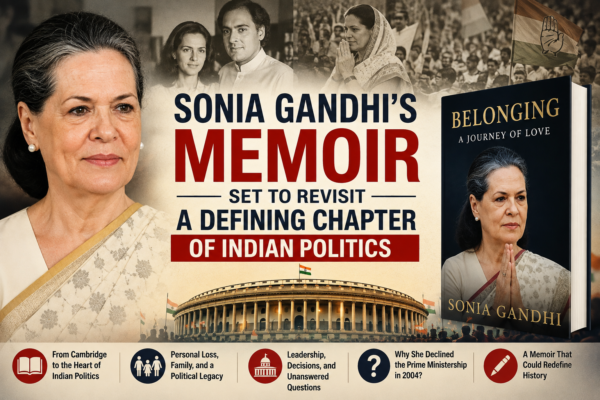
Opinion I New Delhi: Nearly three decades after Sonia Gandhi emerged as one of the most consequential figures in Indian politics, her forthcoming memoir is set to offer a personal account of a journey that transformed her from a largely private individual into the central figure of India’s oldest political party.
Titled Belonging: A Journey of Love, the memoir is scheduled to be published in November by Alfred A. Knopf in the United States and William Collins in the United Kingdom. The book is expected to attract enormous political and public attention because Sonia Gandhi has traditionally maintained a relatively private profile and has rarely offered an extensive personal explanation of the decisions that shaped her political career.
Her story spans extraordinary personal tragedies, the rise and decline of the Congress party, coalition politics, the return of the party to national power in 2004, the decision to nominate Manmohan Singh as prime minister instead of taking the post herself, and the subsequent transfer of the Gandhi family’s political inheritance to her son Rahul Gandhi.
The memoir therefore arrives not merely as the autobiography of a former Congress president but as a potential reflection on several decades of modern Indian political history.
From Sonia Maino to the Gandhi Family
According to the material surrounding the book, the memoir begins in Cambridge in 1965, when a 19-year-old Italian student, Sonia Maino, met Rajiv Gandhi, grandson of India’s first prime minister Jawaharlal Nehru.

At that stage, there was little indication that the young student would eventually become one of the most powerful figures in Indian politics.
Sonia had grown up in a small-town environment in Italy and had no obvious political ambitions. Her relationship with Rajiv Gandhi brought her into one of India’s most prominent political families. Yet even after marriage, she reportedly remained reluctant to embrace a political career.
Rajiv Gandhi’s entry into politics was itself something Sonia had opposed. In her earlier writing, she recalled that she had fought strongly against his decision to enter political life.

But history ultimately placed her at the centre of the same political world she had once tried to avoid.
The deaths of members of the Gandhi family dramatically changed that trajectory.
Personal Tragedy and the Politics of a Family
Sonia Gandhi experienced some of the most devastating moments in modern Indian political history from close quarters.
In 1984, she rushed her mother-in-law, former Prime Minister Indira Gandhi, to hospital after Indira Gandhi was shot by her own security personnel.
Seven years later, another tragedy struck the family. Rajiv Gandhi was assassinated by a suicide bomber during an election campaign in 1991.
These events profoundly affected Sonia, Rahul Gandhi and Priyanka Gandhi.
For years after Rajiv’s assassination, Sonia remained largely outside active politics. She resisted calls to take over the Congress leadership even as the party struggled with declining influence and internal challenges.
Her eventual entry into politics therefore represented a major change.
In 1997, she formally joined the Congress. Within less than a year, she became party president.
The transformation was remarkable.
A woman once described by political opponents as an outsider and even dismissed in some circles as merely a housewife had suddenly become the leader of one of the world’s major political parties.
The “Enigma” Who Learned to Exercise Power
When Sonia Gandhi first assumed the Congress presidency, she was viewed by many party members and political observers as an enigmatic figure.
Her relatively quiet public personality contrasted sharply with the aggressive political environment surrounding the Congress.
Contemporary descriptions portrayed her as reserved, cautious and sparing with words. Yet observers soon began noticing another side of her political personality.
She listened to competing arguments, gathered information and eventually made decisions.
Her style was not necessarily based on loud public confrontation. Instead, her influence increasingly came through organisation, political negotiation and the ability to manage competing interests within the party.
Her early years as Congress president reportedly surprised several senior leaders who had underestimated her political abilities.
What initially appeared to be political inexperience gradually evolved into a leadership style capable of managing a complicated organisation with multiple factions and powerful personalities.
The 2004 Decision That Changed Indian Politics
Perhaps the biggest unanswered question surrounding Sonia Gandhi’s political career concerns the events of 2004.
The Congress-led alliance returned to power after defeating the Bharatiya Janata Party-led government. Sonia Gandhi, as Congress president and the leader who had played a central role in bringing the alliance together, had the numbers and political support necessary to claim the prime minister’s office.
Yet she declined the post.
Instead, she selected Manmohan Singh, the former finance minister and architect associated with India’s economic liberalisation, to become prime minister.
The decision became one of the most discussed political moments in contemporary Indian history.
Why did Sonia Gandhi refuse the prime ministership?
Was it because of political opposition to her foreign origin? Did she believe that her leadership could become a permanent political controversy? Did she have concerns about security? Or were there deeper personal and family considerations?
Her memoir could potentially provide a new perspective on that decision.
Political observers have long debated the issue because, on the surface, Sonia Gandhi appeared to possess the political authority necessary to take the position.
Instead, she chose to exercise power from outside the prime minister’s office.
That decision would define the political structure of the Congress-led government for the next decade.
Foreign Origin Became a Major Political Weapon
Sonia Gandhi’s Italian birth remained a controversial issue throughout her political career.
Her opponents repeatedly questioned whether a person born outside India should lead the country’s government.
The issue became particularly intense around the 2004 election and government formation.
Political opponents portrayed her foreign origin as a matter of national concern, while her supporters argued that her long association with India, Indian citizenship and constitutional rights were sufficient to establish her legitimacy.
The debate became so politically charged that senior opposition leaders publicly announced dramatic forms of protest should Sonia Gandhi become prime minister.
For Sonia Gandhi, therefore, political leadership was accompanied by an unusually persistent question about identity and belonging.
That makes the title Belonging: A Journey of Love particularly significant.
The memoir appears positioned not only as a story about political power but also as a personal exploration of what it meant for an Italian-born woman to become part of one of India’s most politically influential families and eventually lead the Congress party.
Congress Under Sonia Gandhi
Sonia Gandhi’s tenure as Congress president was one of the most important periods in the party’s recent history.
Under her leadership, Congress won two consecutive national elections and returned to power at the head of coalition governments.
The Congress-led administration supported major policy initiatives, including the Right to Information framework and the rural employment guarantee programme.
These measures became important components of the government’s social and governance agenda.
Sonia Gandhi’s supporters viewed her as the political force that helped hold together a complicated coalition of parties with different interests.
Her critics, however, portrayed her as exercising excessive influence over the government despite not occupying the prime minister’s office.
The phrase “remote control” became one of the most frequently used descriptions by her political opponents.
The debate raised a fundamental question about the nature of power in a parliamentary democracy: how much authority can a party leader exercise without formally holding the highest executive office?
The memoir could offer insight into how Sonia herself viewed that relationship.
The Contradictions of the UPA Years
The Congress-led government’s first term was widely regarded as politically successful, but its second term became considerably more difficult.
The government faced a series of corruption allegations, political controversies and accusations of policy paralysis.
The Congress organisation also began experiencing internal weaknesses.
While Sonia Gandhi remained an important political figure, critics argued that the party had become too dependent on the Gandhi family.
Supporters countered that her role was essential in maintaining coalition unity and preventing internal divisions from destroying the government.
These competing interpretations remain part of the larger debate over Sonia Gandhi’s political legacy.
Her memoir could therefore become important not only for what it says about her personal experiences but also for how it interprets the successes and failures of the Congress-led governments between 2004 and 2014.
Rahul Gandhi and the Next Generation
Another major theme likely to attract attention is Sonia Gandhi’s relationship with her son Rahul Gandhi and his political career.
Sonia eventually transferred the Congress presidency to Rahul Gandhi in 2017.
Rahul’s political journey has been significantly different from his mother’s.
While Sonia gradually established herself as a powerful organisational leader, Rahul faced repeated criticism from opponents over his political style and leadership.
His attempts to revive Congress and challenge the political dominance of the BJP have been closely watched for years.
The memoir could provide insight into Sonia Gandhi’s assessment of her son’s political approach and the role she believes the next generation of the Gandhi family should play.
There is also a longstanding question about why Rahul, rather than his sister Priyanka Gandhi, became the principal inheritor of the family’s political responsibility.
Priyanka eventually entered electoral politics formally in 2019 after years of speculation about her possible political role.
Whether Sonia discusses these family decisions in detail remains to be seen.
Bofors and Other Difficult Questions
A memoir of Sonia Gandhi’s political life is unlikely to escape questions about controversies associated with the Gandhi family.
Among them is the Bofors controversy, which badly damaged Rajiv Gandhi’s government and remained a major political issue for years.
Questions surrounding Italian businessman Ottavio Quattrocchi also became part of the wider controversy and were repeatedly used by political opponents to attack the Congress leadership.
Whether Sonia Gandhi addresses these issues directly could become one of the most closely watched aspects of the book.
Political memoirs often reveal how public figures understood controversies that had previously been presented primarily through political opponents, media reports and official investigations.
Readers may therefore be interested in whether Sonia provides new personal information or instead concentrates on the emotional and family dimensions of those years.
The Publishing Controversy
The memoir has already attracted attention even before publication because of a dispute surrounding its publication in India.
Reports suggested that Penguin Random House India had sought changes to certain portions of the manuscript.
Congress leaders subsequently alleged that political pressure had been applied to passages concerning the government, the Rashtriya Swayamsevak Sangh and Chinese intrusions.
Penguin Random House India disputed that account, maintaining that it remained willing to publish the book while relevant discussions were continuing.
The controversy has added another layer of interest to the memoir.
If the final book contains politically sensitive material, its publication could generate fresh debates over political writing, freedom of expression and the boundaries between publishing and politics.
A Different Kind of Political Legacy
Sonia Gandhi’s political legacy is complicated.
Her supporters credit her with rebuilding Congress after its decline during the 1990s, leading the party to two national election victories and maintaining a broad coalition of political parties.
Her critics argue that her leadership reinforced dynastic politics and contributed to the Congress’s dependence on the Gandhi family.
The rise of the BJP and Narendra Modi fundamentally changed India’s political landscape during the latter part of Sonia Gandhi’s career.
The BJP’s campaign for a “Congress-mukt Bharat” directly challenged the historical dominance of the Congress party.
At the same time, the Congress faced repeated electoral setbacks and the departure of several prominent leaders.
The central question consequently became larger than Sonia Gandhi herself: can the Gandhi family continue to hold together the Congress organisation, and can the party develop a political identity capable of competing with a much stronger BJP?
More Than a Political Autobiography
The most interesting aspect of Belonging may ultimately be its personal dimension.
Sonia Gandhi entered public life following years of reluctance. She experienced the deaths of Indira Gandhi and Rajiv Gandhi, raised two children amid extraordinary security concerns and political pressure, and eventually became the leader of a party that had governed India for much of its post-independence history.
Her political career was inseparable from her family’s history.
Yet it was also shaped by decisions that were uniquely her own.
She chose to enter politics.
She chose to lead Congress.
She chose not to become prime minister in 2004.
She chose Manmohan Singh for the post.
And later, she helped prepare the next generation of the Gandhi family for political responsibility.
These choices have generated admiration, criticism and controversy in almost equal measure.
What the Memoir May Finally Reveal
The greatest attraction of Sonia Gandhi’s memoir may not be whether it settles every political controversy.
Instead, readers are likely to look for an explanation of the motivations behind decisions that have remained mysterious for years.
Why did a woman who initially resisted politics eventually become Congress president?
What did she think during the years of extraordinary family tragedy?
Why did she refuse the prime minister’s post in 2004?
How did she understand the criticism over her foreign origins?
What did she think of the Congress-led governments and the controversies that eventually weakened them?
And how does she view the political journey of Rahul Gandhi and the future of the Gandhi family’s relationship with Congress?
These questions have existed for years.
The memoir may answer some of them, while others may remain unresolved.
In her statement about the book, Sonia Gandhi has described it as a testament to the emotional journey of her life, marked by both joy and despair. That description suggests that the book may seek to humanise a family that has spent generations at the centre of India’s political life.
Ultimately, Belonging: A Journey of Love could become more than an account of Sonia Gandhi’s political career. It may represent an attempt to explain the personal meaning of belonging to the Nehru-Gandhi family, living through extraordinary loss and carrying a political inheritance that has increasingly come under challenge.
For decades, much of Sonia Gandhi’s public image has been shaped by political opponents, party supporters, journalists and political commentators.
Her memoir offers the possibility of hearing her own version of that story.
And perhaps that is why its publication is likely to be watched so closely—not simply because Sonia Gandhi was one of India’s most influential political leaders, but because she remained, for much of her career, one of its most enigmatic figures.