

Actors Taapsee Pannu and Kangana Ranaut has once again returned to the spotlight,
Aap khatam kyun nahi hone dete yeh baat?'

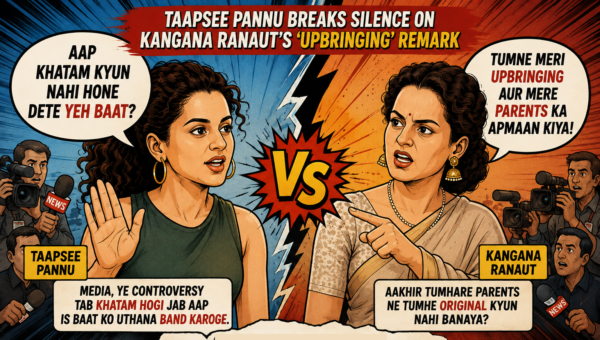
Opinion I Mumbai/New Delhi: The long-running public friction between actors Taapsee Pannu and Kangana Ranaut has once again returned to the spotlight, but this time Taapsee Pannu appears keen to put an end to the controversy rather than prolong it. At the trailer launch of her upcoming film Gandhari, Taapsee was asked yet again about her equation with Kangana and the latest exchange of remarks between the two actors.
Responding to the question, Taapsee questioned why the same controversy continues to be raised in media interactions. She urged journalists to stop repeatedly asking both actors about the issue, arguing that the matter would eventually disappear if it were no longer kept alive through repeated questions.
Her response came after Kangana Ranaut reacted strongly to comments Taapsee had made about their different “upbringings” and ways of speaking. Kangana interpreted Taapsee’s remarks as a criticism of her upbringing and parents and subsequently posted strongly worded messages on social media. The posts were later deleted.
Taapsee Questions Why the Controversy Is Still Being Discussed
At the Gandhari trailer launch, Taapsee was asked about the ongoing disagreement with Kangana. Rather than entering into another round of accusations and counter-accusations, she questioned why the issue was repeatedly being brought back into public discussion.
Her central argument was straightforward: if the media stopped asking the two actors about their disagreement, the controversy would eventually come to an end.

Taapsee said, “Aap khatam kyun nahi hone dete yeh baat?” She further suggested that repeated questions were one of the reasons the matter continued to attract attention.
The actor also indicated that people were interested in watching the exchange unfold, which was encouraging repeated questions on the subject. Her comments effectively shifted the focus from the personal disagreement between the two actors to the broader role of media attention in keeping celebrity controversies alive.
Her response can therefore be seen as an attempt to change the conversation. Instead of responding directly to every allegation or returning another personal comment, Taapsee appeared to be asking whether the entertainment industry and the media should move on.

How the Latest Controversy Began
The latest episode began after Taapsee discussed her long-standing differences with Kangana during an appearance at the India Today Woman Summit 2026.
During that interaction, Taapsee revealed that she and Kangana had never actually met in person, either before or after their public differences began. She explained that their contrasting opinions and ways of communicating could be understood through their different backgrounds, perspectives and upbringings.
Taapsee’s comments were not presented by her as a direct attack on Kangana’s family. However, Kangana interpreted the reference to “upbringing” differently.
The disagreement quickly moved from a discussion about differences in personality and perspective to a more personal exchange involving parents and family background.
That development transformed what might otherwise have remained an old Bollywood disagreement into another highly publicised episode between the two actors.
Kangana Ranaut’s Strong Reaction
Kangana responded through Instagram Stories, although the posts were subsequently deleted.
In the posts, Kangana referred to Taapsee using the previously associated phrase “sasti copy” and accused her of crossing a line by allegedly ridiculing her upbringing and parents. Kangana also questioned why Taapsee’s parents had not produced someone “original” like her, turning the disagreement into a direct exchange involving family background.
The response was significant because the “sasti copy” phrase has been associated with the two actors’ public friction for several years.
Kangana’s latest reaction therefore did not emerge in isolation. Instead, it revived a rivalry that has repeatedly surfaced in public conversations, interviews and social-media exchanges.
The deleted Instagram posts also became part of the news cycle themselves, demonstrating how quickly statements made by celebrities on social media can generate headlines even when those statements are subsequently removed.
The “Sasti Copy” Episode Has a Long History
The public friction between Taapsee and Kangana dates back to around 2019, when Kangana’s sister Rangoli Chandel described Taapsee as a “sasti copy” of Kangana on social media.
The phrase subsequently became closely associated with the dispute between the two actors. Their disagreement has periodically returned to public attention whenever one of them has commented on the other or when journalists have asked them about their relationship.
Interestingly, the two actors have continued to remain professionally successful in their own ways despite the disagreement.
Their careers have followed different trajectories, and both have developed distinct public identities. Yet the question of their alleged rivalry continues to generate media attention whenever they appear at public events.
This has created a situation in which an old disagreement can quickly become news again simply because one actor is asked about the other.
Taapsee Says She Has Never Met Kangana
One of the more interesting aspects of Taapsee’s recent comments is her statement that she has never actually met Kangana.
According to Taapsee, she did not meet Kangana before their public disagreements began and has not met her since. This is notable because their public rivalry has continued for years despite the apparent lack of a conventional personal relationship between the two actors.
The situation raises an important question about celebrity disputes in the digital age: can two public personalities develop a long-running rivalry primarily through interviews, media reports and social-media statements without regularly interacting face-to-face?
In the case of Taapsee and Kangana, the answer appears to be yes.
Their disagreement has largely existed in the public sphere, where comments are reported, interpreted, amplified and responded to through different platforms.
“Upbringing” Became the Central Point of Disagreement
The word “upbringing” has become the most discussed element of the latest controversy.
Taapsee’s original explanation was that the way people speak and perceive situations can reflect their upbringing and worldview. In an interview with Hindustan Times, she clarified that she did not intend to demean Kangana’s upbringing. She argued that her statement was about how a person’s manner of speaking can reflect their background and perspective.
Taapsee also suggested that people could interpret the statement for themselves.
However, Kangana viewed the remark as an insult directed at her parents and upbringing.
This difference in interpretation is at the heart of the latest controversy. One actor says the comment was about differences in communication and perspective, while the other understood it as a personal attack.
The incident demonstrates how statements made during celebrity interviews can acquire a meaning beyond their original context once they enter the social-media cycle.
Taapsee’s “Let It End” Message
The latest comments from Taapsee suggest that she does not want the dispute to become another prolonged public confrontation.
Rather than launching another direct attack on Kangana, she asked why the controversy was not being allowed to end.
Her argument is particularly relevant because the dispute has repeatedly resurfaced through questions from journalists. Each new interview provides an opportunity for the old issue to return, even when the actors themselves may otherwise be focused on their current professional projects.
Taapsee’s message appears to be that the controversy has survived partly because people continue to ask about it.
Her words at the Gandhari event therefore carried a broader message to the entertainment media: if the same question stops being asked, the same controversy may eventually stop making headlines.
Media Attention and Celebrity Controversies
The Taapsee-Kangana episode also raises questions about the relationship between celebrities and the entertainment media.
Celebrity disputes generate attention because audiences are naturally curious about conflicts involving well-known personalities. A disagreement that might otherwise remain private can become a major public story once it is repeatedly discussed in interviews, television programmes, websites and social-media posts.
There is also a commercial dimension to such coverage.
Controversy generates clicks, views, comments and social-media engagement. As a result, old disputes can continue to attract attention long after the original disagreement has lost relevance to the actors’ professional lives.
Taapsee’s frustration appears to be directed, at least partly, at this cycle.
Her question about why the matter is not being allowed to end can be interpreted as a criticism of the repeated revival of celebrity controversies.
The Timing Is Also Significant
Taapsee’s latest comments came while she is promoting Gandhari, an upcoming Netflix film in which she plays the lead role. The project has naturally brought the actor before the media for discussions about her work, the film and her career.
Yet questions about Kangana continue to follow her.
This illustrates one of the persistent challenges faced by public figures: once an individual becomes associated with a major controversy, journalists and audiences often continue to connect new professional appearances with the old dispute.
Taapsee appears to be attempting to redirect attention toward her work.
At the same time, Kangana remains a prominent public figure and actor-politician, meaning her comments are likely to receive substantial attention whenever she responds to criticism.
The combination of celebrity status, social media and political visibility makes their exchanges particularly newsworthy.
Kangana’s “Sasti Copy” Remark Revives an Old Narrative
Kangana’s latest use of the “sasti copy” label has also revived a narrative that has been associated with Taapsee for years.
However, Taapsee has previously indicated that she does not necessarily consider the label personally offensive. In an interview with Hindustan Times, she said she had maintained that she was not offended by the phrase and emphasised that she considered Kangana a phenomenal actor.
That response is important because it suggests that Taapsee does not necessarily view every remark from Kangana as something requiring a direct counterattack.
Instead, she appears increasingly interested in refusing to allow the disagreement to dominate her public identity.
This may explain why her latest response focused more on ending the cycle than escalating it.
A Rivalry That Refuses to Disappear
The Taapsee-Kangana dispute has survived for years because it has repeatedly acquired new dimensions.
Initially associated with the debate around Bollywood, nepotism and competing perceptions of the film industry, the disagreement later became personalised through social-media exchanges and comments about each other’s careers.
Now, the controversy has moved into the territory of upbringing and family.
The latest episode once again demonstrates how quickly a professional discussion can become personal when celebrities are repeatedly asked about old disagreements.
For the audience, the story may appear entertaining. For the people involved, however, constantly revisiting the same dispute can become exhausting.
Taapsee’s latest comments appear to reflect precisely that frustration.
What Happens Next?
Whether the controversy actually ends may depend less on another statement from either actor and more on whether the media and audiences stop demanding another response.
If journalists continue asking Taapsee about Kangana, she may continue to face pressure to explain or defend her earlier remarks. Similarly, if Kangana continues responding publicly, every new statement can create another news cycle.
The possibility of the controversy ending therefore depends on both sides choosing not to engage and on the public conversation moving elsewhere.
For now, Taapsee has made her position clear: she does not want the same dispute to be repeatedly brought into conversations about her career.
Her message is essentially that the issue could have ended much earlier if people had stopped asking about it.
Beyond the Personal Dispute
There is a larger lesson in the Taapsee-Kangana controversy.
Public disagreements between celebrities are often transformed into permanent narratives. Once a particular label or feud becomes popular, it can follow the personalities involved for years.
In the age of social media, a single sentence can be captured, shared, interpreted and debated millions of times. Even deleted posts can continue circulating through screenshots and news reports.
This makes restraint increasingly important for public figures.
It also places responsibility on media organisations and audiences to distinguish between genuine public-interest stories and controversies that survive primarily because they generate attention.
The latest Taapsee-Kangana episode is undoubtedly a compelling Bollywood story. But Taapsee’s response suggests that she would prefer the conversation to move beyond an old disagreement and return to cinema.
Opinion :
The latest exchange between Taapsee Pannu and Kangana Ranaut is another chapter in a public disagreement that has continued for several years. What began with differences of opinion and the infamous “sasti copy” controversy has now evolved into a dispute over comments about upbringing and parents.
Kangana interpreted Taapsee’s comments as a personal attack, while Taapsee has maintained that she was speaking about differences in upbringing, communication and perception rather than insulting anyone’s parents.
But Taapsee’s most recent message is less about defending herself and more about asking the media to stop reopening the issue.
At the Gandhari trailer launch, her question was direct: “Aap khatam kyun nahi hone dete yeh baat?”
Her argument is simple. If the same questions stop being asked, the controversy may finally disappear.
Whether that happens remains to be seen. But one thing is clear: after years of headlines, social-media exchanges and public comments, Taapsee appears to be signalling that she would rather let the chapter close than write another page in the same story.