

Sebastia Emerges as the Centerpiece of a Growing West Bank Disput
Heritage, Sovereignty and the Future:
 Samir Singh 'Bharat'-Editor-in-Chief
Send an email
23 July 2026
Samir Singh 'Bharat'-Editor-in-Chief
Send an email
23 July 2026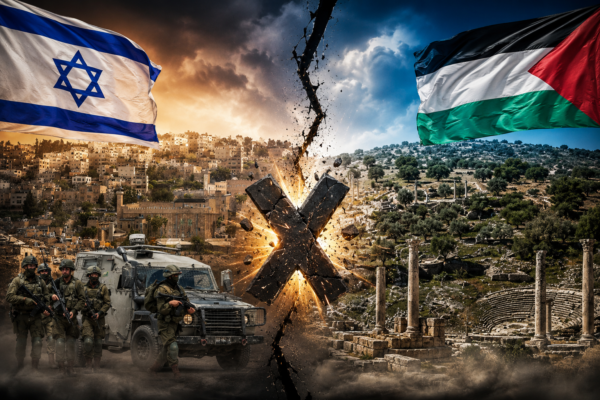
War-Report -Jerusalem – West Bank : A quiet hilltop in the occupied West Bank has become the focus of one of the region’s most politically charged disputes, where archaeology, national identity, historical memory, and territorial claims intersect. The ancient town of Sebastia, located just north of Nablus, is no longer viewed solely as an archaeological treasure preserving thousands of years of civilization. Instead, it has evolved into a strategic symbol in the broader Israeli-Palestinian conflict, with both sides seeking to establish historical legitimacy and future sovereignty through control of the site.
The struggle surrounding Sebastia highlights a larger reality across the West Bank: history is no longer confined to museums and excavation sites. It has become an active element in modern political strategy, diplomatic negotiations, tourism development, and competing national narratives.
An Ancient City at the Crossroads of History
Sebastia is among the oldest continuously inhabited archaeological locations in the Middle East. Historians believe the settlement dates back more than three millennia and has witnessed the rise and fall of numerous civilizations.
Archaeological evidence identifies the site as ancient Samaria, once serving as the capital of the biblical Kingdom of Israel during the Iron Age. Later, Herod the Great reconstructed the city, renamed it Sebastia in honor of Emperor Augustus, and introduced monumental Roman architecture, including temples, palaces, theaters, broad colonnaded streets, and public buildings.
Over the centuries, Byzantine Christians, early Muslim rulers, Crusaders, and Ottoman administrators all left visible traces on the landscape. Local Christian traditions also associate the nearby town with the burial place of John the Baptist, adding another layer of religious significance.

Because of these overlapping civilizations, Sebastia represents Jewish, Christian, Muslim, Roman, Byzantine, Arab, and Ottoman heritage simultaneously—making it one of the most culturally complex sites in the region.
Land Seizure Intensifies Political Tensions
Over the past year, the Israeli government has initiated measures to expropriate approximately 500 acres of privately owned Palestinian land surrounding Sebastia.
Israeli authorities have announced plans to invest nearly $10 million to develop the archaeological site into an international tourism destination, including conservation work, visitor facilities, infrastructure improvements, and enhanced security arrangements.

Israeli officials argue that these investments are intended to preserve an important chapter of Jewish history while improving public access to ancient heritage.
Palestinian residents, however, see the move very differently.
Local leaders argue that the land confiscation threatens agricultural livelihoods, limits access to privately owned olive groves, and risks separating the Palestinian town from its most valuable cultural and economic resource.
UNESCO Recognition Becomes a Diplomatic Battleground
At the same time, the Palestinian Authority has intensified diplomatic efforts to secure full UNESCO World Heritage status for Sebastia.
Although the site has remained on UNESCO’s Tentative List since 2012, Palestinian officials hope that formal inscription would provide stronger international recognition and encourage greater protection for the archaeological remains.
The proposal is being considered during UNESCO discussions, where heritage experts evaluate sites based on cultural, historical, and archaeological significance.
For Palestinian officials, international recognition represents more than cultural preservation—it also reinforces claims regarding Palestinian stewardship of the site.
Oslo Accords Create Administrative Complexity
Sebastia’s geography reflects the complicated administrative divisions established under the Oslo Accords.
The archaeological mound itself lies in Area C, which remains under full Israeli civil and military control.
Meanwhile, the adjacent Palestinian town, including hotels, restaurants, shops, and tourism facilities, falls within Area B, where civil administration is managed by the Palestinian Authority while security responsibilities are shared.
This fragmented jurisdiction creates practical challenges.
Residents say they often require Israeli permission to carry out restoration work, maintain archaeological structures, or even access agricultural land surrounding the ancient ruins.
Local Economy Faces Uncertainty
Tourism has long served as one of Sebastia’s primary economic engines.
Visitors arriving to explore Roman columns, Byzantine churches, ancient walls, and archaeological remains support local businesses, restaurants, guides, transportation services, and family-owned guesthouses.
Agriculture remains equally important.
Thousands of olive trees surrounding the archaeological zone provide income for local families.
Residents fear that expanded restrictions on land access could damage both sectors simultaneously.
Community representatives argue that losing direct access to the archaeological site would significantly reduce tourist activity while limiting traditional olive harvesting, thereby affecting household incomes across the town.
Israel Expands Archaeological Investment
Sebastia forms part of a much broader Israeli heritage initiative launched over recent years.
Since 2023, Israel has allocated more than 250 million shekels toward archaeological preservation projects throughout the West Bank under a program commonly referred to as “Road, Land, Heritage.”
The initiative focuses primarily on locations associated with Jewish historical and biblical traditions.
Among the major projects receiving government attention are:
- Hebron’s Cave of the Patriarchs
- Herodium
- Ancient Samaria (Sebastia)
- Several biblical-era archaeological locations
Israeli Prime Minister Benjamin Netanyahu has repeatedly argued that preserving historical sites strengthens national identity.
Government officials maintain that safeguarding archaeological heritage helps ensure future generations remain connected to Jewish history.
Competing Historical Narratives
The dispute over Sebastia extends beyond physical control of land.
At its heart lies a fundamental disagreement over historical interpretation.
Israeli officials emphasize the city’s role as the biblical capital of ancient Israel and argue that archaeological discoveries confirm longstanding Jewish historical connections.
Palestinian officials acknowledge those ancient layers but stress that Sebastia has also been continuously inhabited through Roman, Byzantine, Islamic, Crusader, Ottoman, and modern Palestinian periods.
They argue that preserving one chapter of history should not erase the others.
Heritage specialists often note that archaeological sites frequently contain multiple civilizations existing one above another.
Consequently, many experts advocate protecting the complete historical record rather than emphasizing a single historical identity.
Archaeology and Sovereignty
Independent researchers have increasingly warned that archaeology has become intertwined with political sovereignty.
Some Israeli archaeological organizations argue that excavation and preservation should remain scientifically independent and free from territorial politics.
Critics contend that archaeological development projects can influence future territorial realities by expanding infrastructure, increasing tourism, and strengthening administrative control over contested areas.
Supporters of Israeli policy reject those claims, arguing that preserving ancient sites serves universal cultural interests and prevents deterioration caused by neglect.
International Law and the West Bank
The international community continues to regard the West Bank as occupied territory under international law, although Israel disputes aspects of that characterization.
Most countries maintain that permanent changes affecting occupied territory should occur only through negotiated political agreements.
Israel maintains that its historical connection to many biblical sites justifies continued investment and preservation efforts.
These competing legal interpretations contribute to ongoing diplomatic disagreements involving the United Nations, UNESCO, and numerous foreign governments.
Heritage as Soft Power
Beyond archaeology itself, Sebastia illustrates how cultural heritage increasingly functions as an instrument of diplomacy.
International recognition, museum exhibitions, archaeological publications, educational programs, and tourism campaigns all influence global perceptions regarding ownership, legitimacy, and historical continuity.
Both Israeli and Palestinian institutions understand that cultural diplomacy can shape international opinion just as effectively as political negotiations.
Growing Regional Implications
The outcome of the Sebastia dispute may influence similar debates across the West Bank, where thousands of archaeological sites remain under varying administrative arrangements.
Future decisions regarding preservation authority, tourism management, land ownership, and international recognition could establish precedents affecting numerous historically significant locations.
Experts suggest that cooperation between Israeli and Palestinian archaeologists would provide the best opportunity to preserve shared cultural heritage while minimizing political conflict.
However, current political realities make such cooperation increasingly difficult.
Looking Ahead
As UNESCO deliberates and development plans continue, Sebastia remains far more than an archaeological destination.
Its ancient stones have become symbols in competing national narratives, reflecting broader questions about identity, sovereignty, cultural preservation, and the future of the Israeli-Palestinian conflict.
Whether viewed as ancient Samaria, Roman Sebastia, a Christian pilgrimage destination, or a Palestinian cultural landmark, the site embodies thousands of years of shared human history.
The challenge for policymakers, archaeologists, and local communities alike will be determining whether that history can serve as a bridge between competing identities—or whether it will continue to deepen one of the world’s most enduring territorial disputes.