


Nuh Police Arrest 3 Sextortion Fraudsters Running Fake Message Scam
Three Cyber Fraud Accused Arrested in Major Online Scam Bust
 Samir Singh 'Bharat'-Editor-in-Chief
Send an email
15 May 2026
Samir Singh 'Bharat'-Editor-in-Chief
Send an email
15 May 2026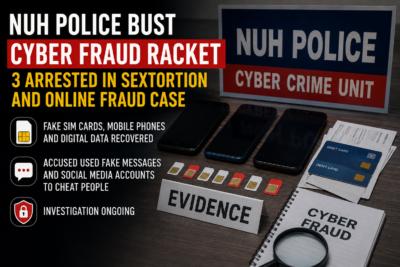
New Delhi : In a significant breakthrough against rising cybercrime activities in Haryana, Nuh Police have arrested three alleged cyber fraudsters accused of operating sextortion schemes and online fraud rackets using fake text messages, forged digital identities, and fraudulent social media accounts. Officials confirmed on Wednesday that the accused were involved in multiple cybercrime operations targeting unsuspecting victims through online manipulation and intimidation.
The arrests come amid increasing concerns across India over the rapid growth of cyber-enabled crimes, particularly sextortion, phishing scams, fake banking alerts, and digital impersonation frauds. Investigators say such criminal networks are becoming more sophisticated, using fake SIM cards, social media platforms, messaging applications, and digital payment systems to trap victims and extort money.
According to police officials, the three accused have been identified as Salman, a resident of Reethat village, and Zahid and Usaid, residents of Jaivant village. During the operations, police recovered fake SIM cards, mobile phones, suspicious digital records, fake banking messages, and cyber fraud-related material from the accused.
Authorities believe the arrests may expose a wider interstate cybercrime network operating through organized digital fraud mechanisms.
Cyber Team Tracked Suspicious Mobile Number
Police officials stated that the breakthrough came after the cybercrime investigation team traced the location of a suspicious mobile number using an online intelligence portal. Investigators had reportedly been monitoring digital activities connected to multiple complaints involving online fraud and extortion.

The cyber tracking operation eventually led police teams to the Ferozepur Namak area on Tuesday, where the first accused, Salman, was located and arrested.
During the search operation, police recovered two mobile phones and a fake SIM card from his possession. Initial forensic examination of the devices allegedly revealed disturbing evidence connected to sextortion and online fraud activities.
According to officials, the recovered mobile phones contained WhatsApp accounts used for fraudulent communication, screenshots linked to cybercrime operations, explicit sextortion videos, and photographs of several young women.

Police suspect that the accused used these materials to threaten victims and extort money online.
Investigators believe the digital content recovered from the devices may help identify additional victims and possibly uncover links to other cybercrime groups operating in the region.
Separate Raid Leads to Two More Arrests
In another operation conducted shortly afterward, police received information regarding two other suspects allegedly involved in online fraud through fake text message schemes.
The accused, identified as Zahid and Usaid, were reportedly operating from the Hussainpur village area and were suspected of targeting individuals using deceptive banking and payment-related messages.
Acting on specific intelligence inputs, police teams conducted a raid in Hussainpur village and arrested both suspects.
During the operation, officers seized mobile phones allegedly containing evidence of cyber fraud operations. According to investigators, the devices included fake debit transaction messages, fabricated payment notifications, barcode images, suspicious WhatsApp conversations, and digital records connected to fraudulent financial activities.
Police suspect that the accused were sending fake banking alerts and payment confirmations to deceive victims into believing money had been transferred or transactions had been completed.
Officials stated that the digital data recovered from the devices is currently being examined by cyber forensic experts.
Growing Threat of Sextortion in India
The arrests have once again highlighted the growing threat of sextortion cases across India.
Sextortion is a form of cybercrime in which criminals manipulate victims into sharing private photographs or videos, or secretly record compromising content during online interactions. The victims are then threatened with public exposure unless money is paid.
Cybercrime experts say such scams have increased sharply in recent years due to the widespread use of smartphones, video calling platforms, social media applications, and anonymous online communication tools.
Fraudsters often create fake social media profiles using attractive photographs to gain victims’ trust. Once communication begins, victims are lured into private conversations or video calls that are secretly recorded.
The recorded material is later used to blackmail victims.
In many cases, victims hesitate to report the crimes due to embarrassment, fear, or social pressure, allowing criminal networks to continue operating unchecked.
Police officials believe the accused arrested in Nuh may have used similar tactics.
Fake SIM Cards Becoming Key Tool for Cybercriminals
Investigators say the use of fake or fraudulently obtained SIM cards has become one of the biggest challenges in combating cybercrime.
Criminals frequently acquire SIM cards using forged identity documents, fake addresses, or illegally obtained credentials. These SIM cards are then used to create temporary digital identities for scams, extortion, phishing, and fraud operations.
Once authorities begin tracking the numbers, the SIM cards are often discarded and replaced.
Police officials stated that the fake SIM cards recovered from the accused could help investigators trace additional criminal activity and identify possible suppliers involved in illegal SIM distribution networks.
Cyber experts warn that anonymous communication remains one of the strongest protections for organized online fraud groups.
Without strong identity verification systems, criminal networks can rapidly create and abandon digital accounts, making investigations difficult.
Social Media and Messaging Platforms Under Scrutiny
The case has also drawn attention to the role of messaging platforms and social media applications in facilitating cybercrime.
Police said the accused allegedly used WhatsApp accounts and digital messaging systems to contact victims, send fraudulent messages, and circulate manipulated or threatening content.
Cybercrime investigators say platforms like WhatsApp, Telegram, Instagram, and Facebook are increasingly exploited by scammers because they allow rapid communication and anonymous account creation.
Criminals frequently use stolen profile pictures, fake identities, and temporary numbers to appear genuine.
In sextortion cases, scammers often pretend to be women and initiate conversations with unsuspecting individuals. Once trust is established, the victim may be manipulated into compromising interactions that are secretly recorded.
Authorities have repeatedly advised people not to engage with unknown profiles online or share personal information and images with strangers.
Rise of Digital Fraud Across India
India has witnessed a massive rise in cyber fraud cases over the past few years, driven by increased internet usage, digital banking expansion, and rapid adoption of online payment systems.
Criminal networks now use sophisticated tactics including:
- Fake investment applications
- UPI payment scams
- QR code fraud
- OTP theft
- Impersonation calls
- Job offer scams
- Fake customer care numbers
- Sextortion
- Cryptocurrency fraud
- Loan app extortion
- Phishing links
Law enforcement agencies across the country are struggling to keep pace with the speed at which cybercriminals adapt to new technology.
Police say cybercrime is no longer limited to highly skilled hackers. Many operations now involve organized groups using easily available digital tools, fake identities, and psychological manipulation.
The Nuh arrests are part of a broader effort by law enforcement agencies to crack down on such networks.
Digital Evidence Under Examination
Officials stated that cyber forensic teams are currently analyzing the seized devices and digital records recovered from the accused.
Investigators hope the data may reveal:
- Financial transaction trails
- Communication records
- Additional victims
- Other gang members
- Links to interstate cybercrime networks
- Use of digital payment wallets
- Possible cryptocurrency transactions
Police suspect that the accused may have operated beyond Haryana and targeted victims across multiple states.
Cybercrime investigators are also trying to determine whether the accused were part of a larger organized gang specializing in sextortion and online financial fraud.
Police Warn Public Against Online Traps
Following the arrests, Nuh police issued a warning urging citizens to remain cautious while interacting online.
Authorities advised people:
- Not to trust unknown social media profiles
- Avoid sharing private photographs or videos online
- Never respond to suspicious video calls
- Ignore fake banking messages and payment links
- Verify all financial communications directly with banks
- Report suspicious activity immediately to police cyber cells
Police emphasized that cybercriminals increasingly rely on fear, embarrassment, and urgency to manipulate victims.
In sextortion cases, victims are often threatened with viral circulation of private content unless money is paid immediately.
Cyber experts advise victims not to panic or comply with extortion demands, but instead contact police authorities promptly.
Organized Cybercrime Emerging From Rural Belts
Investigators say one concerning trend is the emergence of organized cybercrime operations from semi-rural and rural regions where digital connectivity has increased rapidly.
Several states across northern India have witnessed cyber fraud hubs developing in areas with high unemployment and limited economic opportunities.
Criminal groups recruit young individuals familiar with smartphones and social media, training them in online fraud methods ranging from phishing and impersonation to sextortion.
The use of fake SIM cards, temporary devices, and multiple digital accounts allows these operations to function with relative anonymity.
Law enforcement agencies believe dismantling such networks requires not only policing but also stronger digital awareness campaigns and stricter telecom verification systems.
Cybercrime Becoming National Security Challenge
Experts warn that cyber fraud is no longer merely a financial crime issue but an emerging national security and social challenge.
Large-scale digital fraud operations impact public trust in banking systems, digital payments, and online communication platforms.
The psychological impact of sextortion cases is especially severe, with victims often suffering emotional trauma, anxiety, depression, and reputational harm.
Authorities are increasingly calling for coordinated action involving police, telecom companies, banks, technology platforms, and cybersecurity agencies.
The Nuh case reflects how cybercriminals are blending financial fraud with emotional manipulation, creating highly damaging forms of online crime.
Investigation Continues
Police officials confirmed that the investigation remains ongoing and additional arrests may follow.
A spokesperson for Nuh police stated:
“Investigation revealed that the accused were defrauding people online by using fake SIM cards and social media accounts. We are further questioning them.”
Authorities are now examining whether the accused were connected to larger interstate fraud syndicates or operating independently.
Investigators are also attempting to identify the source of the fake SIM cards and determine how many victims may have been targeted through the recovered digital accounts.
As cybercrime networks continue evolving, police say public vigilance remains one of the strongest defenses against online fraud.
The arrests in Nuh may have disrupted one criminal operation, but officials warn that countless similar networks continue operating across the country — exploiting technology, anonymity, and human vulnerability in increasingly sophisticated ways.