

NCH Warns Against Misleading Statements on Homoeopathy, Calls for Responsible Public Discourse
By Doruvu Paul Jagan Babu: Assistant Chief Editor

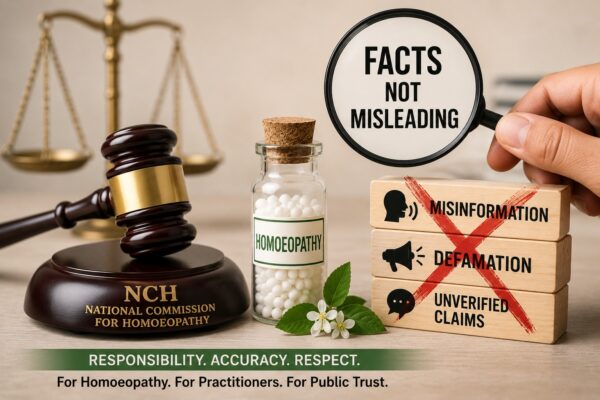
New Delhi-Andhra Pradesh: The National Commission for Homoeopathy (NCH) has issued an advisory urging media organizations, institutions, healthcare establishments, and the general public to exercise responsibility and factual accuracy while making statements concerning Homoeopathy and registered homoeopathic practitioners. Taking serious note of what it described as derogatory, misleading, defamatory, and unverified remarks circulating across various media platforms, the Commission warned that legal action could be initiated against deliberate attempts to spread baseless information about the recognized system of medicine.
Commission issues advisory to protect integrity of Homoeopathy
NCH Chairperson Dr. Tarkeshwar Jain stated that the Commission has issued an official circular dated June 8, 2026, emphasizing the need for responsible communication regarding Homoeopathy and its practitioners. The advisory was issued as part of the Commission’s statutory mandate to regulate standards of education, professional conduct, ethics, and medical practice in the field of Homoeopathy.
According to the Commission, public discussions concerning healthcare systems should be based on verified facts and evidence rather than unsubstantiated claims that may mislead the public or damage the reputation of qualified practitioners.
Homoeopathy recognized under Indian law

Dr. Jain reiterated that Homoeopathy is a legally recognized system of medicine under the National Commission for Homoeopathy Act, 2020. He further noted that homoeopathic medicines are regulated under the Drugs and Cosmetics Act, 1940, and that professional education in the discipline is conducted through a structured academic framework prescribed by the Commission.
Admissions to undergraduate and postgraduate Homoeopathy courses are made through NEET-qualified candidates, while practitioners are required to undergo prescribed educational and training standards before becoming eligible for registration and professional practice.
Concerns should be raised through legal and regulatory channels
The Commission clarified that any allegations, complaints, or grievances against individual practitioners should be pursued through established statutory, disciplinary, regulatory, or judicial mechanisms rather than through generalized criticism directed at the entire profession.
The advisory urged stakeholders to verify information before publishing or sharing content related to Homoeopathy, particularly on digital and social media platforms where misinformation can spread rapidly.
Warning against defamatory and unverified claims
Expressing concern over increasing instances of unverified allegations being circulated through print, electronic, digital, and social media, the Commission emphasized that such actions could undermine public trust and professional credibility.
Dr. Jain stated that the NCH remains committed to protecting the dignity, integrity, and lawful standing of Homoeopathy and registered practitioners. He cautioned that appropriate action, including legal recourse where necessary, may be pursued against individuals or organizations found deliberately spreading false, misleading, or defamatory statements.
Call for fact-based healthcare discussions
The Commission concluded by appealing for balanced, evidence-based, and responsible public discourse on healthcare systems. It stressed that constructive criticism and professional accountability should be pursued through appropriate channels while ensuring respect for legally recognized medical systems and qualified healthcare practitioners.