

PM Narendra Modi’s Melbourne Visit Deepens India–Australia Strategic Partnership Across Key Sectors
Special Correspondent
 war-times.com
Send an email
10 July 2026
war-times.com
Send an email
10 July 2026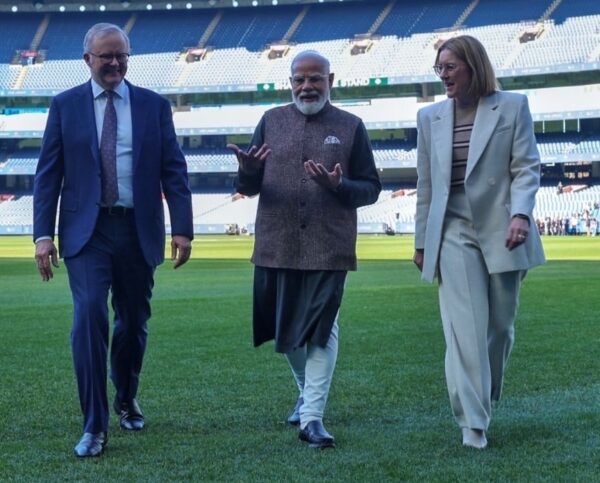
Melbourne, Australia : Prime Minister Narendra Modi’s visit to Melbourne marked another significant chapter in the rapidly expanding India–Australia Comprehensive Strategic Partnership, reinforcing the shared commitment of both nations to deepen cooperation in trade, technology, defence, clean energy, education, critical minerals, and people-to-people ties.
The visit featured comprehensive bilateral discussions with Australian Prime Minister Anthony Albanese, high-level engagements with business leaders and the Indian diaspora, and a symbolic visit to the iconic Melbourne Cricket Ground (MCG), highlighting the growing strategic and cultural bond between the two democratic nations.
Strengthening a Trusted Strategic Partnership
During their bilateral meeting, Prime Minister Modi and Prime Minister Albanese reviewed the progress made under the Comprehensive Strategic Partnership and explored new opportunities to enhance collaboration in areas of mutual interest.
The leaders reaffirmed their shared vision of a free, open, inclusive and rules-based Indo-Pacific region and emphasized closer cooperation in regional and global forums. They agreed that India and Australia, as trusted democratic partners, have an important role in promoting regional stability, economic resilience and sustainable development.
Both sides expressed satisfaction with the growing momentum in bilateral relations, which have expanded significantly in recent years.

Expanding Trade and Economic Cooperation
Economic cooperation remained a central focus of the discussions. The two Prime Ministers welcomed the increasing volume of bilateral trade and investment and encouraged businesses from both countries to explore new opportunities.

Leaders discussed strengthening supply chains, facilitating greater market access, promoting investment in infrastructure, and supporting innovation-driven industries.

Particular emphasis was placed on enhancing cooperation in manufacturing, digital services, agribusiness, healthcare, and advanced technologies, while encouraging greater participation of small and medium enterprises in bilateral trade.
Collaboration in Critical Minerals
Critical minerals emerged as one of the most important pillars of future cooperation.
Australia possesses abundant reserves of lithium, cobalt, nickel, and rare earth elements, while India is rapidly expanding its manufacturing capacity for electric vehicles, batteries, renewable energy technologies, and electronics.
The leaders agreed to deepen collaboration in securing reliable and resilient critical mineral supply chains, reducing dependence on concentrated global sources and supporting emerging clean technology industries.
This partnership is expected to contribute significantly to India’s energy transition and Australia’s position as a reliable supplier of strategic resources.
Clean Energy and Climate Action
Recognizing climate change as a shared global challenge, both leaders reaffirmed their commitment to accelerating cooperation in renewable energy and clean technologies.
Discussions covered solar power, green hydrogen, battery storage, offshore wind energy, and carbon reduction initiatives.
India and Australia also agreed to encourage joint research, technological innovation, and investments that support sustainable economic growth while contributing to global climate goals.
The leaders emphasized that clean energy cooperation would create new employment opportunities while strengthening long-term energy security.
Technology and Innovation
Emerging technologies formed another major area of discussion.
Both countries agreed to expand collaboration in artificial intelligence, quantum computing, cybersecurity, semiconductor development, digital infrastructure, fintech, and space technologies.
The leaders emphasized the importance of trusted digital ecosystems, responsible use of artificial intelligence, secure data governance, and innovation partnerships between universities, research institutions, and technology companies.
Greater cooperation in startup ecosystems was also identified as an important avenue for future engagement.
Defence and Maritime Security
Defence cooperation continued to receive strong attention during the visit.
India and Australia reaffirmed their commitment to expanding military cooperation through joint exercises, defence dialogues, maritime security initiatives, and increased interoperability between their armed forces.
Both leaders reiterated their support for maintaining peace, stability, and freedom of navigation across the Indo-Pacific region.
The growing defence partnership reflects the increasing strategic convergence between the two countries amid evolving regional security challenges.
Education and Research Partnerships
Education remains one of the strongest pillars of India–Australia relations.
The two Prime Ministers welcomed the growing number of Indian students studying in Australian universities and discussed expanding academic collaboration through research partnerships, faculty exchanges, joint degree programmes, and skill development initiatives.
They also encouraged greater cooperation in vocational education, innovation centres, and emerging technologies to prepare future generations for a rapidly changing global economy.
Universities from both countries are expected to deepen collaboration in science, engineering, healthcare, and digital technologies.

Connecting with the Indian Community
A major highlight of Prime Minister Modi’s visit was his interaction with the vibrant Indian community in Melbourne.
Addressing members of the Indian diaspora, the Prime Minister appreciated their significant contributions to Australia’s multicultural society and acknowledged their role in strengthening people-to-people ties between the two nations.
He described the Indian community as a “living bridge” connecting India and Australia through culture, entrepreneurship, education, and innovation.
The enthusiastic reception reflected the growing influence and achievements of the Indian-origin community across Australia.
Visit to the Melbourne Cricket Ground
Prime Minister Modi also visited the historic Melbourne Cricket Ground (MCG), one of the world’s most celebrated sporting venues.
The visit underscored the shared passion for cricket that unites millions of people in both countries and highlighted sports diplomacy as an important dimension of bilateral relations.
The leaders explored opportunities to strengthen sporting cooperation through athlete exchanges, coaching partnerships, grassroots development programmes, and greater collaboration between sporting institutions.
Cricket continues to serve as a powerful cultural connection between India and Australia, fostering goodwill beyond diplomatic engagement.
Business Engagements
The Prime Minister also interacted with leading Australian business executives and investors to encourage greater economic engagement.
Discussions focused on investment opportunities in infrastructure, renewable energy, advanced manufacturing, logistics, technology, healthcare, and digital services.
Business leaders welcomed India’s economic growth trajectory and expressed interest in expanding long-term partnerships with Indian industries.
Both governments reiterated their commitment to creating a predictable, transparent, and business-friendly environment for investors.
Indo-Pacific Vision
India and Australia reaffirmed their shared commitment to a secure and prosperous Indo-Pacific.
The leaders emphasized adherence to international law, peaceful resolution of disputes, respect for sovereignty, and freedom of navigation.
They agreed to continue working closely with regional partners to promote economic resilience, maritime security, disaster preparedness, and sustainable development throughout the Indo-Pacific region.
Looking Ahead
Prime Minister Narendra Modi’s Melbourne visit demonstrated the remarkable evolution of India–Australia relations from traditional diplomatic engagement to a broad-based strategic partnership encompassing economic growth, technological innovation, defence cooperation, clean energy, education, critical minerals, and cultural exchanges.
As both countries continue to strengthen collaboration across multiple sectors, the visit is expected to accelerate implementation of key bilateral initiatives and open new opportunities for governments, businesses, researchers, students, and citizens alike.
The outcomes of the visit reaffirm that India and Australia are increasingly working together as trusted democratic partners committed to building a resilient, innovative, and prosperous future for the Indo-Pacific region and beyond.
 war-times.com
Send an email
10 July 2026
war-times.com
Send an email
10 July 2026