

Israel–Lebanon Ceasefire Raises Questions About Stability
World War
 Samir Singh 'Bharat'-Editor-in-Chief
Send an email
25 April 2026
Samir Singh 'Bharat'-Editor-in-Chief
Send an email
25 April 2026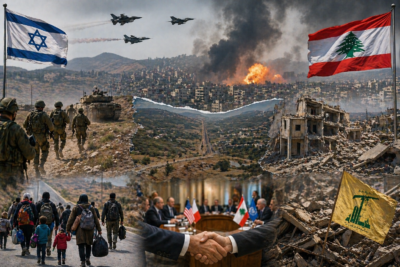
War-Report: The recent ceasefire between Israel and Lebanon has brought a temporary halt to one of the most intense escalations in their long-standing conflict. Yet beneath this fragile calm lie deep uncertainties about long-term stability, shifting military balances, and broader regional consequences. Insights from Heiko Wimmen, a specialist on Iraq, Lebanon, and Syria, help explain the scale of destruction, the current situation on the ground, and what may follow.
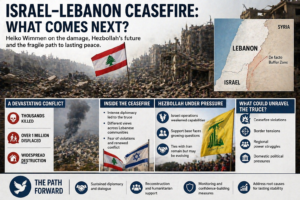
The latest round of fighting between Israel and Hezbollah caused severe human and material losses. Thousands of people were killed, and more than a million were displaced. Most of the displaced population came from Shia-majority areas in southern Lebanon, where the intensity of the conflict was highest. Entire towns and villages were damaged or destroyed as airstrikes, artillery fire, and ground operations spread across the region.

This large-scale displacement has placed enormous pressure on Lebanon, a country already facing deep economic and political challenges. Families have been forced to move to safer areas, often relying on limited humanitarian aid. Many have lost their homes, income sources, and access to basic services. The humanitarian situation remains fragile, even after the ceasefire.
Israeli military operations during the conflict showed clear differences depending on the location. In southern Lebanon near the border, operations focused on removing Hezbollah fighters and destroying military positions. In other parts of the country, strikes targeted infrastructure, supply routes, and communication networks believed to support Hezbollah’s activities.

One major outcome of these operations is the emergence of what analysts describe as a de facto buffer zone along parts of the Israel–Lebanon border. This area is intended to prevent Hezbollah from returning close to the frontier and to reduce the risk of cross-border attacks. Although not officially declared, the buffer zone reflects a key strategic goal for Israel.
The ceasefire itself came after intense diplomatic efforts involving regional and international actors. While the full details remain unclear, it is evident that both sides faced strong pressure to stop the fighting due to the high human and economic costs. The agreement represents a temporary compromise rather than a permanent solution.
Within Lebanon, reactions to the ceasefire are mixed. Many people, especially those directly affected by the conflict, see it as necessary relief from violence. However, there is also uncertainty about how long the peace will last and whether the underlying issues have been addressed.

Different communities in Lebanon view the situation in different ways. Some criticize Hezbollah’s role in bringing conflict to the country, while others continue to support the group as a resistance force. These divisions reflect deeper political and social tensions within Lebanon.
The condition of Hezbollah after the conflict is a key issue. Israeli operations have damaged parts of its infrastructure and disrupted some of its capabilities. However, it is difficult to measure the full extent of this impact. Hezbollah has a history of rebuilding and adapting after previous conflicts.
Its relationship with Iran remains important. Iran has long supported Hezbollah with funding, training, and weapons. Changes in this relationship, influenced by regional developments, could affect Hezbollah’s future strength and strategy.
The conflict has also affected support for Hezbollah among its base. While many supporters remain loyal, the scale of destruction and displacement has raised concerns about the cost of continued confrontation. The group may face increasing pressure to balance military goals with the needs of its community.
Despite the ceasefire, the risk of renewed conflict remains high. Possible triggers include violations of the agreement, unresolved border tensions, or actions by armed groups. Even small incidents could escalate quickly into larger confrontations.
Regional dynamics also influence the situation. Tensions involving Iran and other Middle Eastern actors could affect stability. Internal political developments in both Israel and Lebanon may also shape future decisions.
Experts suggest that maintaining the ceasefire will require continuous diplomatic engagement. Clear communication, monitoring mechanisms, and confidence-building steps are essential to prevent misunderstandings and reduce risks.
Humanitarian and reconstruction efforts are equally important. Rebuilding damaged infrastructure and supporting displaced populations can help reduce instability. Without recovery, economic hardship and social tension may increase.

Long-term stability will depend on addressing deeper political and security issues. These include the role of armed groups in Lebanon, the authority of the state, and Israel’s security concerns. Progress on these issues is difficult but necessary for lasting peace.
Our Media Opinion, the ceasefire between Israel and Lebanon has stopped immediate violence but has not resolved the root causes of conflict. The coming period will be critical in determining whether this pause leads to stability or becomes another temporary break in a continuing cycle of tension and confrontation.