

NHRC Calls for Rights-Based Reforms to Protect Migrant Workers Across India
By Doruvu Paul Jagan Babu: Assistant Chief Editor

New Delhi: NHRC Urges Government, Industry and Civil Society to Ensure Dignity, Fair Wages and Social Protection for Migrant Labourers
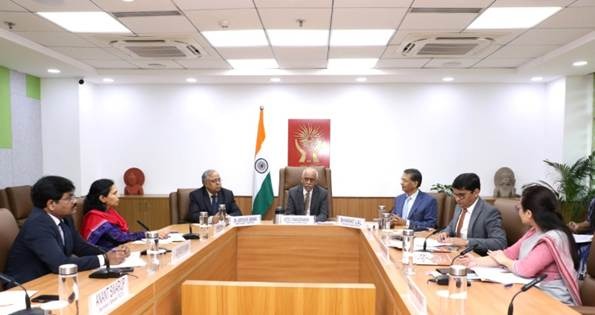
The National Human Rights Commission (NHRC), India, has called for urgent and coordinated reforms to safeguard the rights and dignity of migrant workers, stressing that implementation gaps—not the absence of laws—remain the biggest challenge. During a core group meeting on “Protecting Migrant Workers’ Rights: Shared Responsibility of Government and the Private Sector” held in hybrid mode in New Delhi, the Commission highlighted the exploitation, insecurity and social exclusion faced by millions of migrant labourers working across India’s unorganised sectors.
Chairing the meeting, NHRC Chairperson Justice V. Ramasubramanian observed that migrant workers face greater hardships due to language barriers, unstable shelter, mobility issues and weak collective representation, despite their critical contribution to India’s economy.
Migrant workers remain backbone of India’s economy
NHRC Secretary General Bharat Lal stated that migrant workers constitute nearly 28.9% of India’s population and play an indispensable role in infrastructure, logistics, construction, domestic work and industrial production.

Recalling the hardships witnessed during the COVID-19 lockdowns, he said the crisis exposed the vulnerability of migrant labourers, many of whom were left stranded without wages, food or transportation.
He expressed concern over reports that outsourced workers often do not receive minimum wages, while contractors allegedly deduct substantial amounts through digital payment systems.
Strong laws exist, but implementation remains weak

Justice Ramasubramanian noted that India already has several labour protection laws, including the Inter-State Migrant Workmen Act of 1979 and safeguards under the Industrial Disputes Act. However, he pointed out that loopholes and poor enforcement continue to deprive workers of benefits.
He cited practices where employers allegedly terminate or interrupt employment before workers complete the mandatory eligibility period for legal protections.
The NHRC Chairperson stressed that the country must move beyond a mere “compliance-based” approach and adopt a “rights-based culture” that treats migrant workers with dignity and fairness.
Demand for interstate coordination and portable benefits
The Commission strongly advocated for systemic reforms such as:
Interstate coordination mechanisms
Portable social security and welfare benefits
Stronger implementation of labour laws
Better access to healthcare, housing and education
Real-time migrant worker databases
Multilingual grievance redress systems
Justice Ramasubramanian also proposed involving linguistic and identity-based community associations in coordination councils to improve outreach and support systems for migrant labourers.
“Workers leave homes for survival, yet face exploitation”
NHRC Member Justice (Dr.) Bidyut Ranjan Sarangi said migrant workers often do not receive timely wages or humane treatment despite leaving their homes in search of livelihood.
He emphasised that workers and their families must be guaranteed:
Adequate wages
Decent housing
Healthcare facilities
Educational opportunities for children
Social security protections
He also recommended creating a database of family members accompanying migrant workers to ensure welfare schemes reach entire households.
Businesses asked to share responsibility
Several experts and officials highlighted the role of industries and businesses in protecting migrant workers’ rights.
Representatives from SEBI explained that the Business Responsibility and Sustainability Report (BRSR) framework captures labour welfare indicators, including those related to migrant and contract workers. However, experts acknowledged that the majority of migrants remain outside formal regulatory frameworks because they work in MSMEs and the unorganised sector.
Participants urged companies to adopt ethical recruitment practices, ensure zero recruitment fees, improve worker accommodation and strengthen accountability across subcontracting chains.
e-Shram portal seen as key welfare tool
Officials from the Ministry of Labour and Employment stated that the e-Shram portal provides a strong foundation for building a national migrant worker database.
Experts recommended integrating e-Shram with Aadhaar, EPF, ESIC and various state welfare schemes to improve portability of benefits and service delivery.
Suggestions also included:
QR-based migrant identity cards
National migrant labour dashboards
Pre-departure skill and awareness training
Digital tracking of welfare access
Construction workers among most vulnerable
Experts speaking during the meeting highlighted the plight of construction workers, many of whom reportedly suffer from:
Wage theft
Lack of documentation
Unsafe housing
Absence of overtime compensation
Exclusion from welfare schemes
Concerns were also raised regarding climate vulnerability, digital payment challenges and language barriers that prevent workers from accessing essential services.
Welfare investments improve productivity: Study
Citing a study conducted by the Indian Institute of Management Ahmedabad, Bharat Lal noted that investments in worker welfare directly improve productivity and family well-being.
According to the findings, welfare measures increased factory workers’ efficiency by 1.38 times while also improving education and future prospects for their children.
He remarked that perceived discrimination and injustice can sometimes fuel social unrest and violence, making inclusive labour reforms essential for long-term social stability.
International bodies push for rights-based labour governance
Representatives from international organisations including the International Labour Organization (ILO), International Organization for Migration (IOM), UNDP and World Benchmarking Alliance called for:
Stronger labour governance
Ethical business conduct
Sector-specific welfare policies
Real-time migration data
Better grievance redress systems
Human rights-centred corporate accountability
They stressed that migrant workers should not be treated as temporary outsiders, but as permanent contributors to national development.
NHRC calls for practical, ground-level solutions
The Commission concluded the meeting by emphasising the need for practical, multi-stakeholder recommendations that can be implemented effectively by Union and State governments.
Participants agreed that while India has progressive labour laws and welfare frameworks, the real challenge lies in bridging the gap between policy and implementation.
The deliberations reinforced the growing consensus that migrant workers—who sustain cities, industries and public systems—must receive protection, dignity and equal opportunities as a matter of human rights and national responsibility.