

Ukraine Gains Drone Superiority as Mid-Range Strike Campaign
By Samir Singh 'Bharat': Editor In Chief
 war-times.com
Send an email
10 April 2026
war-times.com
Send an email
10 April 2026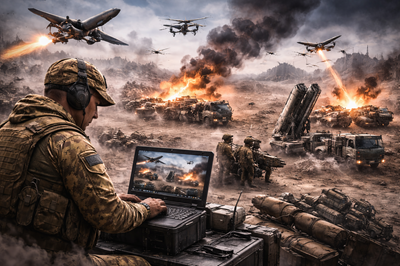
WAR-REPORT : The war in Ukraine is increasingly being shaped by technological innovation, with unmanned aerial systems emerging as one of the most decisive factors on the battlefield. Recent reporting from both Ukrainian and Russian sources indicates that Ukraine has achieved a growing advantage in drone warfare. This shift is playing a critical role in slowing Russian advances, enabling Ukrainian counterattacks, and altering the operational balance across multiple fronts.
The Rise of Drone-Centric Warfare
Drones have become a central component of modern military operations in Ukraine. Initially used primarily for reconnaissance, they are now deployed for precision strikes, electronic warfare, and interception missions. Both sides have invested heavily in expanding their drone fleets, but Ukraine appears to have gained an edge in both quantity and technological sophistication.
This advantage is not merely incremental. It represents a structural change in how operations are conducted. Ukrainian forces are increasingly able to detect, track, and strike Russian positions with greater precision and frequency. At the same time, they are improving their ability to neutralize incoming Russian drones, reducing the effectiveness of enemy reconnaissance and strike capabilities.
The result is a battlefield environment in which Ukraine is better positioned to control the tempo of engagements. Russian forces, which previously relied on drone-supported advances, are now encountering increasing difficulty in maintaining momentum.
Expansion of Mid-Range Strike Campaign
One of the most significant developments contributing to Ukraine’s advantage is the expansion of its mid-range strike campaign. Since late 2025, and especially in early 2026, Ukrainian forces have intensified operations targeting Russian logistics, equipment, and manpower.

The scale of these operations has increased dramatically. Ukrainian forces conducted approximately 41 mid-range strikes in January 2026, 61 in February, and 115 in March. This steady escalation reflects both increased capacity and a deliberate strategic focus on sustained pressure.
These strikes have primarily targeted Russian positions in eastern and southern Ukraine, including areas near occupied Donetsk City. By disrupting supply lines, damaging infrastructure, and targeting staging areas, Ukraine is degrading Russia’s ability to prepare and execute offensive operations.
The impact of these strikes extends beyond immediate damage. Repeated attacks force Russian units to relocate, disperse, or reinforce vulnerable areas, reducing their operational efficiency. This continuous disruption is likely interfering with Russia’s planned spring-summer offensive in 2026.

Slowing Russian Advances
The intensification of Ukrainian strike operations is having a measurable effect on Russian battlefield performance. Advances that once occurred through gradual but steady pressure are now increasingly stalled.
Russian forces face growing challenges in sustaining offensive operations. Damage to logistics networks and equipment, combined with the need to defend against constant drone attacks, is limiting their ability to concentrate forces and maintain momentum.
The cumulative effect is a battlefield characterized by attrition rather than breakthrough. Without the ability to restore operational maneuver, Russian forces are constrained to incremental gains that come at high cost.
Targeting Air Defense Systems
A key element of Ukraine’s strategy has been the systematic targeting of Russian air defense systems. By reducing the effectiveness of these defenses, Ukraine is creating opportunities for more successful drone and missile operations.
Recent reports indicate that Ukrainian forces have destroyed multiple Russian air defense systems in occupied territories within a short period. These losses reduce Russia’s ability to protect critical assets and increase vulnerability to further strikes.
The degradation of air defense systems also has a cascading effect. With fewer defenses in place, Ukrainian drones can operate more freely, increasing the effectiveness of reconnaissance and strike missions.
Increasing Drone Interception Capabilities
Ukraine’s growing advantage is also evident in its ability to intercept Russian drones. Interceptor drones have become an essential tool in countering enemy unmanned systems, and Ukraine has significantly improved its capabilities in this area.
The number of intercepted Russian drones has risen sharply. Ukrainian forces intercepted nearly 3,000 drones in January 2026, over 3,600 in February, and more than 7,600 in March. This rapid increase reflects both improved technology and expanded operational capacity.
The ability to neutralize incoming drones has important tactical implications. Russian forces rely heavily on drones for targeting and coordination. By intercepting these systems, Ukraine is reducing the effectiveness of Russian operations.
This, in turn, slows Russian advances and creates opportunities for Ukrainian counterattacks. Without reliable drone support, Russian units face greater difficulty in coordinating movements and responding to changing conditions.
Compounding Effects on the Battlefield
The combination of mid-range strikes, air defense targeting, and drone interception is producing compounding effects. Each element reinforces the others, creating a cycle that increasingly favors Ukrainian forces.
For example, strikes on logistics hubs reduce the availability of resources needed for offensive operations. At the same time, the destruction of air defense systems allows for more effective drone use, which further degrades Russian capabilities.
These interconnected effects are gradually shifting the balance of power. While the conflict remains contested, Ukraine’s integrated approach is yielding measurable results.
Ukrainian Advances and Operational Gains
Recent Ukrainian advances reflect the impact of these developments. During the winter of 2025–2026 and the spring of 2026, Ukrainian forces have achieved some of their most significant gains since earlier phases of the war.
These gains represent the largest territorial recovery within Ukraine since the 2023 counteroffensive. They also build on momentum established during earlier operations, demonstrating Ukraine’s ability to regain initiative.
While these advances are not yet decisive, they indicate that Ukraine retains the capacity to challenge Russian positions and exploit emerging opportunities.
Russian Challenges and Constraints
Russian forces are facing increasing challenges as a result of these developments. High casualty rates, logistical disruptions, and the need to defend against sustained strikes are placing significant strain on military resources.
Drones remain a central component of Russian operations, but their effectiveness is being reduced by Ukrainian countermeasures. At the same time, the need to replace lost equipment and maintain defensive positions is stretching Russia’s industrial capacity.
These pressures are likely to influence future strategic decisions and may limit Russia’s ability to achieve its broader objectives.
Reports of Internal Concerns
Unverified reports suggest that Russian leadership may be aware of the growing imbalance in drone capabilities. According to some accounts, senior officials have expressed concern about Ukraine’s technological advantage and the implications for the battlefield.
These reports indicate that Ukrainian drones are increasingly sophisticated, capable of continuous operation, and difficult to detect. Traditional countermeasures, such as electronic warfare and standard detection systems, are reportedly less effective against these new systems.
If accurate, such assessments would highlight the need for significant adjustments in Russian strategy and capability development.
The Role of Innovation
Ukraine’s success is closely tied to its emphasis on innovation. Rapid development and deployment of new technologies have allowed Ukrainian forces to adapt quickly to changing conditions.
This adaptability is a key strength. By integrating new systems into existing operations, Ukraine is able to maintain flexibility and exploit opportunities as they arise.
The focus on innovation also extends to production. Ukraine has expanded its ability to manufacture and deploy drones at scale, ensuring a steady supply of critical systems.
Implications for the Future
The growing importance of drone warfare has broader implications for the conflict. As both sides continue to invest in unmanned systems, the nature of operations is likely to evolve further.
For Ukraine, maintaining its technological edge will be essential. Continued innovation and effective integration of new capabilities will be necessary to sustain current advantages.
For Russia, addressing existing gaps will require significant effort. This may involve increasing production, improving coordination, and developing more effective countermeasures.
Strategic Significance
The shift toward drone-centric warfare represents a fundamental change in how conflicts are fought. Relatively low-cost systems are now capable of delivering significant strategic effects.
This challenges traditional models of military power and highlights the importance of adaptability and technological development. The Ukraine conflict is likely to serve as a case study for future military planning and doctrine.
Our Media Opinion
Ukraine’s growing advantage in drone warfare is reshaping the battlefield and influencing the broader trajectory of the conflict. Through a combination of mid-range strikes, improved interception capabilities, and continuous innovation, Ukrainian forces are imposing significant costs on Russian operations.
While the outcome of the war remains uncertain, current trends suggest that technological factors will play an increasingly central role. Ukraine’s ability to leverage its drone capabilities is not only affecting immediate operations but also redefining the nature of modern warfare.
war-times.com
Send an email
10 April 2026