

Houthi Strikes, Iran’s Strategic Messaging, and Russia’s Growing Role
By Samir Singh 'Bharat': Editor In Chief

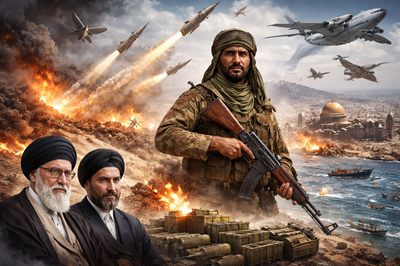
WAR-REPORT : The evolving conflict landscape in the Middle East has entered a new and potentially more complex phase, as the Houthis—an Iran-aligned group based in Yemen—have re-emerged as active participants in hostilities involving Israel. Their recent actions, combined with Iran’s internal messaging and Russia’s increasing cooperation with Tehran, signal a gradual but notable shift in the dynamics of the broader regional confrontation.
This development reflects not only the expansion of military engagement across multiple fronts but also the intricate interplay of political signaling, strategic restraint, and international alignment that continues to shape the trajectory of the conflict.
Houthi Entry into the Conflict: A Calculated Move
On March 27 and 28, the Houthis conducted a series of coordinated attacks targeting southern Israel. These operations included a ballistic missile strike as well as a combination of drone and cruise missile assaults. According to Israeli defense authorities, all incoming threats were successfully intercepted by advanced air defense systems, preventing casualties and limiting material damage.
One of the intercepted threats included a drone that was neutralized over the southern Israeli city of Eilat, a strategic location along the Red Sea. The effectiveness of Israel’s defensive measures highlights its continued vigilance and technological preparedness in the face of evolving aerial threats.
Houthi spokesperson Yahya Saree publicly confirmed the attacks, stating that the group had launched multiple ballistic missiles aimed at what he described as “sensitive” Israeli military installations. In addition, he claimed that drones and cruise missiles were directed toward “vital and military sites” in the same region.


Saree further emphasized that these operations are part of a broader commitment by the Houthis to oppose ongoing military actions by Israel and the United States against Iran and its regional allies, often referred to as the “Axis of Resistance.” He indicated that such operations would continue until those actions cease, though he did not provide specific details about future plans.
Strategic Restraint or Tactical Adjustment?
While the Houthis’ renewed involvement marks a significant development, their operational choices suggest a degree of calculated restraint. Notably, the group has not resumed attacks on international shipping in the Red Sea—a tactic it previously employed extensively during earlier phases of regional conflict.

During the period following the October 7 war and throughout the 12-day conflict in June 2025, the Houthis conducted numerous drone and missile strikes not only against Israeli targets but also against commercial vessels navigating critical maritime routes. These actions had drawn international concern and, at times, direct responses from Western naval forces.
However, since September 2025, there have been no recorded Houthi attacks on international shipping. This apparent shift in focus—from maritime disruption to targeted strikes against Israeli territory—may reflect a strategic decision to limit escalation, particularly with the United States.
By avoiding attacks on global trade routes, the Houthis may be seeking to balance their ideological commitments with pragmatic considerations. Such an approach allows them to demonstrate solidarity with Iran and its allies while reducing the risk of provoking a broader international military response.
Iran’s Messaging: The “Resistance Economy” Narrative
Parallel to these military developments, Iran’s leadership has been actively shaping domestic and international perceptions through strategic communication. On March 28, a Telegram channel associated with Mojtaba Khamenei published an infographic outlining the concept of a “resistance economy.”
This concept, long promoted by Iran’s leadership, emphasizes economic self-sufficiency, resilience in the face of sanctions, and national unity. The infographic detailed what it described as the “path to defeating the enemy in the economic war,” highlighting themes such as domestic production, reduced reliance on imports, and mechanisms to circumvent international sanctions.
Mojtaba Khamenei recently reinforced this narrative by declaring “resistance economy in the shadow of national unity and national security” as the country’s slogan for Nowruz, the Persian New Year. This messaging echoes the long-standing policies advocated by his father, Ali Khamenei, who has consistently emphasized economic independence as a cornerstone of Iran’s strategic doctrine.
However, the timing and tone of this messaging have raised questions among observers. The release of such optimistic and forward-looking material appears somewhat disconnected from the current realities facing Iran, including economic challenges and the pressures associated with ongoing military tensions.
Some analysts interpret this communication as an effort to project stability and continuity, particularly during Nowruz—a period traditionally marked by national reflection and leadership messaging. Others suggest it may serve to reinforce Mojtaba Khamenei’s public image as a capable and engaged leader, especially amid unconfirmed reports regarding his health.
Russia-Iran Cooperation: Expanding Military Ties
Adding another layer of complexity to the situation is the deepening military cooperation between Iran and Russia. Reports from U.S. and European officials indicate that the two countries have engaged in “very active” discussions throughout March بشأن the potential transfer of advanced drone systems from Russia to Iran.
While the specifics of these discussions remain unclear—including the scale, delivery mechanisms, and timeline—they underscore a growing alignment between Moscow and Tehran in the realm of military technology.
According to recent intelligence assessments from the United Kingdom, Russia has already provided Iran with training, intelligence support, and electronic warfare capabilities related to drone operations. These contributions are believed to have enhanced Iran’s ability to deploy and coordinate unmanned aerial systems in regional conflicts.
Earlier reports have also suggested that Russia may be preparing a phased delivery of drone systems to Iran, potentially accompanied by humanitarian supplies such as food and medicine. However, limitations remain. Western intelligence sources indicate that Russia is unlikely to provide Iran with high-end systems like the S-400 air defense platform, instead focusing on more readily available technologies.
Among these are drones similar to the Geran-2, which are derived from Iranian-designed Shahed systems but have been modified and produced domestically by Russia since 2023. These drones have undergone significant upgrades, including increased payload capacity and improved defensive features.
One notable adaptation involves the integration of Verba MANPADS, which enhances the drone’s ability to target airborne threats. This development represents a significant evolution in drone warfare, blurring the lines between offensive and defensive capabilities.
Iran has also expanded its arsenal through direct procurement. Reports indicate that Tehran acquired approximately 500 Verba systems and 2,500 associated infrared-guided missiles from Russia in late 2025. These acquisitions are likely to further strengthen Iran’s layered air defense and drone capabilities.

Regional Implications and Strategic Outlook
The convergence of these developments—the Houthis’ renewed attacks, Iran’s internal messaging, and Russia’s military support—suggests a conflict environment that is becoming increasingly interconnected and multi-dimensional.
The Houthis’ actions demonstrate how non-state actors can influence broader geopolitical dynamics, particularly when aligned with state sponsors. Their decision to engage Israel directly, while avoiding more provocative actions such as targeting international shipping, reflects a nuanced approach to conflict participation.
At the same time, Iran’s emphasis on a “resistance economy” highlights the importance of domestic resilience in sustaining long-term strategic objectives. By framing economic hardship as a component of national resistance, Iranian leadership seeks to maintain public support and legitimacy.
Russia’s involvement, meanwhile, underscores the global dimension of the conflict. Its willingness to provide military assistance to Iran—even in limited forms—signals a continued alignment of interests that extends beyond the immediate region.
Our Media Opinion
As the situation continues to evolve, the interplay between military actions, political messaging, and international cooperation will remain central to understanding the trajectory of the conflict.
The Houthis’ re-entry into active hostilities against Israel marks a significant moment, but their measured approach suggests an awareness of the broader consequences of escalation. Iran’s internal communications aim to project strength and continuity, even as external pressures mount. Meanwhile, Russia’s support adds a new layer of capability and complexity to the regional balance.
Together, these factors point to a conflict that is not only expanding geographically but also deepening in strategic sophistication—one in which restraint, signaling, and alliance-building are as direct military engagement.