

Russia’s Spring–Summer Offensive Intensifies as Heavy Losses Mount 2026
By Samir Singh 'Bharat': Editor In Chief

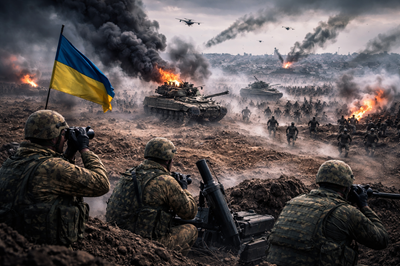
WAR-REPORT : The war in Ukraine has entered a renewed and volatile phase, as Russian forces escalate operations across multiple fronts in what analysts increasingly identify as the opening stage of a coordinated Spring–Summer 2026 offensive. According to Ukraine’s Commander-in-Chief, Oleksandr Syrskyi, the past week has seen a dramatic surge in ground assaults, reflecting a broader shift in battlefield tempo and strategic intent by Russia.
Between March 17 and March 20 alone, Russian forces launched an extraordinary 619 attacks across the theater—an intensity that underscores Moscow’s determination to regain momentum after months of grinding attritional warfare. These developments align with assessments from the Institute for the Study of War, which concluded that Russia has likely initiated its long-anticipated seasonal offensive targeting Ukraine’s heavily fortified defensive network, commonly referred to as the “Fortress Belt.”
A Surge in Attacks Across the Front
General Syrskyi’s briefing on March 23 painted a stark picture of the battlefield. Russian forces, he reported, have significantly intensified offensive operations across multiple sectors, employing a mix of mechanized assaults and infantry-led attacks. The sharp uptick in activity began around March 17, coinciding with increased movement of troops, armored vehicles, and artillery systems toward frontline positions.
The scale and coordination of these assaults suggest a deliberate effort to overwhelm Ukrainian defenses through sustained pressure. Rather than relying on rapid breakthroughs, Russian commanders appear to be adopting a strategy of incremental advances, accepting high casualties in exchange for limited territorial gains.
This approach reflects the evolving nature of the conflict. After more than two years of war, both sides have constructed extensive defensive positions, making large-scale offensives increasingly costly and difficult. In this context, Russia’s renewed push represents both a test of Ukrainian resilience and a gamble on its own ability to sustain prolonged combat operations.

The Role of Weather and Tactical Adaptation
One of the more notable aspects of Russia’s current strategy is its apparent reliance on environmental conditions to offset Ukrainian technological advantages. Syrskyi indicated that Russian military planners are counting on deteriorating spring weather—particularly fog and reduced visibility—to limit the effectiveness of Ukrainian drones and precision artillery.
Unmanned aerial systems have become a cornerstone of Ukraine’s defensive strategy, enabling real-time reconnaissance and targeted strikes against advancing forces. By launching assaults under conditions that degrade drone performance, Russian units aim to reduce their exposure and increase the chances of penetrating defensive lines.
This adaptation highlights the dynamic interplay between technology and tactics in modern warfare. As each side develops new capabilities, the other seeks ways to counter them, resulting in a continuous cycle of innovation and adjustment.

Heavy Losses and Unsustainable Casualty Rates
Despite the intensity of the offensive, the human cost for Russian forces has been staggering. According to Syrskyi, Russia suffered more than 6,090 killed and wounded during the four-day period from March 17 to March 20—an average of approximately 1,520 casualties per day. Over the course of the entire week, Russian losses reportedly reached 8,710 troops.
Such figures, if accurate, represent one of the highest casualty rates observed in recent months. They also raise serious questions about the sustainability of Russia’s current approach. High-intensity assaults that rely heavily on infantry can achieve short-term gains but often come at a steep cost in manpower.
Analysts warn that these losses could strain Russia’s recruitment system, which has already been under pressure. While Moscow has implemented various measures to replenish its ranks—including financial incentives and expanded conscription efforts—the pace of attrition may outstrip the rate at which new soldiers can be trained and deployed.
Over the medium to long term, this imbalance could degrade Russia’s operational effectiveness, limiting its ability to conduct large-scale offensives and forcing a shift toward more defensive or limited engagements.
The “Fortress Belt” and Strategic Objectives
At the center of Russia’s offensive is Ukraine’s “Fortress Belt,” a series of heavily fortified positions designed to slow and repel advancing forces. This defensive network includes trenches, bunkers, anti-tank obstacles, and layered artillery coverage, making it one of the most formidable barriers on the battlefield.
The ultimate objectives of the offensive appear to include key urban centers such as Slovyansk and Kramatorsk. Both cities hold strategic and symbolic significance, serving as major logistical hubs and administrative centers in eastern Ukraine.
However, the Institute for the Study of War has expressed skepticism about Russia’s ability to achieve a decisive breakthrough in 2026. While incremental gains are possible, the combination of strong defenses and high casualty rates is likely to limit the scope of Russian advances.
Managing Expectations at Home
Even as the offensive unfolds, Russian officials are preparing the domestic audience for a prolonged and costly campaign. A deputy in the Russian State Duma recently acknowledged that all wars involve casualties, emphasizing that Russian forces would aim to advance at a “leisurely pace” to minimize losses.
This messaging reflects a broader effort by the State Duma and the Kremlin to manage public expectations. By framing slow progress as a deliberate strategy rather than a failure, officials seek to maintain support for the war despite mounting losses.
At the same time, the emphasis on minimizing casualties contrasts sharply with reports from the battlefield, where high attrition rates suggest that such goals may be difficult to achieve in practice.
Economic Pressures Beneath the Surface
Beyond the battlefield, the war is exerting increasing pressure on Russia’s economy. Speaking on March 23, Vladimir Putin acknowledged that the country’s Gross Domestic Product declined by 2.1 percent in January 2026 compared to the same period the previous year.
While Putin sought to project confidence, noting low unemployment and manageable inflation, underlying indicators point to structural challenges. Russia’s unemployment rate of 2.2 percent, for example, reflects not only economic stability but also significant labor shortages—particularly in industries affected by military mobilization.
These shortages are contributing to wage inflation, as employers compete for a shrinking pool of workers. In turn, rising wages are feeding into broader inflationary pressures, complicating efforts to stabilize the economy.
Energy Revenues and Strategic Calculations
One area where Russia continues to benefit is the global energy market. Rising oil and gas prices, driven in part by geopolitical tensions in the Middle East, have provided Moscow with a valuable source of revenue. Putin has urged Russian energy companies to use these windfalls to reduce their debt burdens and strengthen financial stability.
This reliance on energy exports underscores the dual nature of Russia’s economic situation. On one hand, high prices provide short-term relief and support government spending. On the other hand, dependence on volatile global markets introduces uncertainty and limits long-term growth prospects.
Notably, Putin’s remarks also highlighted the impact of international sanctions. While the Kremlin has often downplayed their effects, the acknowledgment of economic challenges suggests that sanctions, combined with the costs of war, are taking a tangible toll.
The Broader Strategic Picture
The convergence of intensified military operations and economic strain presents a complex strategic landscape. For Russia, the current offensive represents an opportunity to regain the initiative and achieve tangible gains on the battlefield. However, it also carries significant risks, particularly if high casualty rates and economic pressures prove unsustainable.
For Ukraine, the challenge lies in maintaining defensive cohesion under relentless pressure. The effectiveness of its fortified positions, combined with continued support from international partners, will be critical in determining the outcome of the offensive.
The broader implications extend beyond the immediate conflict. The war in Ukraine remains a focal point of global geopolitics, influencing energy markets, security alliances, and international norms.
Outlook for the Coming Months
As spring transitions into summer, the trajectory of the conflict will depend on several key factors:
- Sustainability of Russian operations: Can Moscow maintain the current pace of assaults without exhausting its manpower and resources?
- Effectiveness of Ukrainian defenses: Will the Fortress Belt hold, or will Russian forces achieve localized breakthroughs?
- External influences: How will global economic conditions and geopolitical developments shape the strategic environment?
While it is too early to predict the outcome of the offensive, current indicators suggest a continuation of high-intensity, attritional warfare. Gains are likely to be measured in kilometers rather than sweeping advances, and the human and economic costs will remain significant.
Our Media Opinion
The intensification of Russia’s Spring–Summer 2026 offensive marks a critical juncture in the war in Ukraine. With hundreds of attacks launched in a matter of days and thousands of casualties reported, the scale of the fighting underscores the enduring brutality of the conflict.
At the same time, the economic pressures facing Russia highlight the interconnected nature of modern warfare, where battlefield dynamics and financial stability are deeply intertwined. As both sides navigate this challenging phase, the coming months will be pivotal in shaping the future of the conflict—and its impact on the wider world.
In this War of endurance and strategy, victory may not be defined by rapid advances, but by the ability to sustain effort, adapt to changing conditions, and outlast the opponent in a war that shows no sign of ending soon.