

Chinese Vessel Incursions Are Reshaping Security Around Taiwan 2026
By Samir Singh 'Bharat': Editor In Chief

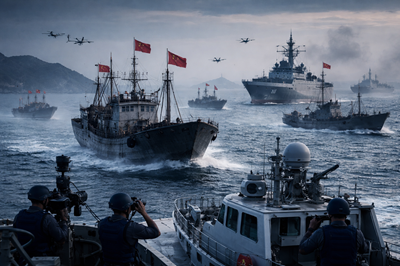
WAR-REPORT : The steady rise in maritime incursions by vessels linked to the People’s Republic of China is emerging as one of the most complex and concerning security challenges in the Indo-Pacific region. Nowhere is this trend more evident than around Taiwan and its vulnerable outlying islands, where unconventional maritime tactics are increasingly blurring the line between civilian and military operations.
According to findings released in October 2025 by Taiwan’s National Security Bureau, Beijing has adopted a wide range of covert and deceptive methods to intrude into restricted waters near Kinmen, a strategically sensitive island just kilometers off China’s coast. These operations are not isolated incidents but part of a broader, evolving strategy designed to test Taiwan’s defenses, undermine its maritime sovereignty, and establish conditions for future escalation.
A New Kind of Maritime Threat
Unlike traditional naval confrontations, the current wave of incursions does not rely primarily on warships or overt military force. Instead, the PRC is deploying a hybrid approach that leverages fishing vessels, commercial ships, and other civilian platforms as tools of statecraft. These vessels often operate under false identities, manipulate tracking systems, or blend seamlessly into legitimate maritime traffic—a tactic known as “mixed navigation.”
This strategy makes detection and attribution significantly more difficult. When a vessel appears to be a harmless fishing boat but is in fact conducting surveillance or probing defenses, it creates ambiguity that complicates response decisions. Should authorities treat it as a civilian entity or a state-backed asset? This uncertainty is precisely what makes the tactic effective.
The waters around Kinmen have become a testing ground for such operations. Located just off the coast of China’s Fujian Province, Kinmen occupies a uniquely sensitive position. Its proximity to the mainland makes it highly susceptible to incursions, while its political status as part of Taiwan gives it immense symbolic and strategic value.


Eight Methods of Deception
Taiwan’s National Security Bureau has identified at least eight distinct methods used by PRC-linked vessels to infiltrate restricted waters. These include:
- Identity falsification: Ships altering registration details or using forged documentation.
- AIS manipulation: Disabling or spoofing Automatic Identification System signals to evade tracking.
- Mixed navigation: Blending into civilian shipping lanes to mask intent.
- Frequent flag switching: Changing national flags to obscure origin.
- Shadowing legitimate vessels: Using proximity to other ships as cover.
- Erratic movement patterns: Mimicking fishing or commercial behavior while conducting surveillance.
- Use of dual-purpose vessels: Ships equipped for both civilian and intelligence roles.
- Coordinated swarm activity: Multiple vessels operating together to overwhelm monitoring systems.
Each of these methods individually presents a challenge. Combined, they create a highly adaptive and resilient system of maritime intrusion that is difficult to counter using conventional tools.

Beyond Kinmen: A Regional Pattern
The phenomenon is not confined to Kinmen or even to Taiwan’s immediate waters. Reports from the Coast Guard Administration highlight the scale of the issue. In 2024 alone, Taiwan expelled over 1,100 PRC fishing vessels from its waters—an extraordinary figure that underscores the persistence and intensity of these incursions.
This pattern extends into the South China Sea, where overlapping territorial claims and strategic competition have created a volatile environment. Here, PRC vessels—often described as part of a “maritime militia”—operate alongside coast guard ships and naval forces, forming a layered approach to asserting control.
These activities serve multiple purposes. On the surface, they allow China to maintain a constant presence in contested areas without triggering outright military confrontation. At a deeper level, they help normalize such presence, gradually shifting the status quo in Beijing’s favor.
Gray Zone Warfare in Action
Security analysts frequently describe these tactics as “gray zone” operations—actions that fall below the threshold of conventional warfare but still achieve strategic objectives. By operating in this ambiguous space, the PRC can exert pressure without provoking a full-scale military response.
Gray zone tactics are particularly effective in maritime environments. The vastness of the ocean, combined with the complexity of international maritime law, creates opportunities for plausible deniability. When a fishing vessel crosses into restricted waters, it can be dismissed as an accident. When hundreds do so repeatedly, the pattern becomes harder to ignore—but still difficult to counter decisively.
For Taiwan, this presents a persistent dilemma. Responding too aggressively risks escalation, while a passive approach may embolden further incursions. The challenge lies in striking a balance between deterrence and restraint.
Strategic Objectives Behind the Incursions
The use of disguised vessels is not random; it is part of a calculated strategy with several key objectives:
1. Surveillance and Intelligence Gathering
Many of these vessels are believed to be equipped with advanced sensors capable of monitoring military activity, mapping seabed conditions, and tracking communications. This information is invaluable for planning future operations.
2. Testing Response Capabilities
By repeatedly probing Taiwan’s defenses, PRC forces can identify weaknesses, response times, and patterns of behavior. This data can be used to refine tactics and improve operational effectiveness.
3. Psychological Pressure
Constant incursions create a sense of vulnerability and fatigue among defenders. Over time, this can erode morale and reduce the willingness to respond forcefully.
4. Legal and Political Signaling
Frequent presence in contested waters can be used to reinforce territorial claims. By acting as if these areas are under its jurisdiction, China seeks to reshape perceptions of sovereignty.
5. Preparing the Battlespace
In the event of a future conflict, having a network of vessels already operating in the area could provide logistical support, reconnaissance, and even direct assistance to military operations.
Implications for Regional Stability
The growing use of disguised maritime incursions has far-reaching implications beyond Taiwan. It challenges established norms of maritime conduct and increases the risk of miscalculation. A seemingly minor incident—such as a collision or confrontation—could quickly escalate into a broader crisis.
Neighboring countries are also affected. Nations in Southeast Asia, many of which have their own disputes with China in the South China Sea, face similar tactics. The normalization of such behavior could weaken international law and encourage other actors to adopt similar strategies.
Moreover, the involvement of civilian vessels complicates the application of traditional rules of engagement. Distinguishing between genuine fishermen and state-backed operatives is not always possible in real time, raising the risk of unintended consequences.
Policy Responses and Countermeasures
Addressing this challenge requires a multifaceted approach that combines technology, policy, and international cooperation.
Enhanced Maritime Domain Awareness
Investing in advanced surveillance systems—including satellite monitoring, radar networks, and artificial intelligence—can improve the ability to detect and track suspicious vessels.
Stronger Legal Frameworks
Clarifying rules regarding maritime conduct and establishing clear consequences for violations can help deter incursions. This may involve updating domestic laws as well as working through international institutions.
Interagency Coordination
Effective response requires close cooperation between military, coast guard, and intelligence agencies. Sharing information in real time can improve situational awareness and decision-making.
International Partnerships
Collaborating with allies and partners can amplify deterrence. Joint patrols, information sharing, and coordinated responses send a strong signal that such activities will not go unchallenged.
Targeted Sanctions and Accountability
Identifying and penalizing entities involved in covert operations can raise the cost of such behavior. This includes companies, organizations, and individuals linked to maritime militia activities.
The Road Ahead
The use of disguised vessels represents a significant evolution in maritime strategy. It reflects a broader shift toward hybrid and gray zone tactics that exploit ambiguity and avoid direct confrontation. For Taiwan and its partners, adapting to this new reality will require innovation, resilience, and sustained commitment.
As tensions in the Indo-Pacific continue to rise, the waters around Taiwan and the South China Sea are likely to remain a focal point of strategic competition. The challenge is not only to respond to current incursions but also to anticipate and counter future developments.
Ultimately, the stakes extend beyond regional security. The principles at play—freedom of navigation, respect for sovereignty, and adherence to international law—are foundational to the global order. How the international community responds to these challenges will shape the future of maritime governance in the 21st century.