



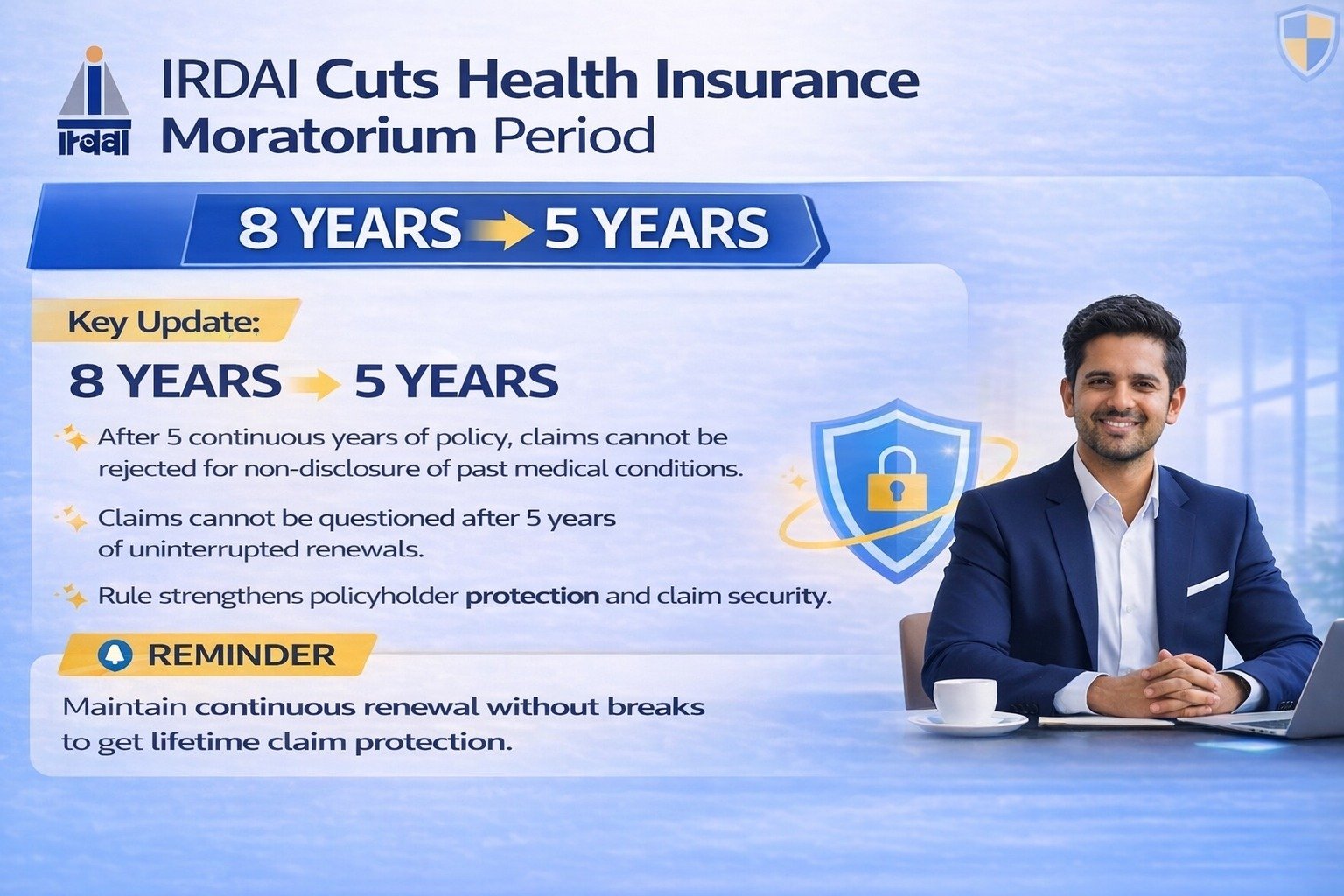
In a major regulatory shift aimed at enhancing consumer protection and improving trust in the insurance ecosystem, the IRDAI has reduced the moratorium period for health insurance policies from eight years to five years. The decision is being seen as a significant step toward making health insurance in India more transparent, reliable, and policyholder-friendly.
The reform comes at a time when rising healthcare costs and increasing awareness about financial planning have made health insurance an essential part of household security. By shortening the moratorium period, the regulator has attempted to address long-standing concerns related to claim rejections and disputes between insurers and customers.
Understanding the Moratorium Period in Health Insurance
The moratorium period is a critical concept in health insurance that determines how long an insurer can scrutinize a policyholder’s disclosures, particularly regarding pre-existing diseases. During this period, insurance companies retain the right to question or reject claims if they discover that the policyholder failed to disclose relevant medical information at the time of purchasing the policy.
Under the earlier framework, this period extended to eight continuous years. This meant that policyholders had to maintain uninterrupted coverage for nearly a decade before gaining full protection against claim rejections related to non-disclosure.IRDAI
With the latest reform, this duration has been reduced to five years, provided the policyholder renews the policy continuously without any lapse. After completing this period, insurers will no longer be allowed to deny claims on the basis of undisclosed pre-existing conditions or past medical history.IRDAI

This change fundamentally shifts the balance of power toward the consumer, reducing the prolonged uncertainty that policyholders previously faced.IRDAI
What the New Regulation Means for Policyholders
The revised rule introduces a clearer and more predictable framework for claim settlement. Once a policyholder completes five years of uninterrupted coverage, the insurance company loses the authority to question claims based on past omissions or misstatements related to health conditions.
In practical terms, this means that policyholders who remain consistent with their policy renewals can access full claim protection much earlier than before. The reduction of three years is not just a numerical change—it significantly lowers the risk window during which claims can be disputed.

For millions of policyholders, especially those from middle-income households, this translates into increased financial security and reduced anxiety during medical emergencies.
Strengthening Claim Security and Reducing Disputes
One of the biggest criticisms of the health insurance sector in India has been the frequency of claim rejections on technical grounds. Non-disclosure of pre-existing diseases—whether intentional or accidental—has often been used as a reason to deny claims, even after several years of policy coverage.
By reducing the moratorium period, IRDAI has effectively limited the timeframe within which insurers can raise such objections. This is expected to significantly reduce disputes between policyholders and insurance companies.
Moreover, the reform encourages insurers to conduct more thorough checks at the underwriting stage, rather than relying on post-claim investigations. This shift promotes accountability and ensures that policies are issued with greater clarity and accuracy from the outset.
Exceptions That Policyholders Must Understand
While the new rule enhances protection, it is not an absolute safeguard against all types of claim rejections. IRDAI has clearly stated that certain exceptions will continue to apply.
Insurance companies can still deny claims under the following circumstances:
-
Fraud or deliberate misrepresentation: If a policyholder intentionally provides false information or conceals critical health details, the insurer retains the right to reject claims even after the moratorium period.
-
Non-covered treatments: Claims related to treatments or procedures that are not included in the policy coverage will not be honored.
-
Violation of policy terms: Any breach of conditions specified in the policy document can lead to claim denial.
This means that while the reform provides stronger protection, it does not eliminate the need for honesty and careful understanding of policy terms.
Driving Consumer Confidence in the Insurance Sector
The decision to shorten the moratorium period is expected to have a positive impact on consumer sentiment. One of the primary reasons for low insurance penetration in India has been a lack of trust, driven by concerns over claim settlement practices.
By introducing a more consumer-friendly rule, IRDAI is signaling its commitment to protecting policyholders and ensuring fair treatment. This is likely to encourage more individuals to purchase health insurance policies and maintain them over the long term.
In particular, younger consumers—who often delay buying insurance—may now be more inclined to invest early, knowing that they can achieve full claim protection within five years.
Importance of Continuous Policy Renewal
A critical condition attached to the new rule is the requirement of uninterrupted coverage. Policyholders must renew their insurance policies on time every year to benefit from the reduced moratorium period.
Any lapse in renewal, even for a short duration, can reset the moratorium clock. This means that the five-year period will start again from the beginning, delaying eligibility for full protection.
This aspect cannot be overstated. Many policyholders underestimate the consequences of missing renewal deadlines, assuming that a brief gap will not have significant implications. In reality, such lapses can nullify years of accumulated benefits.
The new regulation, therefore, not only protects consumers but also encourages financial discipline and long-term planning.
Aligning India with Global Best Practices
The reduction of the moratorium period also brings India closer to international standards in health insurance regulation. In many developed markets, insurers are required to limit the duration during which claims can be contested based on disclosure issues.
By adopting a similar approach, IRDAI is aligning India’s insurance framework with global best practices, enhancing its credibility and attractiveness.
This move is also expected to improve India’s overall insurance penetration rate, which has historically been lower compared to global averages.
Impact on Insurance Companies
While the reform is largely beneficial for policyholders, it also has implications for insurance companies. With a shorter window to investigate disclosures, insurers may need to strengthen their underwriting processes.
This could lead to:
-
More detailed medical evaluations at the time of policy issuance
-
Stricter documentation requirements
-
Potential adjustments in premium pricing
Some experts believe that insurers may increase premiums slightly to offset the reduced risk assessment period. However, others argue that improved efficiency and reduced disputes could balance these costs in the long run.
Rising Healthcare Costs Make the Reform Timely
India is experiencing a steady increase in healthcare expenses, driven by factors such as medical inflation, advanced treatment options, and growing demand for quality healthcare services.
In this context, having a reliable health insurance policy is no longer optional—it is a necessity. The reduced moratorium period ensures that policyholders can access full benefits sooner, providing stronger financial protection during critical situations.
For families facing unexpected medical emergencies, this reform could make a significant difference in managing expenses and avoiding financial distress.
Expert Opinions and Industry Outlook
Industry experts have widely welcomed the decision, describing it as a progressive reform that addresses key pain points in the insurance sector.
According to analysts, the move will:
-
Reduce litigation and disputes related to claim rejections
-
Improve transparency in policy terms
-
Encourage long-term customer retention
-
Strengthen the overall credibility of the insurance industry
However, experts also caution that policyholders must not misinterpret the reform as a relaxation of disclosure requirements. Accurate and honest declaration of medical history remains essential.
What Policyholders Should Do Now
The new regulation creates an opportunity for policyholders to maximize their benefits—but only if they act responsibly.
Key steps include:
-
Purchasing health insurance at an early stage
-
Disclosing all relevant medical information accurately
-
Renewing policies on time without fail
-
Carefully reviewing policy terms and coverage details
Ignoring these basics can still result in claim rejection, regardless of the moratorium rule.