

China Raises Defense Budget Despite Slower Economic Growth 2026
By Samir Singh 'Bharat': Editor In Chief

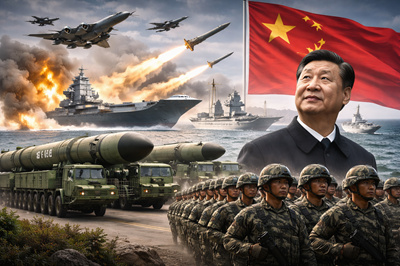
WAR-REPORT : The government of the People’s Republic of China has announced another increase in military spending, signaling Beijing’s continued focus on strengthening its armed forces even as the country faces slowing economic growth. The proposed defense budget for 2026 highlights the leadership’s determination to advance military modernization and reinforce strategic priorities, particularly regarding tensions with Taiwan and regional security dynamics.
The new budget proposal was introduced during the country’s annual legislative gathering known as the Two Sessions, where policymakers outline major economic and political plans for the coming year. According to officials from the Ministry of Finance of the People’s Republic of China, Beijing plans to allocate approximately 278 billion US dollars to defense spending in 2026.
Although the increase is slightly smaller than in recent years, it continues a long-term pattern of sustained military investment. Analysts say the budget reflects the strategic importance that China’s leadership places on the modernization of the People’s Liberation Army and its expanding global ambitions.
Defense Budget Growth Continues Despite Slower Economy
The proposed military budget represents an increase of roughly 7 percent compared with the 2025 defense allocation. This rise is marginally lower than the 7.2 percent annual increases recorded during the previous three years, but it remains substantial given the broader economic context.
China’s economy has been experiencing slower expansion, prompting the government to set a growth target of between 4.5 and 5 percent for 2026. According to economists, this target represents the lowest growth goal since 1991, reflecting structural challenges in the country’s economy, including a struggling property sector, demographic shifts, and global trade uncertainties.

Despite these economic pressures, Beijing has chosen to maintain steady increases in defense spending. The decision highlights the central role of military development within China’s national strategy.
By continuing to allocate significant resources to the armed forces, Chinese leaders appear determined to maintain the pace of modernization across all branches of the People’s Liberation Army, including naval expansion, advanced missile capabilities, cyber warfare units, and space-based military technologies.
Xi Jinping Links Military Strength to Party Leadership
During a plenary session on March 7 involving members of the People’s Liberation Army and the People’s Armed Police, Chinese leader Xi Jinping emphasized the ideological and political foundations of military modernization.

Xi, who also serves as chairman of the Central Military Commission, argued that strengthening the armed forces is inseparable from reinforcing the authority of the Chinese Communist Party.
During the meeting, Xi highlighted key political concepts that have become central to his leadership doctrine. Among these were the “two establishes,” which affirm Xi’s position as the core leader of both the party and the military, and the “two safeguards,” which stress the need to protect that leadership.
Another principle emphasized during the meeting was the Chairman Responsibility System of the Central Military Commission. Under this framework, Xi holds ultimate authority over military decision-making, reinforcing a centralized chain of command within China’s armed forces.
Observers say these ideological themes demonstrate how closely the Chinese leadership links military strength with political loyalty. In Beijing’s view, the armed forces are not only a national defense institution but also a critical pillar of the Communist Party’s rule.
Anti-Corruption Campaign Reshaping the Military
Over the past several years, Xi Jinping has conducted a sweeping anti-corruption campaign within the military establishment. The campaign has resulted in the removal or investigation of numerous senior officers within the People’s Liberation Army.
Analysts believe the initiative serves multiple purposes. On one level, it addresses longstanding corruption issues that have affected procurement, promotions, and internal discipline within the armed forces.
At the same time, many observers view the campaign as a political strategy aimed at consolidating Xi’s control over the military and reducing the influence of rival factions within the Chinese Communist Party.
By reshaping the leadership structure of the People’s Liberation Army, Xi appears to be ensuring that the armed forces remain firmly aligned with his vision for China’s future and loyal to the party’s central leadership.
Tougher Language Toward Taiwan
In addition to announcing new defense spending levels, Chinese officials used stronger language regarding Taiwan in the government’s annual work report.
The Government Work Report is a key policy document presented during the Two Sessions, outlining Beijing’s priorities across economic, social, and foreign policy domains.
In previous versions of the report, officials stated that China would “oppose Taiwan independence.” However, the 2026 document replaces that phrase with a more aggressive formulation: “crack down on Taiwan independence.”
The shift in wording has attracted considerable attention from political analysts and regional governments. Many interpret the language change as a signal that Beijing is prepared to adopt a more assertive approach toward the island.
Rising Tensions Since Taiwan’s 2024 Election
Relations between Beijing and Taiwan have become increasingly strained following the election of William Lai Ching-te, who took office in May 2024.
Chinese authorities have repeatedly described Lai as a “separatist” leader, accusing him of promoting policies that challenge Beijing’s claim over the island. Taiwan’s government rejects these accusations and maintains that the island’s future should be determined democratically by its own citizens.
Since Lai assumed office, the People’s Liberation Army has intensified military activities around the island, including naval exercises, missile tests, and aerial patrols.
These operations are widely viewed as part of a broader strategy of military coercion designed to pressure Taiwan politically while signaling China’s readiness to enforce its territorial claims.
PLAAF Activity Near Taiwan Temporarily Declines
Despite the increasingly confrontational rhetoric, recent developments have introduced a surprising element into the military situation around Taiwan.
The People’s Liberation Army Air Force has sharply reduced its activity near the island since late February. For several years, Chinese military aircraft have conducted frequent flights into Taiwan’s Air Defense Identification Zone, an area where aircraft are monitored for potential security threats.
These flights have become a routine feature of the regional security environment. In fact, the number of incursions has risen dramatically in recent years.
Since 2023, the People’s Liberation Army Air Force has carried out near-daily sorties into Taiwan’s ADIZ, often involving multiple aircraft and coordinated maneuvers.
However, according to reports from the Taiwan Ministry of National Defense, the situation changed abruptly after February 27.
Between February 27 and March 11, Chinese aircraft were absent from Taiwan’s ADIZ on 11 out of 13 days, a notable departure from previous patterns.
A Rare Pause in Military Flights
During the two days when aircraft did enter the zone, activity remained minimal. The People’s Liberation Army Air Force conducted only two sorties on March 6 and three on March 11.
Perhaps even more striking was a seven-day period between February 27 and March 5 when no Chinese aircraft were detected near Taiwan. According to defense analysts, this represents the longest pause in such operations since 2021.
The absence of regular flights has raised questions among observers about whether Beijing may be adjusting its strategy or preparing for a different form of military signaling.
Understanding China’s ADIZ Strategy
China’s aerial operations around Taiwan serve multiple strategic purposes.
One objective is to normalize a high level of military presence in the region. By conducting frequent patrols and incursions, the People’s Liberation Army aims to gradually shift the status quo and make its presence around the island appear routine.
Another goal is to test Taiwan’s air defense response times and operational readiness. Each incursion forces Taiwanese authorities to scramble aircraft and monitor incoming threats, placing strain on the island’s defense resources.
In addition, the flights often function as political signals. Beijing has previously increased the number of sorties following diplomatic developments or political events that it views as unfavorable.
Taiwan Warns Against Complacency
Despite the recent reduction in Chinese air activity, officials in Taiwan have cautioned against interpreting the pause as a sign of de-escalation.
Wellington Koo warned that Taiwan’s military must remain vigilant and prepared for any potential developments.
He emphasized that a temporary lull in flights does not necessarily indicate a shift in Beijing’s long-term strategy.
“Taiwan should not let its guard down,” Koo said, stressing that China’s broader military modernization and regional ambitions remain unchanged.
A Changing Strategic Landscape
Taken together, the developments surrounding China’s defense budget, political messaging, and military operations illustrate the complex dynamics shaping security in East Asia.
The steady growth of China’s military spending reflects a long-term commitment to expanding the capabilities of the People’s Liberation Army, even in the face of economic challenges.
At the same time, the tougher language regarding Taiwan suggests that Beijing is prepared to increase political pressure and potentially intensify coercive measures.
The temporary reduction in People’s Liberation Army Air Force activity near Taiwan adds another layer of uncertainty, leaving analysts to speculate about Beijing’s next moves.
Own Opinion
China’s decision to raise its defense budget once again underscores the importance of military power within its national strategy.
Under the leadership of Xi Jinping, the modernization of the People’s Liberation Army remains a central priority, closely tied to the authority of the Chinese Communist Party.
At the same time, tensions surrounding Taiwan continue to shape the regional security environment.
Whether the recent pause in Chinese military flights represents a temporary adjustment or a sign of broader strategic recalibration remains uncertain. What is clear, however, is that the evolving relationship between Beijing and Taipei will remain one of the most closely watched geopolitical issues in the years ahead.