

7 Powerful Lessons From Ukraine’s Counter-Drone War Now Headed to the Middle East
By Samir Singh 'Bharat': Editor In Chief
 war-times.com
Send an email
9 March 2026
war-times.com
Send an email
9 March 2026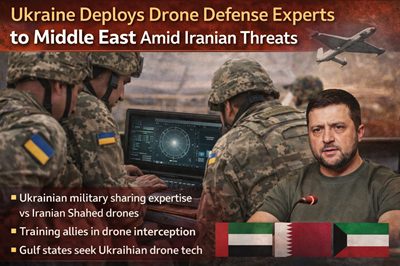
WAR-REPORT : Kyiv: Ukraine is preparing to send a group of military experts and defense specialists to the Middle East in a move that highlights the growing global importance of Ukraine’s battlefield experience in countering Iranian-made drones. The initiative reflects how lessons learned during the ongoing war with Russia are increasingly shaping international defense strategies.
According to Ukrainian officials, the experts will share operational knowledge on detecting, intercepting, and destroying hostile aerial threats, particularly the Iranian-designed Shahed drones that have been widely used in modern conflicts. The deployment underscores the strategic value of Ukraine’s experience after years of defending its cities and infrastructure from large-scale drone attacks.
The announcement was made by Ukrainian President Volodymyr Zelensky on March 8. Zelensky confirmed that an unspecified number of Ukrainian military personnel with specialized expertise would depart the country on March 9 to train partners in the Middle East.
Their mission will focus on helping regional allies improve their defenses against drone strikes, cruise missiles, and other aerial threats.
Sharing Battlefield Knowledge With Allies
Ukraine has become one of the world’s most experienced countries in defending against Iranian-made drones due to the intense use of such weapons during the war with Russia. The Iranian-origin Shahed drones have repeatedly targeted Ukrainian power plants, military facilities, and civilian infrastructure.

Through years of constant defense, Ukrainian forces have developed a sophisticated system for identifying and intercepting these threats.
President Zelensky emphasized that Ukraine is ready to share this knowledge with international partners, particularly the United States and its allies in the Middle East, who are increasingly concerned about similar drone threats.
According to Zelensky, Ukraine’s experience could significantly strengthen regional air defense systems and provide valuable insights into combating Iranian technology.

Growing Concern Over Iranian Drone Warfare
The Iranian-made Shahed drone has become one of the most widely discussed weapons of the modern battlefield. These drones are designed as low-cost loitering munitions capable of flying long distances before striking their targets.
Their relatively cheap production cost combined with their ability to overwhelm air defense systems has made them attractive to several countries and armed groups.
In the war in Ukraine, Russia has used Shahed drones extensively in attempts to weaken Ukrainian infrastructure and drain Ukrainian air defense resources.
Ukraine’s military has therefore spent years refining strategies to intercept these drones quickly and efficiently.
Experts say this experience now provides Ukraine with unique operational knowledge that many countries are eager to learn.
Cooperation With Middle Eastern Partners
In recent days, Zelensky has engaged in diplomatic discussions with several leaders in the Middle East to discuss regional security challenges and Ukraine’s potential role in helping address them.
Among the leaders he spoke with were Hamad bin Isa Al Khalifa and Mohammed bin Salman.
The conversations focused on sharing insights into how nations can defend themselves against Iranian missile and drone threats.
Officials say Ukraine’s experience in managing large-scale drone attacks has attracted interest from several Gulf states seeking to improve their defense capabilities.
Three countries in particular are believed to be exploring closer cooperation with Ukraine: the United Arab Emirates, Qatar, and Kuwait.
These countries are reportedly interested not only in training but also in purchasing Ukrainian-designed interceptor drones.
Demand for Ukrainian Interceptor Drones
The growing demand for Ukrainian counter-drone technology highlights how Ukraine’s defense industry has evolved during the war.
Several Ukrainian companies have developed specialized interceptor drones designed to detect and destroy hostile unmanned aerial vehicles before they reach their targets.
One of the most prominent manufacturers is SkyFall, which has become a key producer of drone interception technology.
According to company representatives, SkyFall has the capacity to produce up to 50,000 interceptor drones each month.
Despite the heavy demands of Ukraine’s own military operations, the company estimates it could export between 5,000 and 10,000 units monthly while still meeting domestic needs.
Such production levels could make Ukrainian drones a major component of future air defense systems in multiple countries.
Expanding Defense Manufacturing
Another important player in Ukraine’s rapidly growing defense sector is TAF Industries.
The company’s head, Oleksandr Yakovenko, confirmed that several Gulf states have already expressed interest in importing Ukrainian interceptor drones.
Yakovenko stated that the UAE, Qatar, and Kuwait have all requested information or initiated discussions regarding potential purchases.
However, he also noted that deploying the technology effectively requires trained personnel.
Training drone interceptor operators can take several months, making it one of the biggest challenges for countries adopting the system.
Because of this, Ukraine’s decision to send military experts to the region could significantly accelerate the process.
Institutional Knowledge From Years of War
Ukraine’s ability to export advanced counter-drone systems is rooted in the country’s extensive battlefield experience.
Since the start of the war with Russia, Ukrainian engineers and military strategists have continuously improved their technology based on real combat conditions.
Unlike many weapons systems developed in laboratories, Ukrainian drone defense technology has been tested repeatedly in active warfare.
This process has allowed companies and military units to refine tactics, improve detection systems, and develop new interception methods.
Over time, Ukraine has institutionalized these lessons, integrating them into its defense doctrine and training programs.
As a result, Ukrainian forces have become highly efficient at countering Iranian-origin weapons systems.
Strategic Importance for the United States
Ukraine’s expertise may also benefit the United States and its broader network of allies.
American military planners have closely observed the evolution of drone warfare in Ukraine, viewing it as a preview of future conflicts.
Iranian drones and missile technologies have already appeared in several regions, including the Middle East.
By studying Ukraine’s defensive strategies, the United States and its partners can better prepare for potential threats.
Sharing operational knowledge with allied nations could also help build a more coordinated regional air defense network.
Middle East Security Landscape
The Middle East remains one of the most strategically sensitive regions in the world, with multiple states facing threats from missile and drone attacks.
Iran has been accused by Western governments of providing drones and related technology to various groups across the region.
These weapons have been used in attacks on infrastructure, military bases, and commercial shipping.
As a result, many countries in the Gulf are investing heavily in advanced air defense systems.
Ukraine’s experience in countering similar threats has therefore become highly relevant.
By combining Western air defense technology with Ukrainian operational expertise, regional allies hope to create stronger protection against future attacks.
Economic Opportunities for Ukraine
Beyond the military benefits, the cooperation could also provide economic advantages for Ukraine.
The country’s defense industry has expanded rapidly since the beginning of the war, with dozens of companies developing new technologies.
Exporting drone interception systems could become a major source of revenue for Ukrainian manufacturers.
Such exports would also strengthen Ukraine’s strategic partnerships with countries outside Europe.
In the long term, this could help Ukraine build a more resilient defense industrial base capable of supporting both domestic and international security needs.
The Future of Drone Warfare
The increasing interest in Ukrainian counter-drone systems reflects a broader shift in modern warfare.
Drones have become one of the most influential technologies on the battlefield, capable of performing reconnaissance, delivering explosives, and overwhelming traditional defenses.
As a result, counter-drone capabilities are becoming just as important as offensive drone systems.
Countries around the world are racing to develop technologies that can detect, track, and destroy unmanned aerial vehicles quickly and cheaply.
Ukraine’s experience in this field has made it one of the global leaders in practical drone defense solutions.
A New Role for Ukraine on the Global Stage
Ukraine’s decision to share its expertise with Middle Eastern allies represents a new phase in the country’s international role.
Rather than being only a recipient of military aid, Ukraine is increasingly becoming a provider of valuable security knowledge.
Its battlefield innovations are now influencing defense strategies far beyond Eastern Europe.
As Ukrainian experts arrive in the Middle East to train partner nations, their work could help reshape regional defense systems and improve protection against emerging aerial threats.
In a world where drone warfare is rapidly expanding, Ukraine’s hard-earned experience may prove crucial in helping allied nations prepare for the conflicts of the future.
war-times.com
Send an email
9 March 2026