

7 Critical Facts About Mojtaba Khamenei Becoming Iran’s Supreme Leader After Historic Power Shift
By Samir Singh 'Bharat': Editor In Chief
 war-times.com
Send an email
9 March 2026
war-times.com
Send an email
9 March 2026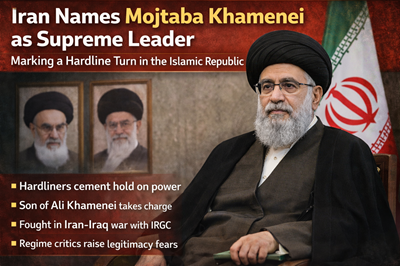
WAR-REPORT : Tehran: Iran has entered a new and uncertain political chapter after the country’s powerful clerical body, the Assembly of Experts, selected Mojtaba Khamenei as the next Supreme Leader on March 8. The decision follows the death of the long-time leader Ali Khamenei and marks one of the most consequential transitions of power in the history of the Islamic Republic.
The appointment has immediately sparked intense debate both within Iran and internationally. Supporters among conservative and hardline factions see Mojtaba Khamenei as a figure capable of maintaining ideological continuity and defending the revolutionary system. Critics, however, warn that the decision may deepen divisions inside the regime and reinforce accusations that Iran’s leadership structure is moving toward hereditary rule.
Mojtaba Khamenei’s rise to the country’s highest political and religious office represents a significant victory for the hardline factions within the Iranian establishment. His political outlook, shaped by decades of association with security institutions and conservative clerical networks, suggests that Iran’s domestic and foreign policies are unlikely to shift dramatically from the trajectory established during his father’s rule.
A Rapid Leadership Transition
The selection of Mojtaba Khamenei occurred during an emergency session of the Assembly of Experts, the body constitutionally responsible for appointing and supervising Iran’s Supreme Leader. The assembly consists of senior clerics who hold the authority to select a successor when the leadership position becomes vacant.
According to analysts and political observers, the speed with which the assembly moved to appoint a successor was deliberate. Several prominent conservative members reportedly pushed for a swift decision to prevent prolonged debate or political maneuvering among rival factions.

Hardline cleric Mohammad Mehdi Mir Bagheri was among those advocating for an immediate appointment. Analysts believe that accelerating the process reduced the chances for opposition figures within the political system to mobilize against Mojtaba’s candidacy.
By securing the leadership quickly, conservative clerics and influential security officials ensured continuity within the state’s most powerful institutions.
Mojtaba Khamenei’s Background
Born in Tehran in 1969, Mojtaba Khamenei grew up in the center of Iran’s revolutionary elite. As the second son of Ali Khamenei, he was raised during the early years of the Islamic Republic, a period marked by political upheaval and war.

His formative years were heavily influenced by the Iran–Iraq War, a conflict that shaped the worldview of many Iranian political and military leaders.
During the war, Mojtaba served in the Habib Ibn Mazahir Battalion, which operated under the 27th Mohammad Rasoul Allah Division. The battalion became known for its intense combat operations and close ties to revolutionary institutions.
Many veterans of the unit later rose to prominent roles within Iran’s security establishment, particularly in the Islamic Revolutionary Guard Corps.
These wartime connections proved invaluable for Mojtaba’s later political influence. Several former comrades eventually held senior positions in the IRGC’s intelligence and security networks, creating a powerful circle of allies around him.
Influence Within Iran’s Security Apparatus
Over the years, Mojtaba Khamenei gradually developed strong relationships with figures inside the Islamic Revolutionary Guard Corps and the Office of the Supreme Leader.
One of his most notable allies was Hossein Taeb, who served as the head of the IRGC Intelligence Organization for many years. Taeb’s influence in Iran’s security community helped strengthen Mojtaba’s connections within the intelligence establishment.
Through these relationships, Mojtaba gained significant informal influence in Iran’s political system long before officially assuming the leadership role.
Observers have frequently described him as a behind-the-scenes power broker who played a role in shaping major political decisions.
Role in the 2009 Presidential Election
Mojtaba Khamenei’s political prominence became particularly visible during the controversial 2009 Iranian presidential election.
The election resulted in the victory of hardline president Mahmoud Ahmadinejad, a result that triggered widespread protests across Iran.
Millions of Iranians took to the streets in what became known as the Green Movement, accusing the government of election fraud and demanding political reforms.
According to numerous reports and analyses, Mojtaba played a key role in supporting Ahmadinejad’s campaign and consolidating conservative support behind him.
Following the election, the government launched a large-scale crackdown on demonstrators. The paramilitary volunteer force known as the Basij was heavily involved in suppressing protests.
Reports from political analysts and opposition groups claim that Mojtaba was instrumental in directing the Basij and coordinating the regime’s response to the protests.
The crackdown successfully restored government control but left a lasting impact on Iran’s political landscape.
International Reaction
Mojtaba’s elevation to the Supreme Leadership has also drawn reactions from international figures.
Former U.S. President Donald Trump told Axios in early March that Mojtaba Khamenei would be an “unacceptable” choice to lead Iran.
Trump’s remarks reflect longstanding tensions between Washington and Tehran, as well as concerns among Western policymakers that Mojtaba’s leadership could reinforce Iran’s confrontational foreign policy.
Many international analysts expect relations between Iran and Western nations to remain strained under Mojtaba’s rule.
Questions of Legitimacy
Despite securing the support of influential institutions, Mojtaba Khamenei faces significant challenges in establishing his legitimacy.
Unlike many senior clerics who have held prominent religious positions for decades, Mojtaba is considered a mid-level cleric. His religious credentials have been questioned by several scholars and senior figures within the clerical establishment.
Some critics argue that his scholarly achievements do not match the expectations traditionally associated with the Supreme Leadership.
Ironically, Ali Khamenei himself faced similar skepticism when he became Supreme Leader in 1989, as he was also regarded as a relatively mid-ranking cleric at the time.
However, over the decades, Ali Khamenei consolidated power through alliances with security institutions and political elites. Mojtaba may attempt to follow a similar path.
Concerns Over Hereditary Rule
Another major controversy surrounding Mojtaba’s appointment is the perception that Iran’s leadership system may be evolving into a hereditary structure.
Since Mojtaba is the son of the previous Supreme Leader, critics have argued that his selection resembles dynastic succession rather than the merit-based selection envisioned by the Islamic Republic’s founders.
Ironically, Ali Khamenei himself was reportedly opposed to hereditary succession during his lifetime.
Nevertheless, the decision by the Assembly of Experts has intensified debates about the future of Iran’s political system and the balance of power among its institutions.
Rival Political Factions
The leadership transition also reflects deep rivalries within Iran’s political elite.
Several pragmatic or moderate figures were reportedly exploring alternative candidates for the position.
Among them was Ali Larijani, the secretary of Iran’s Supreme National Security Council. According to reports from opposition media outlets, Larijani favored his brother, Sadegh Amoli Larijani, as a potential successor.
If Sadegh Amoli Larijani had become Supreme Leader, it would likely have increased Ali Larijani’s influence within the government.
These internal rivalries illustrate the complex power dynamics that shape Iranian politics.
Iran’s Fractured Political Landscape
Mojtaba Khamenei assumes leadership at a time when the Islamic Republic is facing multiple crises.
Internally, the country has experienced waves of protests driven by economic hardship, political grievances, and social tensions.
Externally, Iran remains under heavy international sanctions and continues to face diplomatic isolation from many Western countries.
The new leader will need to navigate these challenges while maintaining unity among Iran’s powerful institutions.
Support from the Revolutionary Guard
One factor that could strengthen Mojtaba’s position is his relationship with the Islamic Revolutionary Guard Corps.
The IRGC is not only a military organization but also a powerful political and economic force within Iran.
Reports from anti-regime media outlets suggest that elements within the IRGC supported Mojtaba’s candidacy for Supreme Leader.
If true, such backing could provide him with a crucial base of power as he attempts to consolidate his authority.
The Road Ahead
Mojtaba Khamenei’s leadership will likely shape Iran’s domestic and foreign policy for years to come.
His political ideology is closely aligned with the conservative revolutionary principles championed by his father.
Analysts therefore expect continuity in several areas, including Iran’s regional strategy, support for allied militant groups, and resistance to Western influence.
At the same time, Mojtaba must navigate a deeply divided political environment and demonstrate that he can govern effectively.
A Defining Moment for Iran
The appointment of Mojtaba Khamenei marks one of the most significant moments in the history of the Islamic Republic.
For supporters of the regime, it represents continuity and stability in a time of uncertainty.
For critics, it raises troubling questions about the future direction of Iran’s political system.
As Mojtaba begins his tenure as Supreme Leader, both domestic and international observers will closely watch how he handles the immense responsibilities of the position.
Whether he succeeds in consolidating power and unifying Iran’s fractured leadership remains one of the most important questions facing the country today.
war-times.com
Send an email
9 March 2026