

NHRC marks 32 years, focuses on human rights of prisoners
By Doruvu Paul Jagan Babu: Assistant Chief Editor

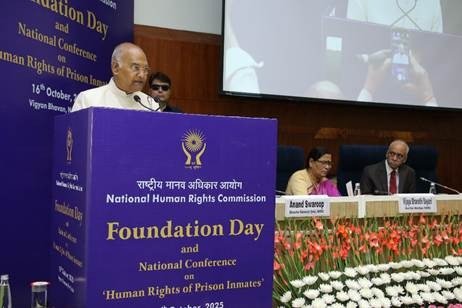
New Delhi: The National Human Rights Commission (NHRC), India, celebrated its 32nd Foundation Day on Thursday at Vigyan Bhawan, New Delhi, with a national conference on “Human Rights of Prison Inmates.” Former President of India Ram Nath Kovind, addressing the gathering as Chief Guest, underscored that the protection of human rights is not merely a legal obligation but a spiritual and moral duty deeply rooted in India’s civilisational ethos.
Kovind calls for compassion and dignity in justice system
Speaking on the theme, Kovind reflected on India’s ancient tradition of compassion and justice, remarking that “long before the modern articulation of human rights, our sages and scriptures spoke of the duty to uphold dharma and ensure justice.” He described NHRC’s 32-year journey as a testament to India’s commitment to liberty, equality, and fraternity, saying the Commission has “given voice to the voiceless and brought human rights concerns into the heart of governance.”
Highlighting the plight of workers in the informal sector—drivers, sanitation workers, and migrant labourers—Kovind said their human rights are often at risk due to unsafe working conditions and lack of social protection. “As their labour sustains our growth, their welfare and dignity must define our success,” he asserted.
He also drew attention to climate change-induced displacement, calling for policies that ensure identity, security, and essential services for affected populations. Kovind lauded NHRC’s advisories on mental health, urging society to recognise mental well-being as a human right.

Emphasis on prison reforms and rehabilitation
Referring to the day’s theme, Kovind said that the treatment of prison inmates is a true test of a society’s values. He stressed that prisons should evolve into “spaces of reform, rehabilitation, and hope,” where inmates are treated with dignity and given opportunities for reintegration. Commending NHRC for organizing the conference, he urged prison officials to adopt gender-sensitive and child-friendly practices within correctional facilities.
He also acknowledged government efforts over the years to improve citizens’ lives through access to sanitation, healthcare, education, and housing—calling these essential elements of human rights. He praised landmark legislations like the Mental Healthcare Act, 2017 and the Transgender Persons (Protection of Rights) Act, 2019, describing them as milestones in India’s human rights journey.

‘Rights come with duties,’
Reaffirming the spirit of the Constitution, Kovind reminded that rights must be exercised with responsibility. “Safeguarding human rights is not just NHRC’s responsibility—it is our collective duty,” he said, urging citizens to strive toward a more humane and inclusive India reflecting the ideal of Sarve Bhavantu Sukhinah (May all be happy).
NHRC Chairperson highlights achievements and global role
NHRC Chairperson Justice V Ramasubramanian outlined the Commission’s work over the last 32 years, noting that it has handled over 23 lakh cases and taken 2,900 suo motu cognizance cases. He said NHRC has recommended Rs 263 crore in monetary relief in more than 8,000 cases. In the past year alone, 73,000 complaints were received, and Rs 9 crore in relief was granted to victims in 200 cases.
He added that NHRC has formed 12 core groups comprising experts, NGOs, and government officials to review and improve human rights mechanisms in various sectors. Over the last year, the Commission held three core group meetings, four open house discussions, and several capacity-building programmes for students, civil servants, and global human rights institutions.
Ramasubramanian also noted that NHRC is engaging with National Human Rights Institutions (NHRIs) of the Global South, with discussions leading to a proposal for a Global South NHRI Forum to strengthen cooperation.
NHRC expands accessibility and international outreach
In his welcome address, NHRC Secretary General Bharat Lal said the Commission serves as the “conscience keeper” of human rights, ensuring dignity and justice for the most vulnerable. He noted that NHRC’s digital outreach through the Human Rights Commission Network (HRCNet) now allows citizens, even in remote villages, to file complaints in any of 22 Indian languages via five lakh Common Service Centres.
He highlighted NHRC’s growing global engagement with international human rights bodies such as the Global Alliance of NHRIs and Asia Pacific Forum. “India’s recent unopposed election to the UN Human Rights Council for 2026–28 reflects our unwavering commitment to human rights,” Lal added.
The event was attended by NHRC Members, High Court judges, senior government officers, state human rights commissions, NGOs, and human rights defenders. The Commission also organized a day-long National Conference on the Human Rights of Prison Inmates as part of the celebrations.rs. The Commission also organized a day-long National Conference on the Human Rights of Prison Inmates as part of the celebrations.