

Russia Reshuffles Military Leadership as Ukrainian Strikes Expose Logistics and Air Defence Weaknesses
President Vladimir Putin appoints new commanders for logistics and unmanned forces while intensified missile attacks and dwindling Ukrainian interceptor supplies reshape the battlefield.

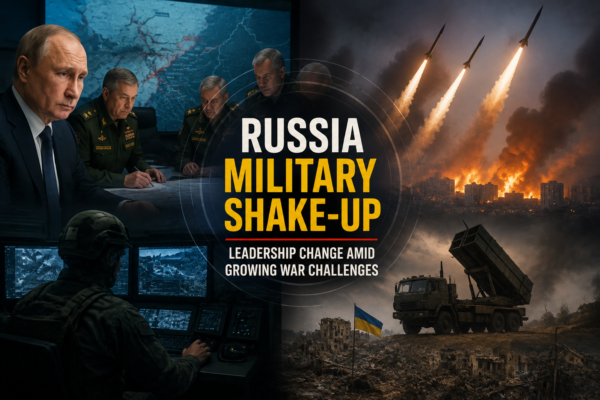
War-Report I Moscow-Kyiv: Russian President Vladimir Putin has announced a major reshuffle of the country’s military leadership, replacing key commanders responsible for logistics and unmanned systems as Ukraine continues to intensify long-range strikes against Russian military infrastructure.
The leadership changes were unveiled during a high-level meeting with senior military commanders and defence officials on August 5, where the Kremlin outlined a restructuring aimed at strengthening logistics, procurement, and military technology management.
As part of the overhaul, Colonel General Valery Solodchuk, Commander of Russia’s Central Military District (CMD), has been appointed Deputy Defence Minister for Logistics, replacing Colonel General Alexander Sanchik. Under the revised structure, Solodchuk will oversee rear-area logistics, while Sanchik will now focus on military procurement.
The Russian Defence Ministry also clarified that Deputy Defence Minister Alexey Krivoruchko will continue supervising the development of advanced weapons and military technologies.
In another significant appointment, Colonel General Denis Lyamin, Chief of Staff of the Central Military District, has been named commander of Russia’s Unmanned Systems Forces (USF). The appointment follows months of speculation regarding the leadership of the drone command.

Reports from Russian military bloggers had previously suggested that Lieutenant Colonel Yuri Vaganov headed the USF, although the Kremlin never officially confirmed his appointment. Analysts believe Lyamin’s promotion indicates that Vaganov has now been replaced following growing criticism over his limited military background and alleged lack of operational experience.
The command changes come as Russia faces mounting challenges from Ukraine’s sustained long-range strike campaign, which has increasingly targeted logistics hubs, supply routes, ammunition depots, and military infrastructure deep inside Russian territory. The attacks have raised questions about the effectiveness of Russia’s logistics network and the ability of its unmanned systems to counter evolving threats.
Meanwhile, Russian forces launched another overnight missile and drone assault against Ukraine on August 4–5, using a comparatively smaller strike package but inflicting significant civilian damage.

According to the Ukrainian Air Force, Russia fired 28 ballistic and quasi-ballistic missiles, including Zirkon/Onyx anti-ship missiles and Iskander-M/S-400 ballistic missiles, alongside 115 strike and decoy drones launched from multiple locations, including Russia’s Kursk, Bryansk, Rostov regions, occupied Donetsk, and Crimea.
Ukraine reported intercepting 98 drones, while several missiles and drones struck 26 different locations, with debris falling across multiple areas. Kyiv Oblast remained one of the primary targets of the attack.
Notably, Ukrainian air defence units were unable to intercept any of the ballistic missiles launched during the assault. Ukrainian officials stated that these missiles require advanced air defence systems such as the U.S.-made Patriot missile system or similar platforms capable of intercepting ballistic threats.
Ukrainian President Volodymyr Zelensky said the country has been receiving significantly fewer anti-ballistic missile interceptors since the beginning of 2026, attributing the shortage largely to increased global demand linked to conflicts in the Middle East.
Military observers note that Russia has recently shifted its operational strategy by increasing the use of ballistic missile attacks while reducing the overall number of drone strikes. This approach appears designed to exploit Ukraine’s limited interceptor inventory and place greater pressure on its air defence capabilities.
The latest battlefield developments highlight the evolving nature of the conflict, with both sides adapting their military strategies. While Russia seeks to strengthen its command structure through leadership changes, Ukraine continues to focus on disrupting Russian logistics and strategic infrastructure, underscoring the increasingly technological and long-range character of the war.