

Philippines’ Bid for a South China Sea Code of Conduct Faces Fresh Setback
as ASEAN Talks Lose Momentum

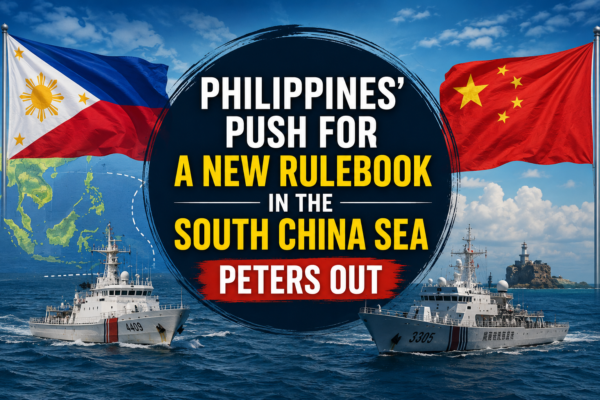
Manila | War-Report: The Philippines’ ambitious effort to place the South China Sea at the center of the Association of Southeast Asian Nations (ASEAN) agenda has encountered significant obstacles, with hopes of concluding a long-awaited Code of Conduct (COC) appearing increasingly uncertain.
After assuming the rotating ASEAN Chairmanship at the beginning of 2026, Manila declared that securing meaningful progress on the South China Sea dispute would be its foremost diplomatic priority. Philippine leaders envisioned the adoption of a legally meaningful framework that could reduce tensions, prevent military confrontation, and reinforce respect for international law in one of the world’s most strategically important maritime regions.
However, despite renewed diplomatic engagement and heightened regional expectations, negotiations have once again slowed, highlighting the enduring political and strategic divisions that have complicated the process for more than two decades.
A Long-Delayed Regional Agreement
The proposed Code of Conduct is intended to establish agreed rules governing the behavior of claimant states in the disputed South China Sea. The framework aims to reduce the risk of accidental confrontations, encourage peaceful dispute resolution, and promote stability through confidence-building measures.
Negotiations between China and ASEAN on the Code of Conduct began over twenty years ago, following the adoption of the non-binding Declaration on the Conduct of Parties in the South China Sea (DOC) in 2002.

Since then, however, discussions have repeatedly stalled amid political disagreements, procedural delays, and differing strategic priorities among participating countries.
Manila’s Diplomatic Push
Upon taking over the ASEAN chairmanship, the Philippines sought to inject fresh momentum into the negotiations.

The Philippine government emphasized that maritime security, adherence to international law, and peaceful conflict management should remain central to ASEAN’s regional agenda.
Officials argued that a meaningful Code of Conduct could help prevent dangerous incidents at sea, improve communication among regional maritime forces, and strengthen confidence among claimant nations.
Manila also reaffirmed its commitment to resolving disputes through diplomatic dialogue while supporting a rules-based international order.
Persistent Challenges
Despite these efforts, analysts believe that several longstanding obstacles continue to undermine progress.
One of the most significant challenges remains the differing interpretations of the Code’s legal status, implementation mechanisms, and enforcement provisions.
Many observers argue that negotiations have been slowed by repeated procedural delays and disagreements over the scope and binding nature of the proposed agreement.
At the same time, ASEAN itself faces internal challenges, as member states hold varying national interests and strategic priorities regarding the South China Sea.
Some countries are directly involved in territorial disputes, while others prioritize maintaining strong economic relations with China or seek to avoid taking positions that could affect regional unity.
These differing perspectives have made it difficult for ASEAN to present a fully unified negotiating position.
Strategic Importance of the South China Sea
The South China Sea remains one of the world’s most strategically significant waterways.
Approximately one-third of global maritime trade passes through these waters each year, making freedom of navigation and regional stability critical for the international economy.
The region is also believed to contain substantial reserves of fisheries, oil, and natural gas, further increasing its geopolitical importance.
Multiple governments—including China, the Philippines, Vietnam, Malaysia, Brunei, and Taiwan—maintain overlapping territorial claims in various parts of the sea.
These competing claims have contributed to recurring diplomatic tensions and maritime incidents over the years.
International Law at the Center
The Philippines has consistently emphasized that any future regional framework should be consistent with international law, including the United Nations Convention on the Law of the Sea (UNCLOS).
Manila continues to advocate peaceful dispute resolution through established legal mechanisms while encouraging dialogue and diplomatic engagement among all parties.
Regional observers note that adherence to internationally recognized legal principles remains one of the most sensitive aspects of the ongoing negotiations.
ASEAN’s Balancing Act
ASEAN faces the difficult task of balancing regional unity with the differing national interests of its ten member states.
While many members support greater regional stability and conflict prevention, varying economic partnerships, security priorities, and diplomatic approaches have complicated efforts to reach a common position on several aspects of the proposed Code of Conduct.
As a consensus-based organization, ASEAN’s decision-making process often requires extensive consultation before major agreements can be finalized.
Outlook Remains Uncertain
Although the Philippines’ 2026 chairmanship generated renewed optimism that meaningful progress could finally be achieved, recent developments suggest that the negotiations continue to face familiar political and diplomatic hurdles.
Experts believe discussions will likely continue, but the timeline for concluding a comprehensive and mutually acceptable Code of Conduct remains uncertain.
Nevertheless, many regional security specialists argue that sustained diplomatic engagement remains essential to reducing tensions, preventing misunderstandings, and preserving long-term peace and stability in the South China Sea.
Looking Ahead
The Philippines’ initiative has once again underscored both the importance and the complexity of establishing clear rules for one of the world’s most contested maritime regions.
While immediate breakthroughs remain elusive, continued dialogue between ASEAN and China is expected to remain central to regional diplomacy.
The eventual success of a South China Sea Code of Conduct will likely depend on mutual trust, political will, adherence to international law, and the ability of all parties to reconcile their strategic interests in pursuit of lasting regional stability.
SOURCE : CRISIS GROUP