


China Conducts Rare Submarine-Launched Ballistic Missile Test
Signaling Expanding Nuclear Deterrence Capability
 Samir Singh 'Bharat'-Editor-in-Chief
Send an email
11 July 2026
Samir Singh 'Bharat'-Editor-in-Chief
Send an email
11 July 2026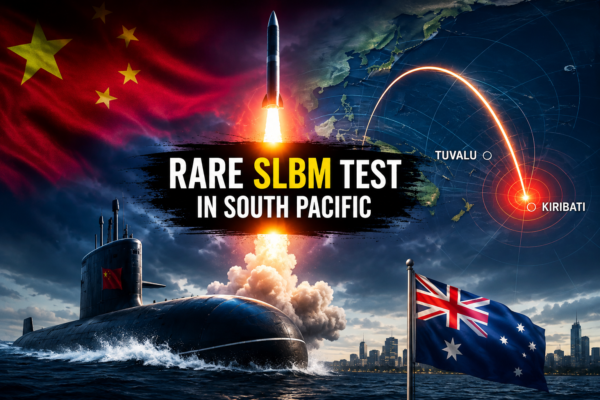
War-Report : Beijing/Taipei/Washington | International Desk : China has reportedly carried out a rare test of a submarine-launched ballistic missile (SLBM) over the South Pacific, a move that defense analysts believe highlights Beijing’s continued efforts to strengthen its nuclear deterrence and enhance its second-strike capability. The test marks one of the most significant demonstrations of China’s evolving sea-based nuclear force in recent years and has drawn close attention from regional security experts and military planners worldwide.
According to reports released by Chinese state media on July 6, an unspecified People’s Liberation Army Navy (PLAN) ballistic missile nuclear submarine (SSBN) successfully launched a ballistic missile during a scheduled test. Although Chinese authorities did not disclose the type of missile or the precise launch location, analysts believe the missile was fired either from the Bohai Sea or the South China Sea, based on navigation warnings issued by China’s Maritime Safety Administration on the same day.
The missile reportedly completed its flight by landing in the South Pacific Ocean, in waters between Tuvalu and the Gilbert Islands of Kiribati, underscoring the long-range capability of China’s submarine-based strategic weapons.
Rare Public Demonstration
The launch is notable because China has seldom acknowledged testing submarine-launched ballistic missiles in public. Analysts note that while China conducted a long-range ballistic missile test over the Pacific in 2024, the country’s last publicly known SLBM test dates back to 1982.
The latest test therefore represents a significant milestone in the modernization of China’s strategic nuclear forces and demonstrates increasing confidence in the operational readiness of its sea-based nuclear deterrent.

Debate Over the Missile Type
Chinese officials did not identify the missile involved in the launch, leading to differing assessments among defense experts.
China’s state-owned newspaper Global Times suggested that the weapon may have been the JL-3, China’s newest generation submarine-launched ballistic missile, first publicly displayed during a military parade in September 2025. The JL-3 is widely believed to possess an estimated operational range of approximately 10,000 kilometers, enabling Chinese submarines to target distant strategic locations without leaving relatively protected waters.
However, Taiwan’s National Security Council Secretary-General Joseph Wu offered a different assessment, suggesting that the missile was more likely the JL-2, an earlier-generation SLBM with an estimated range of around 8,000 kilometers.

The absence of official technical details has left analysts continuing to evaluate satellite imagery, trajectory estimates, and other available intelligence.
Type 094 Submarine Believed to Be Involved
Military experts believe the missile was likely launched from a Type 094 (Type 09IV) Jin-class ballistic missile submarine, currently the only operational SSBN class publicly known to be serving in the People’s Liberation Army Navy.
The Type 094 submarines form the backbone of China’s sea-based nuclear deterrent and represent one of the three components of Beijing’s expanding nuclear triad, alongside land-based intercontinental ballistic missiles and strategic bomber aircraft.
Strengthening China’s Nuclear Second-Strike Capability
Defense analysts believe the primary objective of the launch was to validate China’s ability to conduct a credible second-strike nuclear response.
China officially maintains a long-standing No First Use (NFU) nuclear doctrine, under which it pledges not to initiate the use of nuclear weapons and not to use nuclear weapons against non-nuclear weapon states.
Under such a doctrine, survivability of nuclear forces becomes critically important. A credible second-strike capability ensures that even after suffering a hypothetical first nuclear attack, a country retains sufficient capability to launch a retaliatory response.
Submarine-based nuclear weapons play a central role in this strategy because submarines are considerably more difficult to detect and destroy than fixed land-based missile installations.
Internal Waters Offer Strategic Protection
One of the greatest operational challenges facing China’s nuclear submarines has been safely reaching the open Pacific Ocean.
Chinese submarines operating from mainland bases must transit several narrow maritime chokepoints where they may be monitored by rival naval forces, increasing the risk of detection during any conflict.
To reduce this vulnerability, defense analysts believe Beijing is increasingly focused on developing heavily defended underwater operating areas—often referred to as “submarine bastions.”
These protected zones are expected to include extensive underwater surveillance systems, anti-submarine defenses, naval patrols, and sea mines designed to safeguard strategic submarines while they remain within China’s nearby waters.
If equipped with longer-range missiles such as the JL-3, these submarines could theoretically threaten distant targets without venturing deep into the Pacific Ocean, thereby improving survivability.
Modernizing the Nuclear Triad
China’s latest missile test reflects a broader modernization program aimed at improving both the size and sophistication of its strategic nuclear forces.
Over the past decade, Beijing has invested heavily in expanding missile production, constructing new missile silo fields, deploying advanced mobile missile systems, modernizing strategic bombers, and upgrading submarine capabilities.
The sea-based component of China’s nuclear deterrent is increasingly viewed as a critical element in ensuring a secure retaliatory capability under evolving global security conditions.
Growing Submarine Fleet
Recent assessments from U.S. defense officials suggest that China’s submarine fleet could expand significantly over the coming years.
In testimony before the U.S. Senate earlier this year, Rear Admiral Michael Brookes of the U.S. Office of Naval Intelligence stated that China could field between 20 and 30 missile-capable nuclear submarines by 2040, a substantial increase from its current inventory of approximately 12 cruise missile and ballistic missile submarines.
Such an expansion would significantly strengthen China’s continuous at-sea nuclear deterrence while providing greater operational flexibility.
Strategic Implications
Security experts believe that longer-range submarine-launched ballistic missiles, combined with an expanded SSBN fleet, would substantially improve China’s strategic deterrence posture.
The ability to launch nuclear-capable missiles from secure maritime locations complicates military planning for potential adversaries by increasing uncertainty regarding the survivability and location of China’s strategic forces.
The development also reflects broader trends in global nuclear modernization, with several major powers continuing to invest in advanced delivery systems, improved missile technology, and enhanced strategic command capabilities.
Regional and Global Security Concerns
The missile test comes amid growing geopolitical competition across the Indo-Pacific region, where military modernization, maritime disputes, and strategic competition continue to shape regional security dynamics.
Although China maintains that its nuclear posture remains defensive in nature, neighboring countries and Western defense analysts continue to closely monitor developments in Beijing’s expanding strategic arsenal.
Experts note that improvements in China’s submarine-based nuclear capability may influence future strategic calculations involving regional security, missile defense planning, arms control discussions, and military deterrence across the Indo-Pacific.
Looking Ahead
While Beijing has released only limited information regarding the latest missile launch, the test is widely viewed as another step in China’s long-term effort to modernize its strategic nuclear forces.
Whether the missile was the newer JL-3 or the earlier JL-2, the successful demonstration underscores China’s determination to strengthen the survivability, reach, and credibility of its sea-based nuclear deterrent.
As China’s naval capabilities continue to evolve and its strategic submarine fleet expands over the coming decades, military analysts expect submarine-based nuclear forces to play an increasingly prominent role in shaping the strategic balance across the Indo-Pacific and beyond.