

Iran Expands Military Pressure in the Gulf as Strait of Hormuz Crisis Deepens:
Regional Tensions Reach a Dangerous New Phase

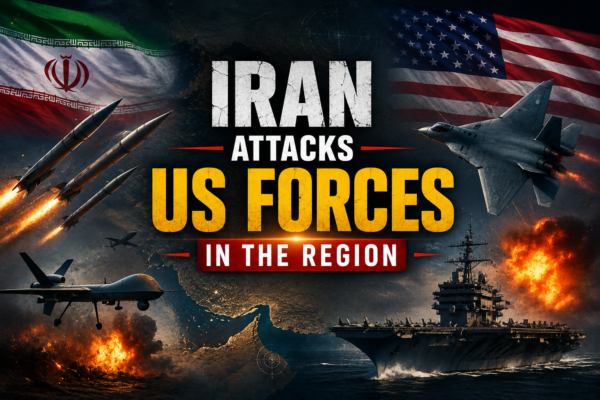
WAR-REPORT : The security situation in the Persian Gulf has entered one of its most volatile phases in recent years as Iran continues to escalate military operations aimed at reinforcing its strategic influence over the Strait of Hormuz. A series of drone strikes, missile attacks, military responses, and increasingly aggressive political statements have transformed the world’s most critical maritime chokepoint into the center of an expanding geopolitical confrontation.
The latest developments suggest that Tehran is pursuing a broader strategy that extends beyond immediate retaliation. Military actions against U.S. forces, pressure on Gulf Arab states, and threats to suspend diplomatic negotiations appear designed to strengthen Iran’s position while discouraging foreign interference in what it considers its sphere of influence.
Iranian Drone Attack Marks New Escalation
The latest escalation began after an Iranian drone reportedly struck the Panama-flagged commercial tanker M/T Kiku on June 27. The incident immediately raised concerns throughout the international shipping community because the vessel was operating near one of the world’s busiest maritime trade routes.
The attack reinforced fears that commercial shipping could increasingly become a target as regional tensions continue to rise.
United States Responds with Precision Military Operations
Following the reported drone strike, the United States launched a series of military operations targeting Iranian military infrastructure.

According to available information, American aircraft struck several strategic military assets, including:
- Surveillance infrastructure
- Military communication systems
- Air defense installations
- Drone storage facilities
- Naval mine deployment capabilities
The strikes appeared carefully designed to reduce Iran’s ability to threaten international shipping while avoiding broader civilian targets.
Military analysts describe the operation as an attempt to degrade Iran’s anti-access and area-denial capabilities without triggering a full-scale regional war.

IRGC Launches Missile and Drone Attacks
Iran responded quickly.
The Islamic Revolutionary Guard Corps (IRGC) Navy issued a strongly worded statement warning that American military facilities across the region would remain vulnerable if Washington continued military operations.
Within hours, Iran reportedly launched drones and ballistic missiles toward:
- The U.S. Fifth Fleet Naval Base in Bahrain
- Ali Al Salem Air Base in Kuwait
Bahrain’s air defense systems intercepted several incoming projectiles.
However, Bahraini authorities reported that one strike destroyed a residential building, highlighting the risks posed to civilians even when military targets are involved.
The attacks demonstrated Iran’s willingness to directly challenge American military infrastructure throughout the Gulf.
Strait of Hormuz at the Center of the Crisis
The Strait of Hormuz remains the strategic heart of the confrontation.
Nearly one-fifth of globally traded crude oil passes through this narrow waterway, making it one of the world’s most important energy corridors.
Any disruption can immediately influence:
- Global oil prices
- Energy markets
- International shipping
- Supply chains
- Inflation worldwide
Iran has repeatedly emphasized that it considers itself a primary guardian of security in the Strait.
Recent statements indicate Tehran is attempting to establish broader political recognition of that role.
Iran Reasserts Claims Over Maritime Control
Iranian Foreign Minister Abbas Araghchi declared that Iran is “solely responsible” for managing the Strait of Hormuz under the recently negotiated U.S.-Iran Memorandum of Understanding.
Iranian military officials further argued that control over the strait represents a broader strategic objective rather than simply an economic opportunity.
According to Iranian military spokesperson Mohammad Akraminia, securing influence over the waterway would strengthen Iran’s regional position and enhance its long-term geopolitical leverage.
These statements suggest Tehran views maritime control as an essential component of its regional security doctrine.
Beyond Tolls: A Larger Strategic Objective
International observers increasingly believe Iran’s objectives extend beyond collecting transit fees from commercial shipping.
Control over the Strait of Hormuz would provide Tehran with:
- Greater regional influence
- Enhanced deterrence against military rivals
- Increased bargaining power during diplomatic negotiations
- Strategic leverage over global energy markets
Rather than treating the strait solely as an economic asset, Iran appears to view it as a central pillar of regional power projection.
Pressure on Gulf Arab States
Iran’s recent military posture may also be intended to influence neighboring Gulf countries.
The Gulf Cooperation Council (GCC), together with the United States, recently rejected any unilateral Iranian attempt to impose mandatory transit fees or exclusive control over the waterway.
Oman has similarly emphasized that international navigation through the Strait of Hormuz must remain free and unrestricted under international maritime law.
These positions appear to have prompted increasingly sharp rhetoric from Iranian officials and state-affiliated media.
Several Iranian publications accused Gulf governments of attempting to undermine what Tehran describes as a “new regional balance.”
Military Signaling Through Controlled Escalation
Defense experts suggest Iran’s recent actions represent a strategy of controlled escalation.
Rather than seeking an immediate large-scale conflict, Tehran may be attempting to:
- Demonstrate military capability.
- Raise costs for continued U.S. military operations.
- Discourage Gulf states from challenging Iranian influence.
- Reinforce domestic political messaging.
- Improve negotiating leverage.
Such calibrated military pressure allows Iran to signal resolve while avoiding outright war.
Diplomacy Under Pressure
Alongside military activity, Iran has also threatened to suspend ongoing diplomatic negotiations.
The IRGC Navy argued that recent American strikes violated existing understandings and warned that continued military operations could halt diplomatic engagement altogether.
This reflects a recurring Iranian negotiating strategy in which military pressure and diplomatic leverage operate simultaneously.
Iran may believe that uncertainty surrounding negotiations could encourage Washington to reconsider additional military operations.
Global Economic Implications
The Strait of Hormuz is indispensable to the international economy.
Approximately 20 percent of global oil exports transit the waterway.
Even limited disruptions could produce:
- Higher crude oil prices
- Increased shipping insurance costs
- Rising transportation expenses
- Greater inflationary pressure
- Energy supply concerns across Asia and Europe
Financial markets therefore continue to monitor every military development in the Gulf with exceptional sensitivity.
Risks of Regional Expansion
Security analysts warn that repeated exchanges between Iran and U.S. forces increase the possibility of unintended escalation.
Any miscalculation involving:
- Naval patrols
- Missile interceptions
- Drone operations
- Commercial shipping
- Military installations
could rapidly expand beyond the immediate Gulf region.
The involvement of multiple regional actors—including Bahrain, Kuwait, Oman, Saudi Arabia, and the United States—makes crisis management increasingly complex.
Strategic Assessment
Iran’s recent military actions indicate a broader strategic campaign rather than isolated retaliation.
The objectives appear to include:
- Strengthening claims over the Strait of Hormuz.
- Deterring further U.S. military intervention.
- Discouraging Gulf opposition.
- Increasing leverage during diplomatic negotiations.
- Demonstrating military readiness to regional and international audiences.
Meanwhile, the United States continues to emphasize freedom of navigation and the protection of international shipping routes, making further strategic competition likely.
Our Media Opinion
The evolving confrontation in the Persian Gulf underscores how the Strait of Hormuz remains one of the world’s most strategically significant waterways. Iran’s combination of military pressure, diplomatic messaging, and assertions of maritime authority reflects a long-term effort to expand its regional influence.
At the same time, the United States and Gulf partners continue to oppose any unilateral changes to the status quo, arguing that international shipping lanes must remain open and governed by established principles of international law.
As military activity and political rhetoric continue, the coming weeks will be critical in determining whether diplomacy can contain the crisis or whether the region moves toward a broader confrontation with potentially far-reaching consequences for global security and energy markets.