


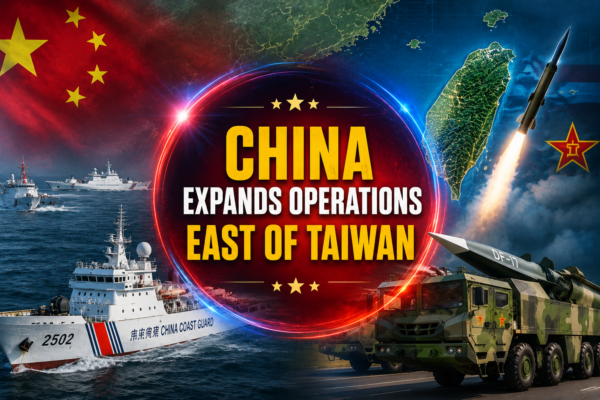
WAR-REPORT: Beijing-Taipei: China is increasingly expanding its maritime law enforcement and scientific research operations in waters east of Taiwan, a move analysts believe is part of a broader strategy to alter the status quo in the Western Pacific and strengthen Beijing’s territorial claims over Taiwan and its surrounding waters.
Recent activity by the People’s Republic of China (PRC) suggests an effort to normalize its presence beyond the Taiwan Strait, reinforcing Beijing’s long-standing position that Taiwan and its maritime boundaries fall under Chinese sovereignty. Security experts warn that these operations could gradually undermine Taiwan’s control over its surrounding waters while expanding China’s administrative and military footprint in the region.
Maritime Operations Intensify East of Taiwan
Chinese state-affiliated media outlet Yuyuan Tantian, linked to state broadcaster CCTV, reported on June 20 that recent environmental surveys and maritime law enforcement activities indicate Beijing may now regard waters east of Taiwan as part of its “near-shore waters.”
Between June 16 and June 18, the East China Sea Bureau under China’s Ministry of Natural Resources deployed the research vessel Xiang Yang Hong 22 to conduct marine environmental surveys east of Taiwan. At the same time, vessel-tracking data indicated that Chinese Coast Guard (CCG) ships have maintained an almost continuous presence in the area since June 1.
China’s Ministry of Transport also carried out a special maritime law enforcement operation from June 6 to June 10, officially citing ongoing efforts by Japan and the Philippines to define overlapping Exclusive Economic Zone (EEZ) claims in nearby waters. Beijing has rejected any maritime boundary agreements that exclude Chinese participation, arguing that all territorial claimants must be involved in such negotiations.

A New Phase of Maritime Governance
Experts believe Beijing could be using the Japan-Philippines maritime negotiations as justification to extend Chinese enforcement activities beyond the First Island Chain.
According to Yuyuan Tantian, future Chinese research and law enforcement operations east of Taiwan may become routine, aimed at safeguarding what Beijing considers its maritime territory. The account previously introduced the so-called “Kinmen Model” in 2024, referring to the sustained deployment of Chinese Coast Guard vessels around Taiwan’s Kinmen Islands to gradually expand Chinese law enforcement authority into Taiwanese-controlled waters.
Analysts suggest that the latest references to “near-shore governance” may signal Beijing’s intention to replicate the Kinmen approach in waters east of Taiwan, gradually increasing operational presence without direct military confrontation.

PLA Highlights Hypersonic Missile Capability
Alongside expanding maritime operations, China’s People’s Liberation Army (PLA) has showcased significant advances in its hypersonic missile program.
On June 22, the PLA’s official newspaper PLA Daily released, for the first time, official footage of the DF-17 medium-range ballistic missile (MRBM) launching the DF-ZF hypersonic glide vehicle (HGV). While the DF-17 has appeared in previous military parades, this marks the first officially published launch imagery of the missile’s hypersonic payload.
Defense analysts believe the release demonstrates growing confidence in the weapon system as it approaches full operational capability following years of testing and development.
The DF-17 reportedly has an operational range of approximately 1,800 to 2,500 kilometers, enabling it to strike targets throughout the First Island Chain and extending toward the Second Island Chain, significantly enhancing China’s regional strike capabilities.
Military experts believe hypersonic glide vehicles could be used to penetrate advanced air defense systems before launching larger precision missile attacks, increasing the effectiveness of broader military operations during a potential conflict.
China-Russia Military Cooperation Under Scrutiny
Meanwhile, concerns over growing military cooperation between China and Russia have also intensified.
European Union High Representative for Foreign Affairs and Security Policy Kaja Kallas confirmed that the EU has verified reports indicating that Chinese personnel have provided training to Russian military forces in mine-clearing techniques and drone operations.
Security analysts believe China could be using the Russia-Ukraine conflict as an opportunity to observe and evaluate modern battlefield tactics, test military equipment, and refine operational doctrine under real combat conditions without direct involvement in the conflict.
Rising Regional Tensions
The simultaneous expansion of China’s maritime enforcement activities, modernization of hypersonic missile capabilities, and closer military cooperation with Russia highlight Beijing’s broader strategic ambitions in the Indo-Pacific.
Observers warn that regular Chinese operations east of Taiwan could gradually reshape regional maritime dynamics, challenge Taiwan’s sovereignty claims, and increase tensions with neighboring countries, including Japan and the Philippines. As China continues to expand both its military capabilities and maritime presence, regional governments and international security partners are expected to closely monitor developments that could significantly impact stability across the Western Pacific.