


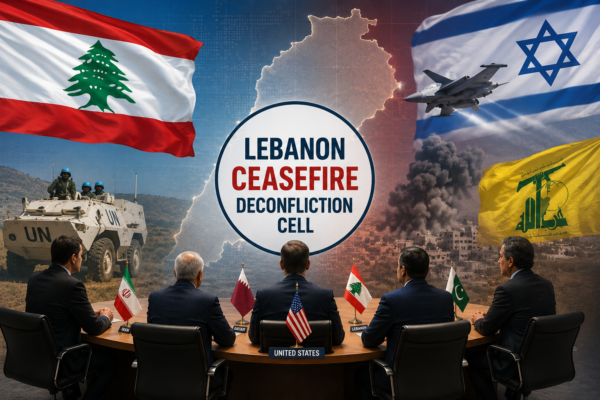
Washington-Beirut: The creation of a new international “deconfliction cell” to oversee the ceasefire in Lebanon is drawing significant attention across diplomatic and security circles, as the mechanism appears to alter the balance of influence established under the November 2024 ceasefire agreement.
The newly formed body emerged from quadrilateral discussions involving the United States, Iran, Qatar, and Pakistan held in Switzerland on June 21. According to reports, the mechanism is intended to coordinate efforts aimed at maintaining the ceasefire and ensuring the termination of military operations in Lebanon. However, the exclusion of Israel from the arrangement and the inclusion of Iran have generated concerns regarding the effectiveness and neutrality of the initiative.
Shift From Previous Monitoring Framework
The new deconfliction cell appears set to replace the ceasefire monitoring mechanism established after the 2024 conflict between Israel and Hezbollah. That earlier framework included Israel, Lebanon, the United States, France, and the United Nations Interim Force in Lebanon (UNIFIL).
Under the previous arrangement, Israel could directly report alleged Hezbollah ceasefire violations to the monitoring committee. The Lebanese Armed Forces (LAF) were then expected to address the reported violations. In cases where the LAF failed to act or responded inadequately, Israel maintained the ability to conduct military operations against Hezbollah targets that it considered security threats.
Security analysts note that the new arrangement may significantly limit Israel’s direct involvement in ceasefire oversight. Instead of presenting concerns directly, Israel may now be required to communicate through the United States, reducing its influence within the monitoring process.

Strategic Advantage for Iran
Observers suggest that Iran secured several diplomatic gains during the Switzerland talks, with the establishment of the deconfliction cell viewed as one of the most significant outcomes.
By becoming a member of the mechanism while Israel remains outside it, Tehran gains a formal role in discussions concerning military activity in Lebanon. This development is particularly noteworthy given Iran’s longstanding support for Hezbollah and its strategic interests in the region.
Critics argue that the new structure removes an internationally recognized forum through which Israel previously raised concerns about Hezbollah’s military activities. As a result, both Iran and Hezbollah could benefit from a system that potentially restricts Israel’s ability to respond quickly to perceived threats.

Concerns Over Neutrality and Effectiveness
Questions are also being raised about whether the deconfliction cell can effectively fulfill its stated goal of ending military operations in Lebanon.
Reports indicate that Iranian personnel remain involved in supporting Hezbollah’s military structure. Regional media sources have cited claims that officers from Iran’s Islamic Revolutionary Guard Corps (IRGC) have been active in southern Lebanon, assisting Hezbollah in rebuilding capabilities following the group’s setbacks during the 2024 conflict.
At the same time, Israeli forces continue to conduct operations in parts of southern Lebanon aimed at dismantling Hezbollah infrastructure and preventing the group from re-establishing military positions near the border.
Analysts warn that including Iran—an actor closely aligned with Hezbollah—while excluding Israel could complicate efforts to create a balanced and credible ceasefire enforcement mechanism.
Differing Objectives Among Member States
Another challenge facing the deconfliction cell is the differing strategic priorities of its member states.
According to Israeli media reports, the United States has reportedly accepted the continuation of a limited Israeli military presence in parts of southern Lebanon. Israeli officials argue that such deployments are necessary to eliminate remaining Hezbollah infrastructure and ensure long-term security along the border.
Israeli Prime Minister Benjamin Netanyahu and Defense Minister Israel Katz have repeatedly emphasized Israel’s right to defend itself and prevent Hezbollah from rebuilding military capabilities near Israeli territory.
Iran, however, continues to advocate for a complete ceasefire that would include the full withdrawal of Israeli forces from southern Lebanon. These opposing positions could make it difficult for the deconfliction cell to reach consensus on future security arrangements.
Upcoming Ceasefire Discussions
The future of the new mechanism is expected to become clearer during scheduled Israel-Lebanon ceasefire discussions in Washington, D.C., from June 23 to June 25. Delegations from Israel, Lebanon, and the United States are expected to address the scope of Israeli military operations, security arrangements in southern Lebanon, and the operational structure of the newly established deconfliction cell.
Diplomatic observers believe these talks will be crucial in determining whether the new framework can maintain stability in Lebanon or whether disagreements over participation and authority will undermine its effectiveness.
As regional tensions continue, the success or failure of the deconfliction cell could have far-reaching implications for Lebanon’s security environment, Israel’s strategic posture, and Iran’s influence in the Middle East