

PM Modi Commissions Three Indigenous Naval Warships in Kolkata,
Editorial : INS Agray, INS Dunagiri and INS Sanshodhak Join Indian Navy;

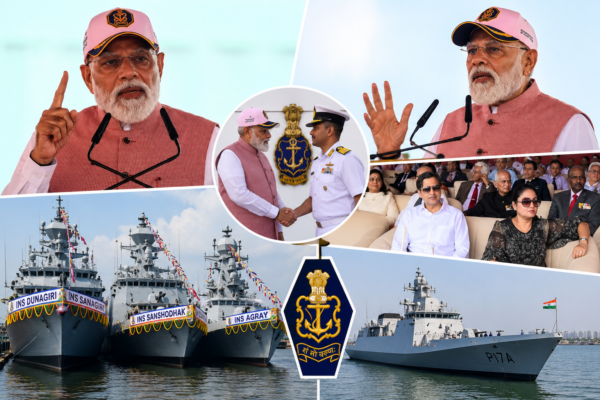
Kolkata : Prime Minister Narendra Modi commissioned three indigenously designed and built naval platforms — INS Dunagiri, INS Sanshodhak, and INS Agray — at the Syama Prasad Mookerjee Port in Kolkata, marking another significant milestone in India’s journey towards maritime strength, defence self-reliance, and technological advancement.
The three vessels, designed by the Indian Navy’s Warship Design Bureau and constructed by Garden Reach Shipbuilders & Engineers (GRSE), Kolkata, have been built with more than 75 percent indigenous content and the participation of over 200 Indian MSMEs. Their induction into the Indian Navy is expected to significantly enhance the country’s operational readiness, maritime surveillance capabilities, and coastal security infrastructure.
Addressing the gathering, Prime Minister Modi described the commissioning ceremony as a landmark moment in India’s march towards becoming a self-reliant and developed nation.
Maritime Strength Key to Economic and Strategic Influence
Highlighting the importance of maritime power in the modern world, the Prime Minister stated that no nation can emerge as a major global power without strong maritime capabilities.
He emphasized that global trade, strategic communication networks, energy resources, critical minerals, and future economic opportunities are increasingly linked to the oceans. Therefore, a nation’s economic prosperity and strategic influence depend significantly on the strength of its maritime sector.

“The country whose maritime strength is robust, its economic and strategic influence will be equally robust. India understands this reality well and is preparing itself accordingly,” Prime Minister Modi said.
A Historic Coincidence on World Hydrography Day
The Prime Minister noted that the commissioning ceremony coincided with two globally significant occasions — the International Day of Yoga and World Hydrography Day.
Calling it a remarkable coincidence, he pointed out that India’s most advanced hydrographic survey vessel, INS Sanshodhak, was commissioned on World Hydrography Day itself.

He congratulated the Indian Navy, scientists, engineers, shipbuilders, workers and all citizens of the country for this achievement, describing it as a reflection of India’s rapidly growing technological and maritime capabilities.
From INS Vikrant to a New Era of Naval Self-Reliance
Prime Minister Modi recalled the commissioning of India’s indigenous aircraft carrier INS Vikrant, which had symbolized the beginning of a new chapter in India’s maritime history.
According to him, the journey from INS Vikrant to the commissioning of INS Agray, INS Dunagiri and INS Sanshodhak is not merely a story of adding new warships to the fleet, but a reflection of India’s growing self-reliance in defence production.
“The journey from INS Vikrant to today is the journey of India’s increasing confidence, indigenous innovation and manufacturing excellence,” he remarked.
The Prime Minister emphasized that all three naval platforms have been designed and built in India, showcasing the capabilities of Indian engineers, shipbuilders, industries and workers.
India Aims to Become a Defence Manufacturer, Not Just a Buyer
Reiterating the government’s commitment to self-reliance in defence production, Prime Minister Modi said India does not want to remain merely one of the world’s largest defence importers.
He stressed that true military strength comes from the ability to design, manufacture and innovate domestically.
“Countries that manufacture become decisive players on the global stage. India seeks to become a producer, innovator and exporter in the defence sector,” he said.
The Prime Minister noted that over the past few years, more than 40 indigenously built warships and submarines have been inducted into the Indian Navy, while nearly 45 major naval platforms are currently under construction across the country.
These achievements, he said, demonstrate India’s growing industrial capacity and technological maturity.
Maritime Sector Emerging as a Major Economic Engine
Prime Minister Modi highlighted the vast employment potential of the maritime industry, describing it as a key driver of economic growth and industrial development.
He explained that modern shipbuilding supports a wide network of industries, including steel manufacturing, electronics, heavy machinery, engineering components and logistics.
The construction of INS Agray, INS Dunagiri and INS Sanshodhak involved the participation of more than 200 MSMEs, generating employment and economic activity across multiple sectors.
According to the Prime Minister, the government views shipbuilding, ship repair and maintenance, repair and overhaul (MRO) services as part of a larger national mission aimed at strengthening India’s industrial ecosystem.
New Vision for Shipbuilding and Blue Economy
The Prime Minister stated that India has entered a new phase of maritime development with a comprehensive vision for shipbuilding and coastal economic growth.
Several policy reforms have been introduced to strengthen domestic shipbuilding capabilities and attract investments in maritime infrastructure.
He highlighted the government’s ₹70,000 crore incentive package for the shipping sector, calling it a strategic investment in India’s maritime future.
Initiatives such as Sagarmala are helping improve logistics efficiency, reduce transportation costs, accelerate industrial growth and create new opportunities in coastal regions.
Defence Manufacturing Witnesses Significant Growth
Reflecting on India’s defence sector transformation, Prime Minister Modi said that the country was once heavily dependent on defence imports, creating strategic vulnerabilities.
However, since 2014, the government has focused on strengthening indigenous defence production through policy reforms and increased investment in research, development and manufacturing.
As a result, India’s defence production has grown significantly from around ₹40,000 crore in 2014 to nearly ₹1.8 lakh crore today.
The Prime Minister described this growth as a clear indicator of India’s progress towards becoming a globally competitive defence manufacturing hub.
West Bengal’s Historic Maritime Legacy
Prime Minister Modi also paid tribute to West Bengal’s rich maritime heritage, noting that Bengal has historically served as an important gateway connecting India to the world through trade and maritime routes.
He said the Hooghly River has witnessed centuries of commercial growth, cultural exchange and economic development.
The commissioning ceremony at Syama Prasad Mookerjee Port carried special significance because the port is named after Dr. Syama Prasad Mookerjee, independent India’s first Industry Minister and one of Bengal’s most prominent leaders.
The Prime Minister expressed confidence that West Bengal would emerge as a major center for India’s Blue Economy, maritime manufacturing, logistics and coastal development in the coming years.
Symbols of Security, Prosperity and Self-Reliance
Concluding his address, Prime Minister Modi reiterated that India has always viewed the oceans as a medium of cooperation, connectivity and shared prosperity.
At the same time, he emphasized that peace can only be safeguarded through strength, prosperity can only be protected through security, and the future can only be built through self-reliance.
“INS Agray, INS Dunagiri and INS Sanshodhak embody these very ideals. They symbolize a confident India that believes in its capabilities, trusts its innovation and is determined to emerge as a leading maritime power in the twenty-first century,” he said.
The Prime Minister extended his congratulations to the Indian Navy, scientists, engineers, shipbuilders, workers and all stakeholders involved in the successful design and construction of the three vessels.
With the commissioning of INS Agray, INS Dunagiri and INS Sanshodhak, India has taken another significant step towards strengthening its maritime security architecture, enhancing indigenous defence production and reinforcing its position as a rising global maritime power.