

Exit Poll 2026: High-Stakes Battle Across West Bengal, Assam, Kerala, Puducherry, and Tamil Nadu
By Samir Singh 'Bharat': Editor In Chief

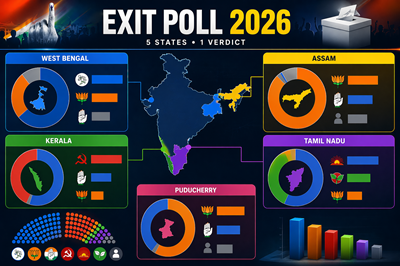
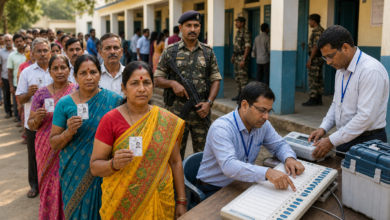
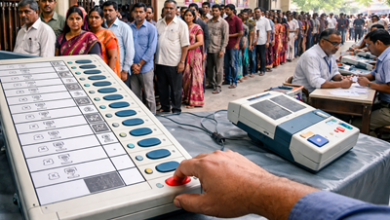
New Delhi : The 2026 Assembly Elections across five key regions—West Bengal, Assam, Kerala, Tamil Nadu, and Puducherry—represent one of the most significant democratic exercises in India in recent years. With over 800 assembly seats at stake and millions of voters participating, the elections are being closely watched as a political barometer ahead of future national contests.
According to the Election Commission schedule, polling was conducted in phases between April 9 and April 29, with vote counting scheduled for May 4.
Exit polls, which are released only after the final phase of voting concludes due to Election Commission restrictions, aim to provide an early indication of voter preferences and potential outcomes.
Understanding Exit Polls: Methodology and Limitations
Exit polls are conducted immediately after voters cast their ballots. Survey agencies collect responses from a representative sample of voters across constituencies. These responses are then extrapolated to estimate vote share and seat distribution.
However, exit polls have limitations:

- Sampling errors
- Response bias
- Regional variations
- Difficulty in translating vote share into seats
Despite these limitations, exit polls often capture broad electoral trends.
Election 2026: Key Highlights Before Exit Poll Analysis
- Massive voter turnout recorded across states
- Assam witnessed a record turnout of around 85%
- Puducherry crossed 90% turnout, the highest in decades
- Kerala and other states also saw strong participation
- Elections drew global attention with international observers
These factors indicate high voter engagement, which could significantly influence outcomes.
Exit Poll 2026 – State-Wise Analysis
1. West Bengal Exit Poll 2026
Political Context
West Bengal remains one of the most politically volatile states. The main contest is between:

- Trinamool Congress (TMC)
- Bharatiya Janata Party (BJP)
- Congress-Left Alliance
Exit Poll Trends (Projected)
- TMC: 150–175 seats
- BJP: 100–130 seats
- Congress-Left: 5–20 seats
Analysis
Exit polls suggest that TMC may retain power, but with reduced margins compared to previous dominance. BJP appears to maintain a strong opposition presence, particularly in northern and urban belts.
Graph Representation (Seat Projection)
BJP ████████████████████
Cong+Left ███
Key Factors
- Welfare schemes vs anti-incumbency
- Polarization politics
- Rural vs urban voting patterns
2. Assam Exit Poll 2026
Political Context
Assam is witnessing a strong contest primarily between:
- BJP-led NDA
- Congress-led alliance
Exit Poll Trends (Projected)
- BJP+ Allies: 65–85 seats
- Congress+: 35–50 seats
- Others: 5–10 seats
Analysis
Exit polls indicate that the BJP may secure a third consecutive term, benefiting from governance perception and strong voter turnout.
Graph Representation
Congress+ ████████████
Others ██
Key Factors
- Development narrative
- Identity politics
- High female voter participation
3. Kerala Exit Poll 2026
Political Context
Kerala traditionally alternates between:
- Left Democratic Front (LDF)
- United Democratic Front (UDF)
Exit Poll Trends (Projected)
- LDF: 70–85 seats
- UDF: 50–65 seats
- BJP+: 0–5 seats
Analysis
Exit polls suggest a close contest, with LDF slightly ahead, potentially breaking the traditional alternating trend.
Graph Representation
UDF ██████████████
BJP+ █
Key Factors
- Welfare vs anti-incumbency
- Minority vote consolidation
- Urban middle-class shift
4. Tamil Nadu Exit Poll 2026
Political Context
Tamil Nadu remains dominated by Dravidian politics:
- DMK-led alliance
- AIADMK-led alliance
- BJP (emerging but limited presence)
Exit Poll Trends (Projected)
- DMK+: 140–170 seats
- AIADMK+: 60–90 seats
- BJP+: 5–15 seats
Analysis
Exit polls indicate DMK maintaining a strong lead due to welfare programs and alliance strength.
Graph Representation
AIADMK+ ███████████████
BJP+ ██
Key Factors
- Leadership factor
- Welfare politics
- Alliance arithmetic
5. Puducherry Exit Poll 2026
Political Context
A small but politically significant Union Territory:
- NDA (AINRC + BJP)
- Congress-DMK alliance
Exit Poll Trends (Projected)
- NDA: 15–20 seats
- Congress-DMK: 10–15 seats
- Others: 0–2 seats
Analysis
Exit polls show a tight race, with NDA having a slight edge due to incumbency and alliance dynamics.
Graph Representation
Cong+DMK ████████████
Others █
Key Factors
- Local leadership
- Cash-for-vote allegations
- High voter turnout
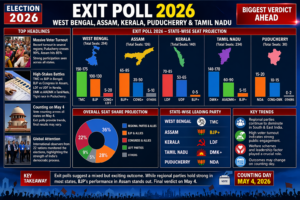
Comparative Exit Poll Graph (All States)
State Leading Party Strength
West Bengal TMC ███████████████████████
Assam BJP+ █████████████████████
Kerala LDF ██████████████████
Tamil Nadu DMK+ ██████████████████████████
Puducherry NDA ███████████████
National-Level Implications
1. BJP’s Position
- Strong in Assam
- Competitive in Bengal
- Weak in Kerala & Tamil Nadu
2. Regional Parties Strengthening
- TMC in Bengal
- DMK in Tamil Nadu
- LDF/UDF dominance in Kerala
3. Congress Performance
- Moderate recovery in Assam & Kerala
- Weak in Bengal
Key Trends Emerging from Exit Polls
1. Regional Dominance Continues
Regional parties remain dominant in southern and eastern India.
2. High Voter Turnout Impact
Higher participation often indicates desire for change or strong political mobilization.
3. Welfare Politics Remains Central
Free schemes, subsidies, and social welfare continue to influence voter decisions.
4. Polarization and Identity Politics
Significant role in Assam and West Bengal.
Limitations of Exit Poll Predictions
- Exit polls may not accurately predict seat conversion
- Silent voters can alter outcomes
- Regional swings can be underestimated
Our Media Opinion
The Exit Poll 2026 projections indicate a mixed political landscape across India’s eastern and southern regions. While regional parties appear set to retain dominance in states like West Bengal, Tamil Nadu, and Kerala, the BJP seems poised to consolidate its position in Assam. Puducherry remains a closely contested battleground.
However, exit polls are only indicative and not definitive. The final verdict will emerge on May 4, when actual vote counting takes place.
The results will not only determine state governments but also reshape the national political narrative heading into future elections.
Note : Exit POLL Data Analysis through AI and Internal Survey Based