

US.–Iran Ceasefire Agreement Faces Early Strains
By Samir Singh 'Bharat': Editor In Chief
 war-times.com
Send an email
9 April 2026
war-times.com
Send an email
9 April 2026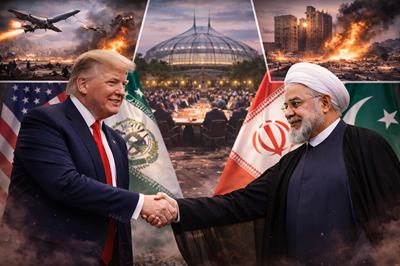
WAR-REPORT : The announcement by U.S. President Donald Trump on April 7 that the United States and Iran had agreed to a two-week ceasefire marked a significant diplomatic development in an increasingly volatile Middle Eastern landscape. Brokered by Pakistan, the agreement was designed to pause hostilities temporarily and create an opportunity for structured negotiations scheduled to begin in Islamabad on April 10. However, developments in the immediate aftermath of the announcement suggest that the ceasefire faces serious challenges, particularly due to overlapping regional conflicts and differing interpretations among key actors.
US–Iran Ceasefire Announcement and Key Terms
President Trump presented the agreement as a major breakthrough, emphasizing that Iran had submitted a ten-point proposal that would form the basis of upcoming negotiations. He stated that “almost all” of the major points of contention between Washington and Tehran had been resolved in principle. This statement reflected optimism within the U.S. administration that a diplomatic pathway had been established after a prolonged period of tension and escalation.
At the core of the agreement is Iran’s ten-point proposal, which reportedly includes demands for a permanent end to hostilities, guarantees against future attacks by the United States and Israel, and the lifting of sanctions. While the U.S. had previously outlined a fifteen-point framework on March 24, the Iranian proposal appears to diverge on several key issues, indicating that substantial differences remain. The upcoming talks in Islamabad are therefore expected to focus not only on consolidating areas of agreement but also on addressing these unresolved disagreements.
Despite the apparent progress, Iranian media affiliated with the Islamic Revolutionary Guards Corps (IRGC) reported on April 8 that Iran could withdraw from the ceasefire agreement if Israel continues its military operations in Lebanon. This conditional position highlights the broader regional dimension of the conflict and underscores Iran’s insistence that any meaningful ceasefire must take into account the activities of its allies and adversaries across multiple theaters.
The question of whether the ceasefire applies to Lebanon has emerged as a central point of contention. Senior U.S. and Israeli officials have consistently stated that the ceasefire agreement between Washington and Tehran does not extend to Israeli operations against Hezbollah in Lebanon. President Trump reiterated this position in a media interview on April 8, describing the situation in Lebanon as “a separate skirmish” and making it clear that the agreement is limited in scope.

Israeli leadership has echoed this stance. The office of Prime Minister Benjamin Netanyahu issued a statement on April 7 confirming that the ceasefire does not apply to Lebanon. Israel Defense Forces (IDF) Chief of Staff General Eyal Zamir further reinforced this position by stating that Israeli operations targeting Hezbollah would continue without interruption. These statements reflect Israel’s determination to pursue its military objectives independently of the U.S.–Iran diplomatic process.
Hezbollah, however, appears to have initially received different signals. According to statements from Hezbollah officials, the group was informed by intermediaries that it would be included in the ceasefire arrangement. Acting on this understanding, Hezbollah reportedly halted its attacks against Israel on April 8, indicating a willingness to comply with what it believed to be a broader agreement.
This apparent miscommunication has contributed to confusion and tension. A Hezbollah official stated that the group had not formally agreed to the ceasefire and emphasized that Israel had not reciprocated by halting its own operations. Another representative indicated that Hezbollah would allow mediators time to secure a comprehensive ceasefire that includes Lebanon but warned that continued Israeli strikes could have consequences for the overall agreement.

Reports from Lebanese sources suggest that Hezbollah ceased its attacks on Israeli targets on April 8, with the last reported strike occurring at 18:00 Eastern Time on April 7. As of the time of writing, there have been no confirmed Israeli reports of subsequent Hezbollah attacks on northern Israel. This temporary pause suggests that Hezbollah is exercising restraint in anticipation of further diplomatic developments.
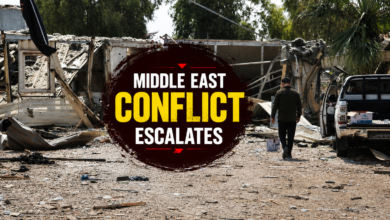
At the same time, Israeli military operations in Lebanon have intensified significantly. The IDF conducted a large-scale series of airstrikes targeting more than 100 Hezbollah-related sites across the country. These targets included headquarters, command-and-control centers, missile launch facilities, and infrastructure associated with Hezbollah’s drone units and elite Radwan Force.
The strikes were carried out in multiple locations, including central Beirut, southern Lebanon, and the Bekaa Valley. Open-source intelligence accounts have published geolocated footage showing explosions in central Beirut neighborhoods such as Ain al Mraiseh and Mazraa. While Israeli forces have frequently targeted Hezbollah strongholds in the southern suburbs of Beirut, strikes in central areas of the city are less common and represent a notable escalation.
Israeli Defense Minister Israel Katz described the operation as the “largest concentrated blow” against Hezbollah since a major operation in September 2024. According to the Lebanese Health Ministry, the strikes resulted in at least 182 deaths and 890 injuries. The figures do not distinguish between combatants and civilians, making it difficult to assess the full humanitarian impact of the operation.
The IDF has justified its actions by citing intelligence that Hezbollah has begun relocating its forces from traditional strongholds to densely populated civilian areas in central Beirut. According to Israeli military officials, this tactic is intended to complicate targeting efforts and increase the risk of civilian casualties. Such claims highlight the challenges of conducting military operations in urban environments where combatants and civilians are often in close proximity.
Among those reportedly killed in the strikes was Sadiq al-Nabulsi, a cleric aligned with Hezbollah who was targeted in an airstrike in the city of Sidon. Although not an official member of Hezbollah, Nabulsi was known for publicly supporting the group. His death underscores the broader scope of Israeli targeting, which extends beyond formal military personnel to include influential supporters.
The escalation of Israeli operations in Lebanon, combined with Iran’s conditional stance on the ceasefire, has introduced significant uncertainty into the diplomatic process. While the U.S.–Iran agreement represents an important step toward de-escalation, its limited scope and the absence of a comprehensive regional framework have created potential points of instability.
From a strategic perspective, the situation illustrates the difficulty of achieving lasting peace in a region characterized by multiple overlapping conflicts and alliances. While the United States and Iran may be able to reach a bilateral understanding, the actions of other actors—particularly Israel and Hezbollah—will continue to shape the overall trajectory of the conflict.
Pakistan’s role as a mediator has been widely recognized as a constructive factor in bringing the parties to the negotiating table. By facilitating dialogue between Washington and Tehran, Islamabad has positioned itself as an important diplomatic actor. The upcoming negotiations on April 10 will be a critical test of whether this initial progress can be translated into a more comprehensive and durable agreement.
Our Media Opinion, the two-week ceasefire agreement between the United States and Iran represents a significant but fragile step toward reducing tensions. While both sides have expressed a willingness to engage in negotiations, the evolving situation in Lebanon and differing interpretations of the agreement’s scope highlight the complexities involved. The success of the diplomatic process will depend not only on U.S.–Iran relations but also on the ability to address broader regional dynamics in a coordinated and inclusive manner.
war-times.com
Send an email
9 April 2026