

Proddatur Workers Observe ‘Black Day’ Against Four Labour Codes, Rally Demands Job Security and Equal Pay 2026
By Doruvu Paul Jagan Babu: Assistant Chief Editor

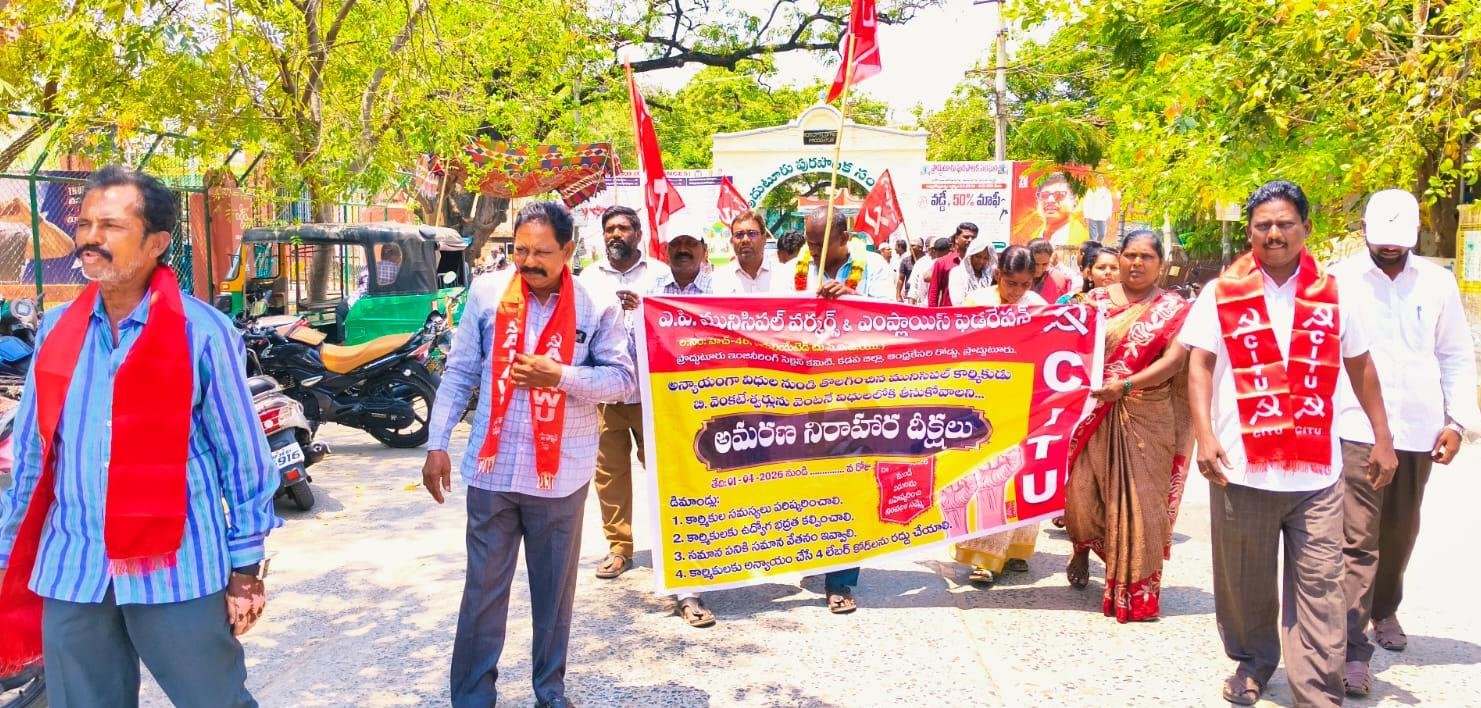
Proddatur – Andhra Pradesh: Municipal workers and trade union leaders in Proddatur staged a large-scale protest on Wednesday as part of a nationwide “Black Day” call, opposing the four new labour codes introduced by the Central Government and demanding job security, equal pay, and protection of workers’ rights.
‘Black Day’ call against labour codes
Responding to the nationwide call given by trade unions, workers under the banner of CITU observed April 1 as “Black Day” in protest against the four labour codes introduced by the Central Government led by Narendra Modi.
CITU District Secretary Satyanarayana announced that the protest was aimed at pressing key demands, including repeal of the labour codes, implementation of equal pay for equal work, job security, wage hikes, and regularization of contract and outsourced workers.
Rally held in Proddatur

As part of the agitation, a rally was organized from the Proddatur Municipal Office to Vijay Kumar Circle. Workers participated in large numbers, raising slogans against the new labour laws and what they termed as anti-worker policies of the Central Government. Union leaders stated that the move reflects growing unrest among workers across the country.
Criticism of new labour codes
Trade union leaders strongly criticized the new labour codes, alleging that they favour corporate and multinational interests at the cost of workers’ rights. They claimed that the codes, introduced in place of long-standing labour laws, would increase working hours, weaken job security, and fail to ensure timely payment of wages.
Threat to trade union rights

Leaders further expressed concern that the new labour framework could restrict the functioning of trade unions and limit their ability to fight for workers’ issues. They argued that the changes undermine decades of struggle that secured labour protections.
Call for united struggle
Emphasizing the need for unity, union leaders called upon workers to strengthen their collective struggle to safeguard their rights. They asserted that continued agitation is essential to resist policies perceived as detrimental to the working class.
Our Opinion
The protest in Proddatur is not an isolated—it is a signal of a deeper and widening conflict between policy decisions and ground-level realities. When workers across sectors come together under a “Black Day” banner, it reflects more than dissatisfaction; it indicates a serious trust gap between the government and the workforce.
The four labour codes were introduced with the stated aim of simplifying and modernizing India’s labour framework. On paper, efficiency and ease of doing business sound logical. But the real question is simple: who benefits the most, and who bears the cost?
Workers fear that flexibility for employers may translate into insecurity for employees. If job protection weakens, wages remain uncertain, and contract workers continue without stability, then reforms risk becoming one-sided. Economic growth cannot be sustainable if it sidelines the very workforce that drives it.
Another critical issue is perception. Whether the labour codes are actually harmful or not, a large section of workers believes they are. That alone is a problem. Policy without trust leads to resistance, and resistance at scale leads to instability.
At the same time, trade unions must also move beyond slogans and offer constructive engagement. Continuous protests without structured dialogue will only prolong the deadlock. Both sides—government and workers—need to shift from confrontation to negotiation.
Ignoring such protests would be a strategic mistake. Labour unrest, if left unaddressed, has the potential to spread, disrupt services, and impact economic productivity. More importantly, it can deepen social divisions.
The situation demands balance. Reforms are necessary, but so is protection. Growth is important, but so is fairness.
If this balance is not achieved, today’s protests could become tomorrow’s nationwide crisis.