

8 Alarming Indicators of Russia’s Relentless 2026 Push Toward Kramatorsk
By Samir Singh 'Bharat': Editor In Chief

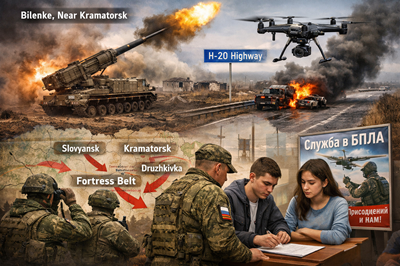
WAR-REPORT : Russian forces escalated military pressure in eastern Ukraine this week by shelling the settlement of Bilenke, a suburb northeast of Kramatorsk, in what analysts believe may signal the opening phase of a broader Spring–Summer 2026 offensive campaign. The strikes on February 26 and 27 marked the first reported use of tube artillery against Kramatorsk or its immediate outskirts since the start of Russia’s full-scale invasion, underscoring a potentially significant shift in Moscow’s operational posture in Donetsk Oblast.
Artillery Strikes Near the Fortress Belt
Bilenke lies roughly 14 kilometers from the current frontline and immediately northeast of Kramatorsk, forming part of the northern arc of Ukraine’s so-called “Fortress Belt” — a chain of fortified cities that has underpinned Ukrainian defensive operations in Donetsk Oblast since 2014. The Fortress Belt includes key urban strongholds such as Slovyansk, Kramatorsk, Druzhkivka, and Kostyantynivka. Together, these cities serve as a defensive backbone that has repeatedly absorbed and repelled Russian advances.
The use of tube artillery against Bilenke is notable for both tactical and symbolic reasons. Until now, Russian forces had largely refrained from directly targeting Kramatorsk and its immediate suburbs with sustained artillery barrages, instead focusing on frontline positions or conducting missile and drone strikes against deeper rear targets. Tube artillery, unlike long-range missile systems, indicates preparation for ground maneuver warfare. It is typically employed to soften defensive lines, degrade logistics, and sow confusion before infantry and armored units attempt advances.
Military observers suggest that the artillery strikes against Bilenke likely represent the beginning of a preparatory fires phase ahead of a larger ground offensive. Historically, Russian doctrine emphasizes a methodical approach in which artillery is used extensively to degrade enemy defenses before mechanized units attempt breakthroughs. If this pattern holds, ground assaults could follow in the near term.
Battlefield Air Interdiction Intensifies
Simultaneously, Russian forces appear to be expanding a campaign of battlefield air interdiction (BAI) along the southern segment of the Fortress Belt. BAI refers to the use of air power to strike targets in the operational rear of the frontline, typically 20 to 100 kilometers behind the line of contact, with the aim of disrupting supply routes, command posts, reinforcements, and logistics hubs.

In the current phase of the war, Russia has relied heavily on drone warfare to execute this interdiction strategy. Geolocated footage published on February 26 reportedly showed Russian drone strikes targeting a civilian cyclist on the Kostyantynivka–Slovyansk highway northwest of Kostyantynivka, as well as Ukrainian forces in Oleksiievo-Druzhkivka, both situated near the southern edge of the Fortress Belt.
The Kostyantynivka–Slovyansk corridor includes the H-20 highway, the principal ground line of communication (GLOC) linking major urban centers within the defensive belt. By targeting this route, Russian forces appear intent on complicating Ukrainian logistical flows and isolating strongpoints from one another.
Russia has employed similar BAI campaigns in previous operational cycles, including prior offensives in eastern and southern Ukraine. These interdiction efforts typically precede ground thrusts and are designed to erode defensive resilience gradually. By striking both military and infrastructure targets in the operational rear, Moscow aims to force Ukrainian commanders to divert resources from frontline defense toward rear-area security and air defense.

Reinforcements in the Slovyansk Direction
Additional indications of impending offensive operations emerged on February 26, when a Ukrainian servicemember operating in the Slovyansk direction reported that Russian command had deployed reinforcements to that axis. Slovyansk, together with Kramatorsk, forms the northern anchor of the Fortress Belt and has long been viewed as a strategic objective for Russian planners.
The movement of reinforcements suggests prioritization. Russia’s military has faced resource constraints throughout the conflict and has often been compelled to sequence its offensives due to manpower and equipment limitations. Concentrating additional units near Slovyansk implies an intention to intensify pressure in that sector.
However, a direct ground offensive to seize the entire Fortress Belt would likely constitute a prolonged and costly undertaking. Ukrainian defenses in these cities are deeply entrenched, fortified over more than a decade of intermittent conflict. Urban warfare in such environments tends to favor defenders and often results in high casualties and extensive destruction.
Analysts caution that capturing the Fortress Belt would probably require sustained multi-year operations, significant manpower, and vast quantities of ammunition and armored assets. To date, Russian forces have struggled to mass sufficient resources for decisive breakthroughs in similarly fortified areas. Previous campaigns have often devolved into grinding attritional battles rather than rapid advances.
Strategic Implications
The emerging pattern—artillery preparation in Bilenke, drone-based interdiction along the H-20 corridor, and reinforcement of the Slovyansk axis—fits a broader Russian campaign design. Moscow appears intent on gradually degrading Ukrainian defensive capacity ahead of committing to large-scale maneuver operations.
This approach reflects lessons learned earlier in the war, when rapid thrusts without adequate preparation often faltered. By contrast, extended preparatory phases seek to weaken defenses incrementally, reduce Ukrainian operational flexibility, and set conditions for eventual territorial gains.
At the same time, Ukraine continues to fortify positions, deploy counter-battery systems, and expand drone defenses. The coming months may therefore witness an intensification of long-range fires and drone engagements before any clear ground breakthrough materializes.
Recruitment Push in Higher Education
Parallel to developments on the battlefield, Russia is reportedly expanding recruitment efforts within higher educational institutions to staff its Unmanned Systems Forces (USF). According to reporting by the BBC Russian Service, the Russian Ministry of Defense (MoD) has broadened recruitment activities to at least 95 educational institutions across the country. In 90 of these institutions, officials reportedly conducted face-to-face meetings urging students to sign contracts.
These efforts are part of a larger strategy to bolster Russia’s unmanned warfare capabilities. The war in Ukraine has underscored the central role of drones in reconnaissance, strike operations, and electronic warfare. By recruiting students into USF units, the MoD appears to be tapping into a technologically literate demographic capable of operating and maintaining advanced systems.
The BBC report indicated that the 95 institutions listed do not include universities where recruitment is conducted indirectly, such as through the establishment of unmanned systems centers on campuses. Universities have reportedly publicized successful recruitment cases, possibly to encourage broader participation.
Germany-based Russian opposition outlet Echo reported that recruitment spans at least 57 universities and 13 colleges across 24 federal subjects, including occupied Crimea. Echo noted that the recruitment drive has expanded beyond academically underperforming students and now targets the general student population.
According to Echo, the MoD has assured recruits that they would serve exclusively in USF units—positions perceived as less hazardous than infantry roles. However, some contracts reportedly contain clauses permitting assignment to any military unit at the MoD’s discretion.
“Carrot and Stick” Approach
Recruitment efforts appear to employ both incentives and pressure tactics. Benefits reportedly include competitive salaries, a guaranteed single year of service, education grants, and student debt forgiveness. At the same time, opposition outlets claim that coercion and threats have been used to secure signatures.
Meduza reported that the Nikolai Lunin Novosibirsk College of Transport Technologies organized a three-day screening of propaganda films depicting alleged “betrayers” of Russia after students refused to volunteer for military service. Such actions suggest an effort to shape perceptions and reduce resistance among the student body.
The MoD initially targeted academically underperforming students in December 2025 before broadening the campaign in January 2026. Observers believe that some student recruits may ultimately serve in conventional units, despite assurances regarding USF placement.
Recruitment Challenges
Russia’s intensified recruitment drive comes amid mounting manpower pressures. Reports indicate that in January 2026, Russia’s casualty rate outpaced its recruitment rate for the first time since the beginning of the full-scale invasion. Sustained high casualties, combined with war fatigue and demographic constraints, have complicated efforts to replenish frontline units.
By expanding recruitment into higher education institutions, the MoD may be attempting to stabilize force generation without resorting to another large-scale mobilization, which could prove politically sensitive domestically.
Outlook
The convergence of intensified artillery strikes near Kramatorsk, expanded drone interdiction campaigns, reinforcement deployments, and aggressive recruitment efforts suggests that Russia may be preparing for a significant new operational phase in eastern Ukraine.
Whether this anticipated Spring–Summer 2026 offensive achieves strategic gains remains uncertain. Ukrainian defenses in the Fortress Belt are formidable, and Russia’s ability to sustain high-intensity operations depends on continued manpower, logistics, and industrial output.
As the war enters another year, both sides appear locked in a cycle of preparation and counter-preparation. The coming months may determine whether Russia can translate its current preparatory measures into meaningful territorial advances—or whether the con