

Russia Expands Naval Drone Regiments as Putin Signals Broader
Moscow Accelerates Naval Modernization Amid Growing Ukrainian Drone Threats

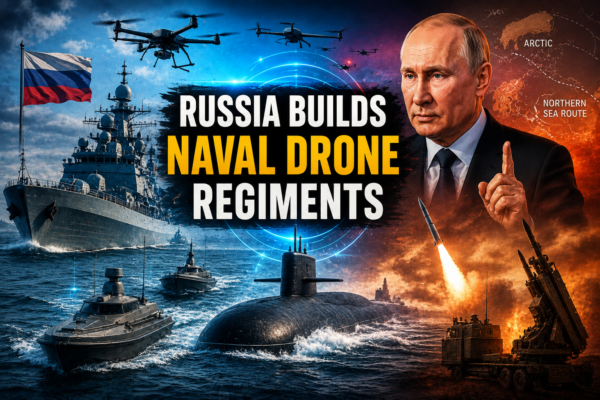
War-Report : Moscow: Russia has announced the formation of specialized unmanned systems regiments within its navy, marking a significant step in modernizing its maritime forces as Ukrainian drone strikes continue to challenge Russian naval operations in the Black Sea and the Sea of Azov. The move reflects Moscow’s increasing reliance on autonomous technologies to protect its fleet, safeguard strategic ports, and strengthen its overall military capabilities.
Russian Navy Commander-in-Chief Admiral Alexander Moiseyev revealed that the country’s first Naval Unmanned Systems Regiment officially became operational within the Northern Fleet on July 1, 2026. According to Moiseyev, additional unmanned regiments will be established throughout the Northern Fleet before the end of the year, while similar formations are expected to be introduced into the Pacific Fleet beginning in 2027.
The announcement underscores Russia’s growing recognition that unmanned aerial, surface, and underwater systems have become essential components of modern naval warfare.
Response to Ukraine’s Expanding Drone Campaign
Military analysts believe the decision is largely driven by the increasing effectiveness of Ukrainian long-range drone attacks targeting Russian naval assets.
Over the past two years, Ukraine has successfully employed maritime drones, aerial drones, and precision strikes against Russian ships, naval headquarters, fuel depots, and logistics facilities throughout the Black Sea region. These operations have forced Russia to relocate several major vessels away from Crimea and reinforce coastal defenses.

Despite deploying anti-drone barriers, electronic warfare systems, patrol aircraft, and mobile defense units, Russia has struggled to completely prevent repeated Ukrainian attacks.
The creation of dedicated unmanned naval regiments appears intended to improve surveillance, early warning, reconnaissance, and rapid response capabilities while integrating drone technology directly into naval command structures.
Integration of Unmanned Warfare into the Russian Navy
Russia began establishing its dedicated Unmanned Systems Forces (USF) in 2024 to centralize drone operations supporting ground forces in Ukraine.

However, the newly announced naval unmanned regiments will operate separately under the direct authority of the Russian Navy rather than the existing USF command.
This organizational shift demonstrates that unmanned systems are no longer viewed as supporting assets alone but are becoming independent operational components across every military branch.
The naval units are expected to utilize a combination of:
- Maritime reconnaissance drones
- Autonomous surface vessels
- Underwater robotic systems
- Electronic warfare platforms
- Counter-drone technologies
- Artificial intelligence-assisted surveillance systems
Such capabilities are designed to detect incoming threats, protect warships, monitor coastal regions, and enhance maritime intelligence gathering.
Major Naval Expansion Continues
Alongside announcing the drone regiments, Admiral Moiseyev highlighted broader naval modernization efforts.
According to Russian officials, the Navy has already commissioned 20 ships, vessels, and boats during 2026 and plans to introduce another 21 vessels before the year’s end.
Among the most significant additions will be Russia’s first nuclear-powered submarine equipped with the Zircon (Zirkon) hypersonic missile system.
The Zircon missile is regarded as one of Russia’s most advanced weapons, reportedly capable of traveling at hypersonic speeds while engaging both naval and land targets over long distances.
Russian defense planners argue that these platforms will significantly strengthen the country’s strategic deterrence capabilities.
Putin Uses Navy Day to Project Military Strength
Russian President Vladimir Putin used the annual Navy Day celebrations on July 26 to reinforce Moscow’s military posture beyond the ongoing war in Ukraine.
During his address, Putin described the Russian Navy as an essential instrument for achieving Russia’s strategic objectives while maintaining global security interests.
He emphasized that naval modernization remains one of the country’s highest defense priorities.
According to Putin, Russia intends to continue expanding its military capabilities across multiple regions, particularly the Arctic.
Renewed Focus on the Arctic
One of the most notable aspects of Putin’s speech was his emphasis on Franz Josef Land, a remote Arctic archipelago inhabited primarily by Russian military personnel.
Putin stated that Russia has begun restoring and strengthening its military presence across the islands in response to increasing international competition in the Arctic.
The Arctic has become strategically important because of:
- Vast untapped natural resources
- Emerging shipping routes
- Military positioning
- Climate-driven accessibility
- Energy exploration opportunities
Russia views the region as vital to its long-term geopolitical interests.
Northern Sea Route Remains a Strategic Priority
Putin also reaffirmed Moscow’s commitment to securing the Northern Sea Route (NSR).
The route, stretching across Russia’s Arctic coastline, has gained increasing economic significance as melting sea ice allows longer navigation periods each year.
Russia considers much of the route to lie within its territorial waters and has repeatedly asserted control over commercial shipping operations using the passage.
Moscow believes the NSR could become one of the world’s most important maritime trade corridors connecting Europe and Asia.
Protecting the route has therefore become a major element of Russia’s national security strategy.
Kaliningrad Remains a Strategic Flashpoint
Putin additionally stressed that Russia would defend Kaliningrad, its heavily militarized Baltic exclave situated between Poland and Lithuania.
He declared that Russia would use “all available means” if threats emerged against the region.
Kaliningrad hosts significant Russian military assets, including naval forces, air defense systems, missile units, and electronic warfare capabilities.
Its strategic location makes it a central focus of NATO-Russia military planning.
Technology Reshaping Naval Warfare
The Russian Navy’s adoption of dedicated unmanned formations reflects broader global military trends.
Navies worldwide are increasingly investing in autonomous systems capable of:
- Intelligence collection
- Mine detection
- Anti-submarine warfare
- Fleet protection
- Maritime surveillance
- Precision strike support
The conflict in Ukraine has accelerated this transformation by demonstrating how relatively inexpensive drones can threaten high-value naval assets worth hundreds of millions of dollars.
Strategic Implications
Russia’s latest military reforms indicate that Moscow is adapting to lessons learned during the Ukraine conflict while preparing for future multidomain warfare.
The establishment of naval unmanned regiments, continued investment in advanced submarines, and renewed emphasis on Arctic security collectively signal a broader effort to strengthen Russia’s long-term strategic posture.
At the same time, Putin’s remarks extending beyond Ukraine—to the Arctic, Northern Sea Route, and Kaliningrad—highlight the Kremlin’s intention to project military influence across multiple regions rather than focusing solely on the current conflict.
As drone technology continues reshaping modern warfare, Russia’s evolving naval strategy illustrates how autonomous systems are becoming central to national defense planning, maritime security, and great-power competition in the years ahead.