


INTERPOL-Led Global Crackdown Nets 5,811 Suspects, Seizes USD 293 Million in Massive Anti-Fraud Operation
Special Correspondence


Operation First Light 2026 Exposes Worldwide Cyber Scam Networks Across 97 Countries and Territories
Special Report : LYON, France: In one of the largest coordinated international operations against cyber-enabled financial crime, INTERPOL has announced the successful conclusion of Operation First Light 2026, a four-month global enforcement campaign that resulted in the arrest of 5,811 suspects, the identification of over 15,600 alleged offenders, and the seizure or freezing of approximately USD 293 million in illicit assets.
Conducted between 15 January and 30 April 2026, the operation brought together law enforcement agencies from 97 countries and territories, demonstrating an unprecedented level of international cooperation against sophisticated social engineering scams, cyber fraud syndicates, and global money laundering networks.
A Coordinated Global Response to a Growing Threat
Social engineering fraud has become one of the fastest-growing forms of transnational organized crime. Unlike traditional cyberattacks that rely solely on hacking computer systems, social engineering scams manipulate human emotions such as fear, trust, urgency, and greed to deceive victims into voluntarily transferring money or revealing confidential information.
Recognizing the scale of this evolving threat, INTERPOL coordinated intelligence-sharing, operational planning, and synchronized enforcement actions involving national police agencies, financial intelligence units, cybercrime divisions, and anti-money laundering authorities across multiple continents.
Following months of intelligence collection and analysis, participating countries launched coordinated raids, arrests, financial investigations, digital forensic examinations, and asset-freezing operations targeting criminal organizations operating both online and offline.

Remarkable Results of Operation First Light 2026
According to INTERPOL, the operation produced significant results worldwide, including:
- 5,811 suspects arrested
- 15,606 suspects identified
- 152,808 fraud cases analyzed
- 23,715 criminal cases solved
- 142,000+ victims identified globally
- 31,014 bank accounts blocked or frozen
- 99 INTERPOL Notices and Diffusions issued
- USD 293 million worth of criminal assets intercepted
Investigators believe these figures represent only a fraction of the actual global financial damage caused by cyber-enabled fraud.

Understanding Social Engineering Scams
INTERPOL emphasized that social engineering fraud encompasses a broad range of criminal techniques designed to manipulate victims psychologically rather than technically.
These include:
- Business Email Compromise (BEC)
- Romance scams
- Investment fraud
- Sextortion schemes
- Government impersonation fraud
- Online shopping scams
- Cryptocurrency investment fraud
- Fake employment offers
- Lottery and prize scams
- Technical support fraud
Criminal organizations increasingly combine artificial intelligence, stolen identities, fake websites, spoofed phone numbers, and cryptocurrency payment systems to make their scams appear authentic.
Intelligence Sharing Played a Critical Role
A key component of Operation First Light was extensive intelligence sharing between participating countries.
Authorities exchanged:
- Criminal intelligence
- Financial transaction data
- Cryptocurrency wallet information
- Digital evidence
- Suspicious banking activity
- International arrest requests
- Cross-border investigative leads
INTERPOL’s secure communication platforms enabled investigators across multiple jurisdictions to identify transnational criminal networks operating simultaneously in different countries.
I-GRIP Helped Freeze Criminal Funds Quickly
One of the operation’s most effective tools was INTERPOL’s Global Rapid Intervention of Payments (I-GRIP) mechanism.
The system enables law enforcement agencies to rapidly request the freezing of suspicious financial transactions before criminals can move stolen funds through multiple banking systems or convert them into cryptocurrency.
Through I-GRIP, authorities successfully blocked millions of dollars before they disappeared into international laundering networks.
Eswatini: Fake Brazilian Police Station Used to Trick Victims
One of the most extraordinary cases uncovered during the operation occurred in Eswatini, where investigators dismantled an elaborate criminal organization involved in illegal online gambling, money laundering, and impersonation scams.
Authorities arrested 82 suspects during coordinated raids.
Police also seized:
- 240 electronic devices
- Foreign currencies
- Multiple digital storage devices
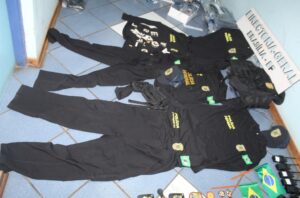
- Fake official uniforms
- Counterfeit police signage
- Communication equipment
Perhaps most remarkably, investigators discovered an entire replica of a Brazilian Federal Police station, complete with realistic uniforms, official-looking signs, furniture, and equipment.
The fraudsters used video calls from this fake police station to convince victims they were under investigation and instructed them to transfer their savings into so-called “safe government accounts.”
The money was instead stolen by the criminal syndicate.
Due to the enormous quantity of digital evidence recovered, INTERPOL deployed a specialized Operational Support Team to assist local investigators with forensic analysis.
Thailand Uncovers Massive Cryptocurrency Laundering Network
Authorities in Thailand arrested two suspects connected to a sophisticated money laundering operation linked to international romance scams.
Investigators discovered that one suspect, only 20 years old, controlled cryptocurrency wallets that processed more than USD 122.5 million within just ten months.
The organization allegedly used:
- Cross-chain cryptocurrency swaps
- Multiple digital wallets
- Blockchain mixing techniques
- International exchanges
to conceal the origin of stolen funds before redistributing them through international criminal networks.
Singapore and Oman Prevent USD 6.6 Million Fraud
Another significant success occurred through cooperation between Singapore and Oman.
Authorities intercepted an illicit transfer worth USD 6.6 million linked to a sophisticated Business Email Compromise (BEC) scam.
Criminals impersonated a legitimate supplier and successfully deceived a Singapore-based commodity trading company into preparing payment to fraudulent bank accounts.
Quick intervention through INTERPOL’s I-GRIP mechanism enabled authorities to freeze the transaction before the funds disappeared.

Macao Police Rescue Fraud Victim During Public Awareness Campaign
An unusual success story emerged from Macao, China, where police officers conducting an anti-fraud public awareness campaign encountered an individual who was actively communicating with fraudsters.
The victim had been convinced by criminals impersonating government officials that they were involved in a financial crime investigation.
The fraudsters demanded approximately USD 372,000 for so-called “investigative purposes.”
Because officers identified the scam during the outreach campaign, they intervened before the victim transferred the money.
The case demonstrated how public education can directly prevent financial crime.
Scam Centres Shut Down in Palau
Authorities in Palau dismantled two scam centres operating from hotels.
Investigators deported 22 foreign nationals believed to be operating cryptocurrency fraud schemes, illegal gambling websites, and other online scams targeting victims overseas.
The operation disrupted organized criminal activities that had been using hotel facilities as temporary cybercrime headquarters.
INTERPOL Warns Fraud Continues to Expand
Tomonobu Kaya, Director of the INTERPOL Financial Crime and Anti-Corruption Centre, warned that social engineering scams remain among the world’s fastest-growing criminal threats.
According to INTERPOL, organized criminal groups continue to exploit human psychology because manipulating people often proves easier than hacking secure computer systems.
The organization stressed that international cooperation is essential because modern fraud networks operate across multiple jurisdictions simultaneously.
International Cooperation at Historic Scale
Operation First Light 2026 involved participation from countries across:
- Asia
- Europe
- Africa
- North America
- South America
- Oceania
- Middle East
Regional law enforcement organizations including ASEANAPOL, GCCPOL, and Europol also supported the operation.
Funding for the initiative was provided by China’s Ministry of Public Security, while INTERPOL coordinated intelligence, communications, and operational planning among participating member countries.
Financial Crime Becoming Increasingly Global
Experts note that fraud syndicates increasingly resemble multinational corporations.
These criminal organizations often maintain:
- Customer service teams
- Call centres
- Fake investment platforms
- Money laundering specialists
- Cryptocurrency experts
- Identity document forgers
- Technology developers
Their operations span multiple countries, making international cooperation indispensable.
Protecting Citizens Against Social Engineering
INTERPOL urged individuals and businesses to remain vigilant against increasingly sophisticated fraud techniques.
Authorities recommend:
- Verifying payment requests independently.
- Never transferring money under pressure.
- Confirming changes to banking information through trusted contacts.
- Avoiding unsolicited investment opportunities.
- Being cautious with online relationships requesting financial assistance.
- Reporting suspicious communications immediately.
A Continuing Global Fight
Operation First Light 2026 demonstrates that coordinated international policing can significantly disrupt sophisticated cyber-enabled financial crime. However, INTERPOL cautioned that criminal syndicates continue to adapt rapidly by exploiting emerging technologies, cryptocurrencies, artificial intelligence, and cross-border financial systems.
The agency reaffirmed its commitment to strengthening global partnerships, enhancing intelligence sharing, and expanding international operational capabilities to combat cyber fraud, money laundering, and organized financial crime. As digital scams become increasingly complex and transnational, sustained collaboration between governments, law enforcement agencies, financial institutions, and the private sector will remain essential to protecting citizens and safeguarding the integrity of the global financial system.