

Russia Prioritizes Attrition Warfare in Ukraine as Economic Pressures Deepen
Ukraine's Pressure on Logistics

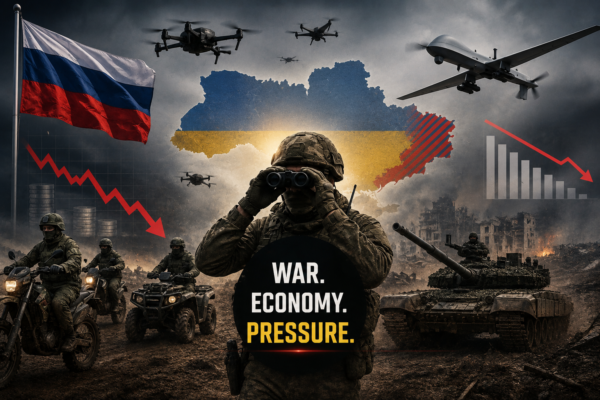
War-Report : Moscow: Russia’s military leadership appears to be doubling down on a strategy of prolonged positional warfare in Ukraine rather than preparing for large-scale mechanized offensives, according to recent assessments. The approach emphasizes the use of drones, motorcycles, all-terrain vehicles (ATVs), and other lightweight mobility platforms instead of heavy armored formations, reflecting Moscow’s continued focus on incremental battlefield gains.
During a Russian Ministry of Defense (MoD) board meeting on July 17, Defense Minister Andrei Belousov met with senior military officials and deputy defense ministers to review progress on defense objectives established at the end of 2025. Discussions centered on improving battlefield logistics, expanding drone capabilities, and increasing the mobility of frontline assault units.
Shift Toward Small, Mobile Assault Units
Deputy Defense Minister for Logistics Colonel General Alexander Sanchik stated that Russian forces have significantly improved battlefield mobility by expanding the deployment of motorcycles, buggies, ATVs, unmanned aerial vehicles (UAVs), and unmanned ground vehicles (UGVs). These systems are increasingly being used to deliver supplies and support troops operating in contested frontline zones.
Deputy Defense Minister Alexey Krivoruchko claimed that more than 8,000 drone specialists had been trained during the first half of 2026 and that drone deliveries to frontline units had more than doubled compared to the previous year.
Military analysts, however, have questioned these claims, arguing that Russia continues to face shortages of qualified drone operators and ongoing recruitment and training bottlenecks within its unmanned systems units.

Focus Remains on Slow Territorial Gains
The latest announcements suggest that Russia remains committed to a battlefield doctrine centered on gradual advances rather than rapid armored breakthroughs. Instead of relying on tanks and large mechanized formations, Russian forces continue to prioritize small assault groups supported by drones and light vehicles.
Analysts note that this strategy reflects the realities of modern battlefield conditions, where extensive drone surveillance, precision strikes, and fortified defensive positions make traditional large-scale maneuver warfare increasingly difficult.
Despite these adjustments, Russian forces have struggled to achieve significant territorial gains in recent months. Current battlefield assessments indicate that the pace of Russian advances remains limited, highlighting the challenges of sustaining offensive operations under heavily contested conditions.

Economic Strains Continue to Mount
At the same time, Russia’s war effort is placing growing pressure on its domestic economy.
The Moscow Exchange Composite Index (IMOEX) recorded one of its sharpest declines since 2022, while shares of major state-owned financial institutions, including VTB Bank, also fell significantly.
Economic indicators released by Russia’s Central Bank showed that business confidence weakened further in July, with the Business Climate Indicator (BCI) falling to its lowest level since the early months following the 2022 invasion of Ukraine.
Economists suggest that prolonged military spending, persistent inflation, labor shortages across key industries, and increasing pressure on public finances are contributing to the slowdown.
Defense Spending Reshapes the Economy
Russia’s continued prioritization of defense production has strengthened parts of its military-industrial sector but has also diverted resources away from civilian industries. Rising government expenditures on the war, combined with workforce shortages and reduced private investment, are placing additional strain on long-term economic growth.
Financial experts also point to the depreciation of state-owned financial institutions and continued government intervention in parts of the economy as factors affecting investor confidence.
Ukraine’s Pressure on Logistics
Ukraine’s long-range strikes against Russian military infrastructure, fuel facilities, and logistics networks continue to complicate Moscow’s operational planning. The disruption of supply chains has increased the importance of drones, unmanned logistics systems, and smaller, more flexible assault formations for Russian forces operating along the front.
Strategic Outlook
Military observers believe Russia is preparing for a prolonged conflict characterized by attritional warfare rather than rapid offensives. While the expansion of drone capabilities and lightweight assault units may improve tactical flexibility, they are unlikely to produce decisive battlefield breakthroughs without broader operational changes.
At the same time, sustaining the war effort is expected to remain an increasing challenge as economic pressures continue to build, forcing Moscow to balance military priorities with growing domestic financial constraints.
The evolving battlefield strategy and mounting economic challenges suggest that Russia’s campaign in Ukraine is entering another phase where endurance, logistics, and industrial capacity may prove as decisive as military operations on the front lines.