


Bareilly Man Loses ₹5.41 Lakh After Opening Fake Wedding Invitation
Invitation PDF on WhatsApp-Shocking Digital Trap:
 Samir Singh 'Bharat'-Editor-in-Chief
Send an email
20 May 2026
Samir Singh 'Bharat'-Editor-in-Chief
Send an email
20 May 2026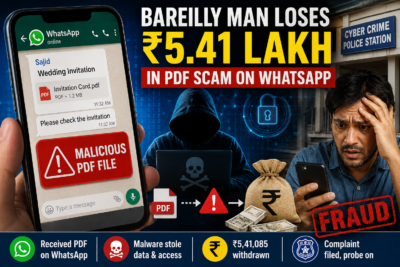
Bareilly, Uttar Pradesh: In a disturbing case that highlights the rapidly evolving tactics of cyber criminals in India, a man from Bareilly district allegedly lost more than ₹5.41 lakh after opening a malicious wedding invitation PDF received on WhatsApp. The incident has once again raised serious concerns about digital security, malware-based cyber fraud, and the increasing sophistication of online scammers targeting ordinary smartphone users.
The victim, identified as Nitin Gupta, a resident of the Dunka area in Shahi, approached the Cyber Crime Police Station after discovering that a huge amount had been fraudulently withdrawn from his bank account. According to police officials, the cyber fraud appears to have been executed through a malware-infected PDF file disguised as a wedding invitation card.
Authorities believe the incident may be part of a growing trend in which fraudsters use fake social invitations, APK files, PDF attachments, and phishing links to secretly gain access to victims’ devices, banking information, and personal data.
WhatsApp Message Turned Into Financial Nightmare
According to the complaint filed by Nitin Gupta, the chain of events began on April 22 when he received a WhatsApp message from an unknown mobile number. The sender introduced himself as “Sajid” and sent what appeared to be a wedding invitation card in PDF format.
The document looked genuine and harmless at first glance. Since wedding invitations through WhatsApp have become increasingly common in India, Nitin reportedly did not suspect anything unusual. Believing the message to be authentic, he downloaded and opened the PDF file on his smartphone.

Soon after opening the document, unexpected technical issues began occurring on the device.
Nitin told investigators that WhatsApp was automatically deleted from his phone shortly after he accessed the file. Initially confused, he reinstalled the application and logged in again. However, after reinstalling WhatsApp, he noticed that nearly two months of chats, media files, and application data had disappeared completely.
At that moment, he still did not realise he may have become a victim of cyber fraud.

Silent Malware Attack Suspected
Cyber investigators now suspect that the PDF attachment may have contained hidden malware, spyware, or a phishing exploit capable of compromising the victim’s mobile device.
Experts explain that modern cyber criminals are increasingly using sophisticated malicious files disguised as ordinary documents. Once opened, such files can secretly install malware, steal passwords, track OTPs, monitor banking applications, or provide remote access to hackers.
Investigators suspect that the malware may have silently collected sensitive information stored on Nitin’s phone, including banking credentials, saved passwords, SMS alerts, UPI details, and financial app access.
Police are also examining whether the malware enabled remote control of the device or intercepted authentication messages required for financial transactions.
Discovery of Fraudulent Transactions
For several weeks after opening the suspicious PDF, Nitin remained unaware that cyber criminals may have gained access to his banking information.
The shocking truth came to light on May 15 when he checked his bank account and discovered that ₹5,41,085 had been withdrawn fraudulently through unauthorized transactions.
The sudden disappearance of such a large amount left the victim shocked and distressed. Realising he had become the target of a cyber scam, he immediately contacted the Cyber Crime Police Station and submitted a formal complaint.
The complaint was registered on May 18 before Inspector KB Singh, who is currently leading the investigation into the matter.
Police Begin Detailed Investigation
Following the complaint, police initiated a detailed cyber investigation to trace the source of the malicious file, identify the mobile number used by the accused, and track the flow of stolen money.
According to Inspector KB Singh, preliminary findings strongly suggest that the PDF file contained either malware or a phishing-based exploit designed specifically to compromise mobile devices.
“The entire matter is being investigated in detail. Technical experts are examining the victim’s mobile phone, transaction records, digital footprints, and the suspicious PDF file,” the officer stated.
Authorities are also coordinating with banks, telecom service providers, and cyber forensic experts to trace the accounts where the stolen funds were transferred.
Police suspect that the fraudsters may have routed the money through multiple mule accounts or digital wallets to avoid detection.
Rise of PDF-Based Cyber Frauds
Cyber security experts warn that criminals are increasingly shifting from traditional scam calls and OTP frauds to more advanced malware-driven attacks.
In recent months, several cyber fraud cases across India have involved fake APK files, malicious PDF documents, phishing emails, and fraudulent app downloads disguised as wedding invitations, courier notifications, electricity bills, or KYC update messages.
Unlike ordinary scam links, malicious PDF files are particularly dangerous because many users consider them safe and trustworthy.
Experts explain that advanced malware can exploit vulnerabilities in smartphones and messaging applications once a file is opened. In some cases, victims do not even realise their device has been compromised.
Cyber criminals often use social engineering techniques to gain trust. Wedding invitations are especially effective because recipients are naturally curious and less likely to suspect malicious intent.
Cyber Criminals Exploiting Human Psychology
Investigators say the success of such scams often depends more on psychological manipulation than technical hacking.
Fraudsters carefully design messages that appear familiar, emotional, or urgent. Invitations, family events, festival greetings, job offers, parcel delivery notifications, and banking alerts are commonly used themes to trick users into downloading infected files.
Cyber experts note that criminals take advantage of people’s trust and lack of technical awareness.
In many cases, victims unknowingly grant permissions or access to malicious applications, allowing hackers to monitor activities, steal information, or conduct unauthorized transactions.
The Bareilly case demonstrates how even a simple PDF attachment can become a gateway for large-scale financial theft.
Financial Losses Due to Cyber Crime Rising Rapidly
India has witnessed a sharp increase in cyber fraud cases over the past few years as digital banking, online payments, and smartphone usage continue to expand rapidly.
According to cyber crime officials, fraudsters are now using increasingly sophisticated methods involving remote access malware, phishing kits, fake investment schemes, cloned applications, and AI-generated scams.
Elderly individuals, small business owners, and users unfamiliar with cyber security practices are often the most vulnerable targets.
Financial losses due to cyber frauds across the country are running into hundreds of crores annually, with many victims struggling to recover stolen funds.
Investigators say that in many cases, victims report fraud too late, allowing criminals enough time to transfer money through multiple accounts and convert it into untraceable assets.
Importance of Immediate Reporting
Cyber crime experts stress that victims should immediately report suspicious financial activity through official channels.
Authorities recommend contacting the national cyber fraud helpline 1930 as soon as unauthorized transactions are noticed. Early reporting increases the chances of freezing stolen funds before they are fully transferred.
Victims are also advised to file complaints through the National Cyber Crime Reporting Portal and immediately inform their bank to block accounts, cards, and digital payment services.
In Nitin Gupta’s case, investigators are now examining whether faster detection could have reduced the financial loss.
Warning Issued for Smartphone Users
Following the incident, police have issued an advisory asking people to remain extremely cautious while opening files received from unknown numbers on WhatsApp or other messaging platforms.
Cyber experts recommend several basic precautions:
- Never open PDF files, APKs, or links from unknown senders.
- Avoid downloading suspicious attachments.
- Use updated antivirus and security software on smartphones.
- Enable two-factor authentication for banking applications.
- Avoid saving passwords or sensitive financial information on mobile devices.
- Regularly update operating systems and applications.
- Monitor bank account activity frequently.
- Immediately report unusual device behavior or unauthorized transactions.
Experts also advise users to avoid clicking on invitations, KYC requests, or parcel delivery messages unless verified directly with the sender.
Growing Need for Cyber Awareness
The Bareilly incident has once again highlighted the urgent need for large-scale cyber awareness campaigns across the country.
As technology becomes more advanced, cyber criminals are also becoming more innovative in exploiting digital platforms. Experts believe that public awareness is the strongest defence against such attacks.
Police departments, banks, schools, and digital platforms are increasingly encouraging users to learn basic cyber hygiene practices to avoid falling victim to online fraud.
Authorities say even educated and technologically active users can become targets if they fail to exercise caution.
Investigation Continues
The Cyber Crime Police Station in Bareilly is continuing its investigation into the fraud. Officials are analysing digital evidence, transaction trails, IP logs, and the suspicious PDF file used in the scam.
Efforts are underway to identify the individuals behind the WhatsApp number and trace the bank accounts involved in receiving the stolen funds.
Police believe the fraud may be linked to a larger organized cyber crime network operating across multiple states.
As investigators continue to uncover more details, the case serves as a powerful reminder that even a seemingly harmless wedding invitation on WhatsApp can become a dangerous cyber trap capable of causing devastating financial losses.
Bareilly cyber fraud case has exposed a dangerous new tactic being used by online scammers across India. A man from Bareilly, Uttar Pradesh allegedly lost more than ₹5.41 lakh after opening a fake wedding invitation PDF received on WhatsApp from an unknown number. According to Bareilly Cyber Crime Police, the malicious PDF may have contained hidden malware that secretly accessed banking details and enabled unauthorized transactions. Investigators in Bareilly suspect the fraudsters used advanced cyber tools to steal sensitive information from the victim’s smartphone. The shocking Bareilly incident has raised serious concerns over WhatsApp PDF scams, mobile malware attacks, and the growing threat of cyber fraud targeting ordinary smartphone users across the country.