


China and North Korea Deepen Strategic Ties Amid Rising Military Concerns
By Samir Singh 'Bharat': Editor In Chief
 war-times.com
Send an email
15 April 2026
war-times.com
Send an email
15 April 2026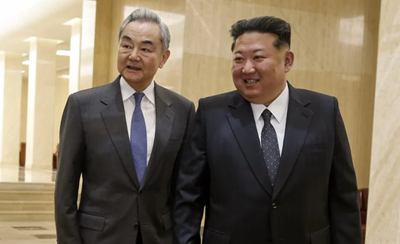
Special Report : North Korea has extended a significant diplomatic gesture by inviting the Foreign Minister of the People’s Republic of China, Wang Yi, to visit Pyongyang. The visit, which took place from April 9 to April 10, marked his first trip to the country since 2019 and signals a renewed effort by both nations to strengthen bilateral cooperation. Analysts believe that beyond reinforcing ties, the move may also be aimed at positioning China as a potential intermediary in future engagement between the United States and North Korea—provided Washington agrees to Pyongyang’s conditions.
According to official statements released by North Korean state media, the invitation for Wang Yi originated from Pyongyang itself, underscoring the importance North Korea places on its relationship with Beijing. During his visit, Wang held extensive talks with North Korean Foreign Minister Choe Sun Hui. Both sides agreed to expand exchanges and cooperation throughout 2026, a symbolic year marking the 65th anniversary of the 1961 Treaty of Friendship, Cooperation, and Mutual Assistance between the two nations.
This historic treaty remains a cornerstone of China–North Korea relations. It functions as a mutual defense pact, obligating both countries to provide military assistance to one another in the event of a conflict. The reaffirmation of this agreement highlights the enduring strategic alignment between Beijing and Pyongyang at a time of growing geopolitical tensions.
During the discussions, Wang Yi praised North Korea for what he described as its resilience in the face of sustained pressure and isolation from the United States and Western countries. His remarks echoed a broader narrative often promoted by both governments—that external pressures have failed to weaken their political systems or strategic resolve.

China’s official readout of the meeting emphasized North Korea’s support for the “One China principle,” including Beijing’s positions on Taiwan, Tibet, and Xinjiang. While North Korea’s initial statement did not explicitly mention Taiwan, the issue was addressed during a separate high-level meeting between Wang Yi and North Korean leader Kim Jong Un on April 10. In that meeting, Kim reportedly expressed full support for China’s territorial claims over Taiwan, describing them as legitimate.
Notably, neither side’s official statements referenced the United States or South Korea, despite their central role in regional security dynamics. This omission may indicate a deliberate effort to focus publicly on bilateral cooperation rather than broader geopolitical rivalries.
Emerging Missile Capabilities Raise Regional Security Concerns
While diplomatic ties between China and North Korea appear to be strengthening, developments in North Korea’s military capabilities are simultaneously raising alarm in the region. Recent missile tests conducted on April 7 and April 8 suggest that North Korea is advancing its ballistic missile technology, potentially incorporating cluster munition warheads to enhance their effectiveness.

North Korea tested two types of short-range ballistic missiles: the KN-25 and the KN-23, also known as the Hwasong-11A. One of the KN-25 launches reportedly failed shortly after liftoff, as the missile disappeared early in its flight. However, the KN-23 tests were more successful, with missiles traveling approximately 240 kilometers and 700 kilometers, respectively.
According to North Korean state media, the KN-23 test included a cluster munition warhead capable of dispersing submunitions across an area of 16 to 17 acres. Cluster munitions are designed to release dozens of smaller bomblets before impact, enabling a single missile to strike a wide area. This capability significantly increases the destructive potential of each missile and complicates efforts to defend against them.
The potential deployment of cluster munition warheads on ballistic missiles represents a notable shift in North Korea’s military strategy. Such weapons could overwhelm missile defense systems by saturating them with multiple targets, making interception far more difficult.
Learning from Global Conflicts
Experts suggest that North Korea may be drawing lessons from recent conflicts, particularly Iran’s use of cluster munitions in its confrontations with Israel and the United States. By observing how such weapons perform in real-world scenarios, North Korea could be adapting its own arsenal to maximize effectiveness against advanced defense systems.
This development is especially concerning for South Korea, which relies heavily on missile defense systems to counter the North Korean threat. If North Korea successfully integrates cluster munitions into its ballistic missile program, it could significantly reduce the effectiveness of these defenses.
Interestingly, North Korea has previously criticized the use of cluster munitions. In July 2023, Foreign Minister Choe Sun Hui condemned the United States for supplying such weapons to Ukraine, describing them as internationally banned. Despite this stance, evidence suggests that North Korea may have exported cluster-armed rockets to Russia for use in its ongoing war in Ukraine.
Strategic Implications for Regional Security
The combination of diplomatic coordination with China and advancements in missile technology underscores North Korea’s evolving strategic posture. By strengthening ties with Beijing, Pyongyang secures a powerful ally that can provide political, economic, and potentially military support. At the same time, its continued investment in advanced missile systems enhances its ability to deter adversaries and project power.
Defense analysts have noted that North Korea is prioritizing missile technologies designed to evade interception. These include low-altitude flight paths and quasi-ballistic trajectories, which make it more difficult for missile defense systems to track and destroy incoming threats. The addition of cluster munition warheads could further complicate interception efforts by multiplying the number of targets that defense systems must engage.
Even if North Korea’s missile-launching capabilities were to be degraded in a conflict, the use of cluster munitions could allow it to achieve significant impact with a relatively small number of launches. This efficiency increases the overall threat posed by its missile arsenal.
A Shifting Balance of Power
The recent developments highlight a shifting balance of power in East Asia. China’s willingness to deepen its relationship with North Korea, combined with Pyongyang’s advancing military capabilities, presents a complex challenge for the United States and its allies in the region.
While the possibility of China facilitating dialogue between the United States and North Korea remains uncertain, the strengthening of China–North Korea ties suggests that any future negotiations will be shaped by this partnership. At the same time, North Korea’s evolving missile technology adds a new layer of urgency to regional security concerns.
As geopolitical tensions continue to rise, the actions of both Beijing and Pyongyang will be closely watched. Their decisions in the coming months could have far-reaching implications, not only for the Korean Peninsula but for global security as a whole.
war-times.com
Send an email
15 April 2026