


Karnataka Government Employee Loses ₹83.22 Lakh in Sophisticated ‘Digital Arrest’
Editorial Report

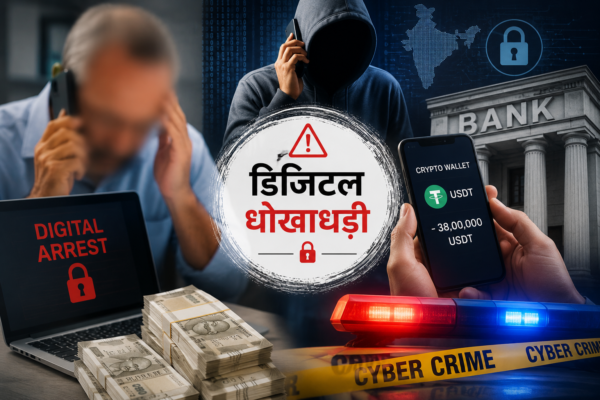
Bagalkot (Karnataka)-New Delhi: In a shocking case highlighting the growing menace of cybercrime in India, a 59-year-old Karnataka government employee was allegedly duped of more than ₹83 lakh by cyber fraudsters who placed him under a so-called “digital arrest” and manipulated him into transferring his life savings, selling gold, liquidating investments, and even creating a cryptocurrency wallet to move funds.
Police officials described the case as one of the most unusual cyber fraud incidents reported in recent months, as the criminals allegedly used a combination of fake government documents, psychological intimidation, and cryptocurrency transactions to execute the fraud.
The victim, an employee of the Water Resources Department in Bagalkot district who is scheduled to retire later this year, reportedly lost ₹83.22 lakh over nearly two months before realizing he had fallen prey to an elaborate scam.
Fraud Began with a Call Claiming Telecom Violations
According to police records, the fraud began on February 22, 2026, when the victim received a phone call from individuals claiming to be officials of the Telecom Regulatory Authority of India (TRAI).
The callers informed him that a mobile SIM card allegedly registered using his identity documents had been involved in sending obscene and illegal messages. They further claimed that a criminal case had already been registered against him in Mumbai and warned that he could face serious legal consequences.

The unexpected allegations reportedly caused panic and anxiety for the government employee, who had no prior knowledge of any such activity.
To strengthen their credibility, the fraudsters allegedly sent several fabricated documents through WhatsApp, including forged government letters, fake official seals, counterfeit logos, and fabricated legal notices.
The documents appeared authentic enough to convince the victim that he was facing a genuine criminal investigation.

‘Digital Arrest’ Used as a Psychological Weapon
Investigators said the accused subsequently shifted communication to the encrypted messaging platform Signal, where they maintained constant contact with the victim.
The fraudsters allegedly informed him that he was under a “digital arrest,” a term increasingly being used by cybercriminals to create fear among victims.
Under this tactic, victims are told they are being monitored by law-enforcement agencies and are instructed not to discuss the matter with family members, friends, colleagues, or local police.
The victim reportedly remained under continuous virtual surveillance for several weeks.
Cybercrime experts explain that digital arrest scams are designed to isolate victims psychologically. Fraudsters create an atmosphere of fear and urgency, convincing targets that any attempt to seek outside assistance could worsen their legal situation.
As a result, victims often comply with instructions without verifying their authenticity.
Victim Pressured Into Repeated Bank Transfers
Once the victim was convinced that he was under investigation, the accused allegedly instructed him to transfer money to designated accounts as part of a so-called verification and clearance process.
Between February 25 and April 13, he transferred approximately ₹14.61 lakh from his State Bank of India account to an ICICI Bank account provided by the fraudsters.
The transfers were carried out in multiple installments over several weeks.
Investigators believe the accused deliberately avoided demanding a large amount at once, instead gradually increasing the financial burden to maintain the victim’s trust and compliance.
Police said the victim was repeatedly assured that all funds would be returned after the completion of the alleged investigation.
Gold Sold and Investments Liquidated
As the scam progressed, the fraudsters reportedly persuaded the government employee to arrange additional funds.
According to the FIR, he was instructed to liquidate financial assets and generate more money to demonstrate his innocence and cooperate with the supposed investigation.
The victim allegedly sold gold and withdrew money from his Systematic Investment Plans (SIPs).
After arranging additional funds, he transferred another ₹30.61 lakh to an account maintained with IDFC First Bank, again following instructions from the fraudsters.
Police believe the criminals deliberately exploited the victim’s fear of legal action and reputational damage, especially considering his status as a government employee nearing retirement.
Cryptocurrency Used to Conceal the Fraud
The most alarming aspect of the case emerged when the accused allegedly instructed the victim to create an account on the global cryptocurrency platform Binance.
Police said the fraudsters guided him through the process of opening a cryptocurrency wallet and converting his money into digital assets.
Between March 18 and April 15, the victim reportedly transferred approximately ₹38 lakh in USDT (Tether) cryptocurrency to wallet addresses controlled by the accused.
Investigators say this represents a significant evolution in cybercrime techniques.
Traditionally, fraudsters relied primarily on bank transfers. However, the use of cryptocurrency makes tracking and recovering stolen funds substantially more difficult due to the complex and often international nature of blockchain transactions.
Officials noted that this could be one of the rare cases in which cybercriminals specifically forced a victim to create a cryptocurrency wallet as part of a digital arrest scam.
Total Loss Exceeds ₹83 Lakh
By the time the fraud ended, the victim had transferred money through multiple channels, including bank accounts and cryptocurrency wallets.
Police records indicate that the total financial loss amounted to ₹83.22 lakh.
The funds included:
- ₹14.61 lakh transferred through an SBI account.
- ₹30.61 lakh transferred after selling assets and liquidating investments.
- ₹38 lakh transferred through cryptocurrency transactions.
The fraud continued until mid-April, with the victim remaining under the influence and control of the scammers.
Authorities believe the accused maintained constant communication to ensure the victim remained fearful and compliant.
Realization and Police Complaint
The victim reportedly began suspecting foul play only after repeated assurances failed to materialize and the promised return of funds never occurred.
Upon realizing that he had likely been cheated, he approached law-enforcement authorities.
A formal complaint was subsequently filed with the cybercrime police.
Based on the complaint, police registered a case under relevant provisions of the Information Technology Act and the Bharatiya Nyaya Sanhita (BNS) at the Bagalkot CEN Police Station.
Investigators have launched a detailed probe into the matter.
Investigation Underway
Cybercrime investigators are currently examining bank records, digital communications, cryptocurrency transactions, and mobile phone data associated with the case.
Authorities are also attempting to identify the beneficiaries of the cryptocurrency transfers and determine whether the fraud network operated from within India or from overseas locations.
Experts believe organized cybercrime syndicates often use multiple layers of bank accounts, shell identities, and cryptocurrency wallets to conceal the movement of illicit funds.
The investigation is expected to involve coordination with financial institutions, cryptocurrency exchanges, and national cybercrime agencies.
Rise of Digital Arrest Scams Across India
The case is part of a growing trend of digital arrest frauds being reported across India.
In such scams, fraudsters typically impersonate officials from organizations such as:
- TRAI
- Central Bureau of Investigation (CBI)
- Enforcement Directorate (ED)
- Income Tax Department
- Reserve Bank of India (RBI)
- Mumbai Police or other law-enforcement agencies
Victims are falsely accused of crimes ranging from money laundering and narcotics trafficking to cyber offences and illegal SIM card usage.
The criminals then demand money under various pretexts, including verification, security deposits, account audits, or legal settlements.
Cyber experts warn that legitimate government agencies never place citizens under digital arrest through phone calls, video calls, WhatsApp messages, or Signal communications.
Public Advisory
Cybercrime authorities have urged citizens to remain vigilant and follow basic precautions:
- Never trust calls claiming immediate legal action without independent verification.
- Do not transfer money to unknown accounts under pressure.
- Verify government notices through official channels.
- Avoid sharing banking credentials, OTPs, or personal information.
- Be cautious of requests involving cryptocurrency transactions.
- Contact local police or the National Cyber Crime Helpline (1930) immediately if suspicious activity is detected.
A Warning for Citizens
The Bagalkot case serves as a stark reminder that cybercriminals are constantly developing new methods to exploit fear, trust, and technology. What began as a phone call about an alleged SIM card violation eventually resulted in the loss of a lifetime’s savings for a government employee approaching retirement.
As digital fraud schemes become increasingly sophisticated, experts emphasize that awareness, verification, and prompt reporting remain the strongest defenses against cybercrime. Authorities continue to investigate the case in an effort to identify the perpetrators and trace the stolen funds.