

India showcases Ayush Vision at 2025 Arctic Circle Assembly in Iceland
By Doruvu Paul Jagan Babu: Assistant Chief Editor

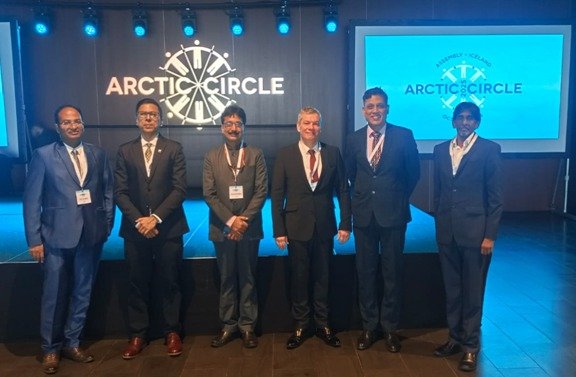
Reykjavik: In a significant step toward integrating traditional Indian medicine into global health and sustainability dialogues, India’s Ministry of Ayush delegation participated in the 2025 Arctic Circle Assembly held in Reykjavík, Iceland. The team, led by Prof. (Vaidya) Rabinarayan Acharya, Director General of the Central Council for Research in Ayurvedic Sciences (CCRAS), highlighted India’s proactive Arctic engagement and the potential of Ayush systems in fostering wellness even in extreme environments.
India emphasises Global South’s role in Arctic sustainability
Speaking during the plenary session titled “The Role and Importance of the Global South in the Arctic,” Prof. Acharya underscored India’s holistic Arctic Policy and its inclusive approach toward sustainable development. He noted that traditional medicine systems like Ayurveda and Homoeopathy can contribute significantly to health resilience and adaptation in challenging Arctic ecosystems.
The session was organised by the Government of India and featured distinguished speakers including Rear Admiral TVN Prasanna, Polar Coordinator, Government of India; Manish Tiwari, Scientist F, National Centre for Polar and Ocean Research (NCPOR); and Wassim Said, Steering Committee Member, Emirates Polar Program, UAE.
Ayush interventions for global wellness and Arctic research

Prof. Acharya presented a forward-looking vision for integrating Ayush research with Arctic studies through transdisciplinary collaboration. He proposed launching proof-of-concept clinical trials in Arctic conditions to evaluate the efficacy of Ayush-based interventions on wellness, immunity, and stress adaptation in extreme climates.
He also called for the establishment of a joint research consortium under India’s Arctic Policy architecture to strengthen cooperation between traditional knowledge systems and modern science. The proposed initiatives include capacity-building programmes in cross-cultural Ayush delivery, safety surveillance, and evidence-based validation.
Bridging traditional and modern science

Emphasising the importance of credible scientific validation, Prof. Acharya urged the publication of robust, peer-reviewed evidence to bridge traditional medicine and modern clinical practice. He noted that this would enhance global confidence in Ayush systems and facilitate their inclusion in future public health frameworks.
He also proposed embedding Ayush awareness and training modules into India’s Arctic outreach diplomacy, thereby promoting health diplomacy as a new dimension of India’s engagement with the Arctic nations.
India’s commitment to global health and sustainability
Dr. Srinivas Rao Chinta, Joint Advisor (Homoeopathy), Ministry of Ayush, was also part of the Indian delegation. Their participation underscored India’s commitment to integrating Ayush-based innovation, research, and diplomacy into global sustainability platforms.
Officials noted that this engagement reflects India’s evolving role as a responsible stakeholder in Arctic affairs—one that promotes not only scientific collaboration but also people-to-people partnerships through traditional health and wellness systems.
Strengthening India’s Arctic Policy through Ayush diplomacy
India’s presence at the 2025 Arctic Circle Assembly highlighted the interdisciplinary scope of its Arctic Policy, which seeks to balance environmental stewardship, scientific exploration, and sustainable human development.
Through Ayush-led initiatives, India aims to contribute to Arctic wellness, cross-cultural knowledge exchange, and adaptive health strategies suited for extreme conditions. The Ministry of Ayush’s participation reinforced India’s global commitment to holistic health, climate resilience, and ethical science diplomacy.